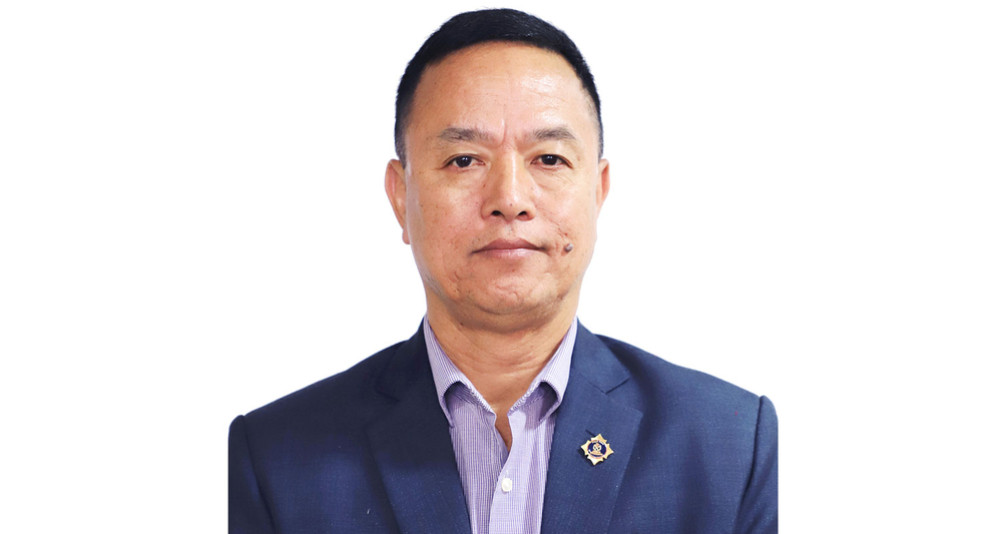
Khapung became the third IGP after the current IGP Deepak Thapa retired.
We use Google Cloud Translation Services. Google requires we provide the following disclaimer relating to use of this service:
This service may contain translations powered by Google. Google disclaims all warranties related to the translations, expressed or implied, including any warranties of accuracy, reliability, and any implied warranties of merchantability, fitness for a particular purpose, and noninfringement.
Chandrakuber Khapung, who has been promoted to Inspector General of Nepal Police (IGP), will remain in charge for 69 days. Khapung, who is the head of Central Investigation Bureau (CIB) of Police, was promoted to IGP in the cabinet meeting held on Friday morning. He will take over the leadership from August 19.
The next 69 days he will remain in the leadership. The current IGP Deepak Thapa is going on compulsory retirement next week from August 18 due to 30 years of service. After the Prime Minister left for a visit to China, the Council of Ministers decided on the future IGP on Friday.
In 2051, Khapung was placed in the third phase when the then government gave appointments to the group participating in the police inspector competition in three phases. The team including former IGP Vasant Kunwar was appointed in the first batch on 5 Chait 2051 with 60 people. 8 people including current IGP Thapa, AIG Sudeep Giri and Tek Bahadur Tamang were chosen as alternates.
The team including Tek Bahadur Tamang and Sudeep Giri along with the current IGP Thapa got appointment on 19 August 2052 from 1 to 50 in Nepal Police, two in 'Special Police' and the remaining 8. As the second lot, another 40 people also took their names to the inspector. It had officers including Khapung, but they were not given appointments. Later the case came up in court.
Then the government gave them appointment in the third lot on 27th October 2052. At that time, 2051 Chaitkos were selected as 108 teams and later 110 teams were selected in two lots. However, Khapung was about a month and a half behind as he was appointed earlier and later, and now Khapung is the only one who has succeeded in becoming IGP. Khapung IGP of the third batch will remain in office till 27 October 2082 after being promoted.
According to Police Regulations 2071, there is provision for IGP to go on compulsory retirement at the age of 58 years, 4 years tenure and 30 years service period, whichever comes first. The current IGP is about to retire from the third provision. According to this provision, Khapung will also retire after 69 days.
Last time, the government tried to amend the rules by removing the 30-year service period in the provision of rule 127 of the rules and keeping only the age and tenure. The government was publicly criticized after reports detailing the government's covert efforts and backtracked after seeing the Supreme Court ruling go against it. If the rules were amended, the tenure of the current IGP Thapa would have been extended. In this same month, the Prime Minister is also leaving for a visit to China on Saturday.
By the time he returns, the tenure of the IGP will end and the cabinet meeting to appoint a new one will not be held, so the cabinet on Friday decided the future leadership before that. Born on 23 November 2027 in Morahang, Tehrathum, the 55-year-old Khapung has served as the Chief of Koshi Province Police, Kathmandu Valley Crime Investigation Office, Ward, Locality and Police Chief in various districts, Security Officer of the Prime Minister, in addition to the CIB, and has worked twice in the United Nations Federal Peace Mission in Haiti.
Khapung, who has received various security related trainings from Italy, Korea, Vietnam and China, has a master's degree from Tribhuvan University and a bachelor's degree in law. Due to the short tenure for Khapung, there is no situation in the police to make far-reaching and long-term policy decisions and make leaps in administrative, policy and 'operational' work.
However, it seems that priority should be taken to make other administrative work including regular peace and security, buying and selling transparent according to the rules and procedures. Such decisions have always been in the circle of controversy because of the distortions that have been rampant in the police system since the past, regular transfers and promotions are based on merit rather than ability. To get rid of this, there is a risk that Khapung will have to follow the method and process and reject the pressure and influence of power.