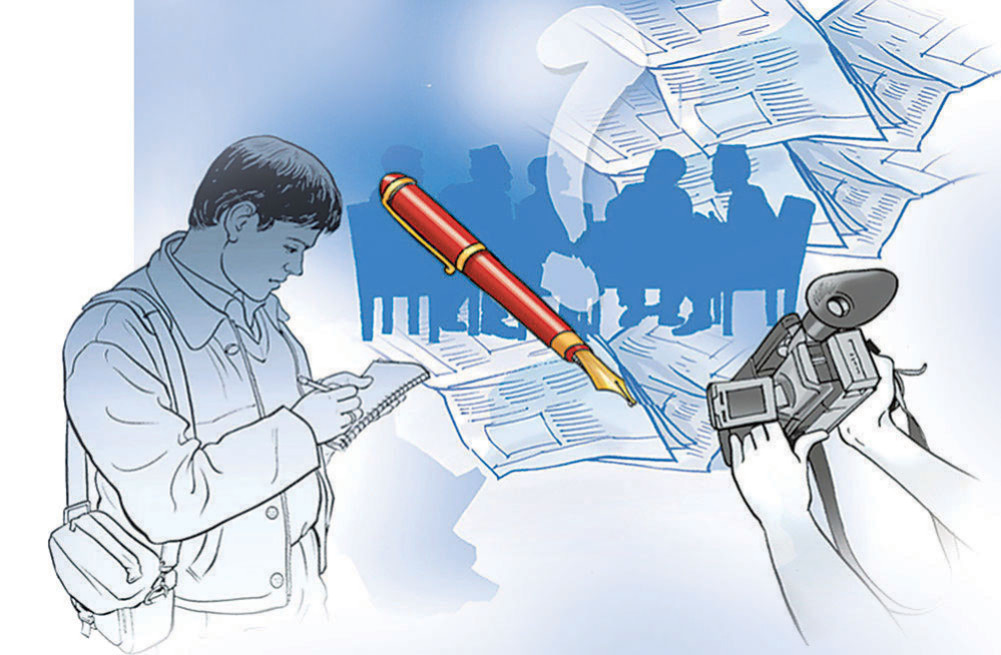
During the Panchayat period, the sitting judge of the Supreme Court used to be the chairman of the press council, after 2047, a provision was made that retired judges of the Supreme Court or senior advocates or senior journalists would be presidents and members of the National Assembly and the House of Representatives, but now it is being sought to be appointed by the government.
We use Google Cloud Translation Services. Google requires we provide the following disclaimer relating to use of this service:
This service may contain translations powered by Google. Google disclaims all warranties related to the translations, expressed or implied, including any warranties of accuracy, reliability, and any implied warranties of merchantability, fitness for a particular purpose, and noninfringement.
The government has brought the Media Council Bill ignoring the suggestions given by the various committees formed by the concerned organizations and by itself. Stakeholders are concerned that the independence and autonomy of the council will not remain if the parliament does not amend the bill, which is being discussed in the Education, Health and Information Technology Committee of the House of Representatives.
Critics say that the provision regarding the formation of the council in the
bill is weaker than that of the Panchayat law and the Press Council Act 2048. They said that amendments are needed in the bill that was introduced so that the government has the upper hand in the appointment and dismissal of officials including the president.
The structure of the council as a body under the Ministry of Communication and Information Technology is proposed in the bill. There is a provision in the bill for the government to appoint the chairman and members of the council on the recommendation of the committee chaired by the secretary of the ministry. The recommendation committee will consist of an expert appointed by the government and a joint secretary of the ministry. The main demand of the
media sector and stakeholders is about the formation of the council. They have a serious disagreement with the provisions of the bill that the secretary can recommend and appoint and dismiss as per the government's wishes. Similarly, there is a debate about who will be the president of the council and who will be among the members.
In the past, the bill has forgotten the tradition of sitting judges, retired judges, senior journalists and senior advocates of the Supreme Court. A person who has qualified to be a judge of the Supreme Court or has obtained at least a bachelor's degree from a recognized university and has made a special contribution in the field of journalism with at least 15 years of experience is said to be eligible to be the president of the council.
It is proposed that one member of the joint secretary of the ministry and the secretary of the director general of the information and broadcasting department will be in the council. Likewise, the president of the Federation of Nepalese Journalists will be an ex-officio member.
print journalism, online journalism, radio and television publishers, editors, working journalists will also be represented, and there will be seven members, one person from each province, and at least three women. It is proposed to have one member to represent the readers, viewers and listeners of the media.
The suggestions given by the Federation of Nepalese Journalists, the Press Council and the High Level Media Advisory Committee have been ignored in the bill. In the report submitted by the high-level media recommendation committee formed by the government in 2073, it is suggested that the committee, headed by the Speaker of the National Assembly, the Minister of Information and Communication, the Chairman of the National Inclusion Commission, the Chairman of the Federation of Journalists and the prominent members of the Tribhuvan University Journalism Department, should recommend names for the chairman and members of the council. Chairman of the
committee, Kashiraj Dahal, says that such a recommendation committee was proposed to prevent government interference in the appointment of the council for autonomy. The bill introduced now is unreasonable. It is against the National Mass Communication Policy 2073," he said. "The provision of appointing and removing by the government weakens the institution. A lot of amendments and reforms are needed in the bill to make the institution autonomous, fair and professional.'
History of Supreme Court Justice Council President
According to the Printing and Publishing Act 2019, Press Council Nepal was formed on October 6, 2027 as a regulatory body in the press sector. At that time, the council was established with the aim of controlling the newspapers that opposed the Rajsanstha and Panchayat system. Rashtriya Panchayat member Surendra Bahadur Basnet was the first chairman of the council.
In 2032, a new Printing and Publishing Act was introduced. In section 27 of the Act, provision was made for the formation of the Press Council. There was a provision that a person who had qualified to be a judge of the Supreme Court or who was nominated by the government of His Majesty the King from among sitting or retired judges would be the president. Similarly, there was a provision that one of the members or member secretaries of the Central Committee nominated by the government, one member of the National Panchayat, one of the communications secretary or the director of the information department should be the member secretary.
Similarly, there was a provision at that time that one of the editors of Gorkhapatra or Rising Nepal, the general manager of the National News Committee, the president of the journalists' association or one of the journalists nominated by the government and two other members nominated by the government. According to the provisions of the Act, until 2048, the chairman of the council was made from among the judges of the Supreme Court.
After the restoration of democracy, the incumbent judge of the Supreme Court was barred from being the president. After that, the tradition of a sitting judge of the Supreme Court being the chairman of the Press Council was stopped. Before the promulgation of the 2047 constitution, the then Supreme Court judge Surendra Prasad Singh was the council president. He later became the Chief Justice.
On 28 October 2048, the Press Council Act came into force. The Act provided for the appointment of a retired judge of the Supreme Court or a senior advocate or a person who has made a special contribution in the field of newspapers to be the chairman of the council. According to the Act, Senior Advocate Nutan Thaplia became the first Chairman of the Council. Member of the House of Representatives Hiranyalal Shrestha and Member of the National Assembly Suresh Malla were members. People including the editors of various newspapers and the executive director of Nepal Press Institute were council members. After adding
, senior journalist Gopaldas Shrestha became the chairman of the council. At that time, Purna Bahadur Khadka, a member of the House of Representatives, and Narahari Acharya, a member of the National Assembly, were members. In 2058, when senior journalist Harihar Virhi headed the council, Bhim Bahadur Shrestha from the House of Representatives and Radheshyam Adhikari from the National Assembly were members. Kedarnath Acharya, a retired Supreme Court judge, became the council president after a while. Until the dissolution of the House of Representatives in 2059, the Council was represented by the House of Representatives and the National Assembly.
The Council Act, 2048 provided for one member nominated by the Speaker from among the members of the House of Representatives and one member nominated by the Speaker from among the members of the National Assembly. In 2066, the Act was amended and the provision for representation from the House of Representatives and the National Assembly was removed.
People who have made special contributions in the field of law or journalism will be the president, and the members of the House of Representatives and the National Assembly will increase the dignity of the Press Council at that time. Since the MPs of the two houses are the members, the chairman was also considered to be able to manage that dignity.
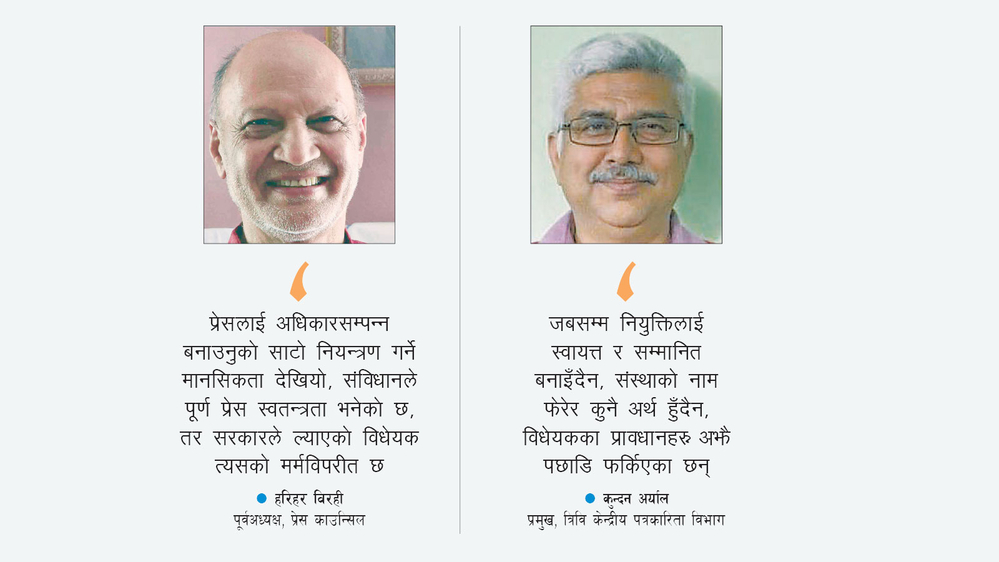
The former chairman of the council Virhi says that since the common people have direct relations with the media, they are represented in the council through MPs. It would have balanced the influence of the people nominated by the government," he said.
The Constitution of 2072 prohibits persons who have been Chief Justice or Supreme Court Judges from being appointed to government positions other than the Human Rights Commission. That provision prevents a retired judge of the Supreme Court from chairing the council. Senior advocate Borna Bahadur Karki (2069-2073) was once the president after the mass movement of 2062/063. Apart from that, the council has been chaired by journalists.
Stakeholder's interest in the appointment of the council
Political affiliation has started to become a priority in the appointment of members from the chairman of the council. Birhi, who is also the former chairman of the Federation of Journalists, says that the dignity of the organization is being eroded by the appointment.
He expressed his disappointment saying that the bill brought by the government now pushes it further back in order to increase the autonomy, independence and dignity of the council. "Instead of empowering the press, there was a mentality of controlling it," he said, "The constitution says full freedom of the press." However, the bill introduced by the government is contrary to its spirit. If the council is not kept autonomous, this institution will remain like a bouquet of plastic flowers without fragrance.' The main responsibility of the
council is to protect, enhance and promote the freedom of press and expression, the right of communication and to issue a journalistic code of conduct and implement it. For that, there has been a demand for an autonomous organization without government interference for a long time. But regardless of the government that comes, the council has been made a worker recruitment center by ignoring it.
Tribhuvan University Central Journalism Department Head Kundan Aryal says that the use of the Press Council, which was born to support autocracy during the Panchayat period, is now being used to control the press. "The purpose of the organization is not above regulation and control," he says. Media is an institution. It can also cause unnecessary suffering to a person. The council should also be accountable to the people.' He mentioned that the council is also envisioned for the role of mediator between the
media and the concerned person. People with social image, professional, moral, prudent and understanding the technical aspects of media should be appointed in the council. Let the media listen, let the editor believe. The complainant should also have confidence," he said, "the kind of appointments that are being made now. Like Ayaram Gayaram. There is only a tendency to eat jobs. The institution is getting weaker day by day because of lack of people capable of leading the media world.' He said that the mediator between
media and consumers is weak and as a result of the lack of reliable institutions, people are going to court against the media. "Unless the matter of appointment is made autonomous and respected, changing the name of the organization has no meaning," he said. The provisions of the Bill are still retroactive. The main thing is the appointment process. It should be widened.'
The then Minister of Communication and Information Technology Rekha Sharma registered the Media Council Bill in the National Assembly on 13 Baisakh 2081. The provisions in the Bill have not given autonomy to the institution. There is a provision that the government can remove the chairman or member of the council due to lack of efficiency, bad conduct or non-fulfilment of official duties.
For that, the ministry is said to form a three-member investigation committee chaired by a retired judge from the High Court, including two other experts. On the recommendation of the same committee, there is a provision that the ministry will take the proposal to remove the chairman or member to the Council of Ministers. Similarly, in the event that the post of chairman is vacant or under suspension, the joint secretary of the ministry, who is an ex-officio member of the council, will preside over the meeting. Earlier, there were similar provisions in the Media Council brought by the then Minister of Communications Gokul Baskota in 2076. The government and the parliament could not increase the bill after the journalists' federation protested strongly, and it became inactive with the end of the term of the House of Representatives.
The MPs of the House of Representatives are in favor of freeing the media council from interfering with its formation and appointment, saying that the media council will lose its autonomy. More than 30 MPs have proposed amendments to correct the provisions on the formation of the council. There are MPs from all the ruling and opposition parties who propose amendments to the bill. Article 6 and 7 of the
bill contain provisions regarding the constitution and qualifications of the council. The number of parliamentarians who have amended that section is large. The MPs have proposed the appointment of a retired judge as the chairman of the council. It is their proposal that an independent committee should be formed to recommend such appointment and not be a minister or an employee of the ministry.
The National Assembly passed the bill on January 28 and sent it to the House of Representatives. The National Assembly has changed the name of the proposed 'Media Council' to 'Aamsanchar Parishad'. Apart from that, no attempt has been made to make the council autonomous and independent. The National Assembly has introduced a provision to directly appoint the government by removing the recommendation committee led by the secretary. Similarly, the proposed council of 11 members has been reduced to 13 members and the bill has been passed.
The General Secretary of the Federation of Journalists, Ram Prasad Dahal, says that the National Assembly has not fulfilled the voice that the council should be freed from government interference and made autonomous and independent. "The government should not dominate the formation and appointment or dismissal of the council," he said. He informed that the federation is going to send written suggestions to the committee to correct it.
Media Society's demand to rewrite the bill
Nepal Media Society has suggested to amend the Media Council Bill saying that it is control-oriented. The society has mentioned that the bill may narrow the freedom of the press, government interference in the selection of council president and members.
Mentioning that the role of independent media is indispensable in democracy, the society said that although the establishment of the council is important, the influence of government control on the structure of the bill and the appointment process is worrying. The society has also objected to the provision of making the joint secretary of the Ministry of Communications the acting chairman in the absence of the chairman.
The society argues that the provision giving the council the right to suspend press credentials directly attacks independent journalism. According to the society, the bill has promoted 'self-censorship'. "The provision that gives the Council the right to suspend the press representative's identity card of a journalist if it is found to have violated the code of conduct can create a serious problem," the suggestion states.
Similarly, the society mentioned that the bill is silent on digital platform and social media regulation. It has suggested making a clear system to regulate misinformation and hate speech spread through Facebook and YouTube and to address the challenges posed by artificial intelligence (AI). The Bill has made a provision to compulsorily disclose the details of other businesses of media house operators. The society said that this provision is not only unreasonable but can be used by the state as a weapon of revenge.
"If a media house publishes investigative news criticizing the government, a political party or a powerful entity, the government may target other businesses of the same media owner," the society's advisory said, "There may be an attempt to silence the media by taking retaliatory actions such as investigating tax evasion, imposing environmental or other regulatory agencies, or canceling contracts." This creates a kind of business blackmailing situation.'
Media Society has demanded that the bill be immediately withdrawn and rewritten. The society has demanded that the process of appointing the chairman and members of the council should be done through an autonomous recommendation committee attached to the parliament. Similarly, it has emphasized to remove the right to suspend the press identity card and give official recognition to the letter issued by the media house. Also, it is suggested to prioritize self-regulation over punitive action.