We use Google Cloud Translation Services. Google requires we provide the following disclaimer relating to use of this service:
This service may contain translations powered by Google. Google disclaims all warranties related to the translations, expressed or implied, including any warranties of accuracy, reliability, and any implied warranties of merchantability, fitness for a particular purpose, and noninfringement.
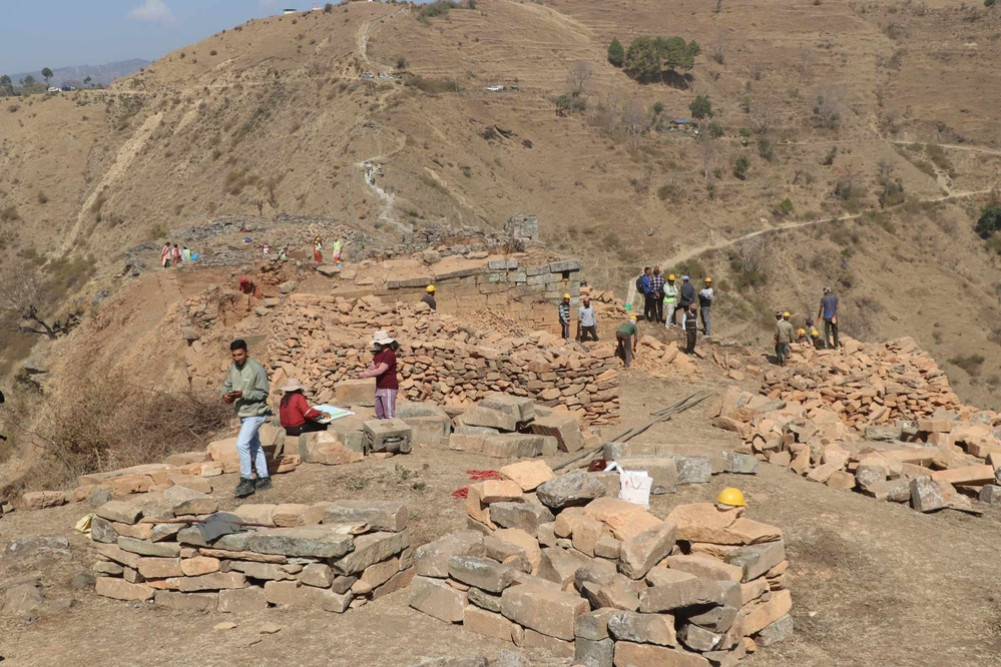
Excavation of Ajaymerukot, which carries the history of Doteli state in Ajaymeru rural municipality, has been started. Excavation of the said coat has been started by the team of Archeology Department.
The rural municipality allocated a budget of 90 million for the excavation. With the help of that budget, the team of the Department of Archeology has been excavating for 23 days.
Ajaymerukot was built in the best art style of the Katyuri dynasty, said Bhaskar Gyawali, chief archeological officer and archaeologist of the Department of Archaeology. He says that this is the area of influence of the Katyuri dynasty because of the different artefacts and construction styles here, which were first excavated and started to study and research.
According to the official Gyawali, the work of 'numbering' the ruins is being done during the excavation. 'The specific artwork and construction style of Ajaymerukot is different from the Devals of Karnali River east,' he said.
According to the details obtained in the excavation, there is a style of making a mandap in the middle and a wall on the left and right. The meeting room and Naula are unique. He said that another team of the Department of Archeology will conduct further studies in an effort to include Ajaymeru Kot in the World Heritage List.
Saraswati Khadka, Minister of State for Social Development of Sudurpaschim Province, said that the attention of all three levels of government should be paid to the protection and promotion of historical and touristic places like Ajaymerukot.
As the importance of Ajaymeru Kot protection is increasing, the local level has requested more budget and necessary support from the federal and provincial governments, says Umesh Bhatt, Chairman of Ajaymeru Rural Municipality.
Establishment of Ajaymerukot Legend has it that in the latter half of the 13th century, two brothers Rajkumar Sahastrapal and Nirayadeva Pal of the Katyuri dynasty fought against the Sinja kingdom and established Kot as an independent state. Ekthari also says that this coat was built by King Nagi Malla . However, the evidence confirms that this coat was built by Pal Raja of Katyuri descent . It is said that Ajaymerukot became known as the coat of arms of Nagi Malla only after Nagi Malla of the Raca dynasty captured Ajaimeru in 1441. King Nirayapaladeva's copperplates and inscriptions dating back to 1419 are found in this place.
Ajaymerukot is scattered with historical objects including the ruins of the ancient palace, Naula, Deval, Birkhamb, artistic ceiling, meeting place of the king . Currently, out of the three naulas in Ajaymeru, there are only the ruins of two naulas . A well is being used to drink water . The artistic idols carved on the stone wall and naula reflect the ancient architecture .
The hill where the main palace of Ajmerukot is is surrounded by a gad (river). It takes 15-20 minutes to climb from the bottom of the hill to the top of the coat. On top of the crested hill, the palace and the haveli where the king's brothers used to live are seen as ruins . The structure of the palace is all in a state of collapse. It is said that the main palace had seven floors when it was built. From the topmost floor, the temple of Kuldevi Jagdamba Bhagwati of the Katyuri dynasty, built by the Katyuri king in Uttarakhand, was visited and offered water.
This is the place where the king's horses are tied. Locals call it 'Gholidans' (horse stable). There is an ancient tunnel with 25 windows made with the purpose of not getting dark when going from the court to the gad (river) from the east-south of the palace to the place where the queen goes to fill water and take a bath.
There is a meeting place for the people of the palace on the bank of the grave from the coat site. The locals call it 'Okhadeki Mandau'. There are two walls on some of the graves. At the top of this Karputar field, there are three ancient channels for drinking water. This place is famous for visiting the historical palace of Mallakal .