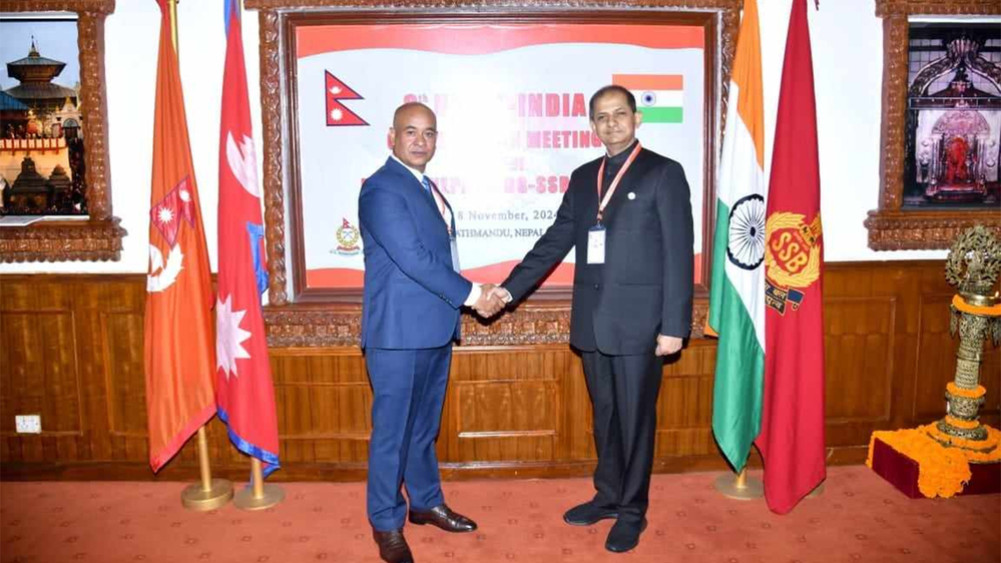
Discussion on dozens of issues like cross-border crime, smuggling, customs evasion control, joint signing on Monday
We use Google Cloud Translation Services. Google requires we provide the following disclaimer relating to use of this service:
This service may contain translations powered by Google. Google disclaims all warranties related to the translations, expressed or implied, including any warranties of accuracy, reliability, and any implied warranties of merchantability, fitness for a particular purpose, and noninfringement.
Nepal has requested India for cooperation in stopping the infiltration of third country citizens by land. Stating that illegal infiltration can become a challenge for national security, Nepal's security officials have requested the Indian side to strictly regulate the movement of citizens of third countries by land.
Inspector General of Armed Police Force (APF) Raju Aryal presented the 11 points set as a common agenda in the eighth Nepal-India border security coordination meeting which started in Kathmandu on Saturday. During that time, the Nepal side also raised the proposal to have a separate 'Tourist Desk' for the facilitation of the citizens of the two countries and the regulation of the people from the third country. In the
meeting, Director General of the Indian Armed Forces (SSB) Amrit Mohan Prasad said that it was difficult to identify the citizens of third countries by their appearance because of their "similar face and character". "The infiltration of people from a third country will affect both countries, security personnel deployed in the border areas on behalf of both countries should be vigilant," he said.
According to the records of the Immigration Department, citizens of Bangladesh, Afghanistan, Myanmar, Bhutan and other countries have come to Nepal through the Indian land route and acted as 'refugees'. The Office of the United Nations High Commissioner for Refugees in Nepal has been 'lobbying' to grant them 'refugee status'. An officer of the department says that there is frequent pressure from the commissioner's office to allow foreign nationals residing illegally in Nepal to 'not take action' and settle as 'refugees' according to the immigration law.
A large number of Rohingya community displaced from Myanmar after 2012 have entered illegally through India and settled in various places in Kathmandu. After the recent fall of Sheikh Hasina's power in Bangladesh, its citizens also entered Nepal illegally, some were turned back through the border.
In August 2021, a large number of Afghans were displaced after the insurgent Taliban seized power in Afghanistan. During that time, after finding out that the Afghans who were passing through India were about to enter Nepal, the Ministry of Home Affairs arranged that the citizens of Nepal and India should have an identity card. After the dissatisfaction of the Indian side, the provision of identity card was removed. "We have drawn the attention of the Indian side about the illegal infiltration of third country citizens and the risk it poses to both countries," said an official who participated in the meeting.
The Indian side drew attention to the fact that drugs and illegal gold and silver are being smuggled to India through gangs from Nepal. The Nepali security officials also brought to the attention of the SSB officials that smuggling gangs were bringing 'pharmaceutical drugs' (medical drugs) from India and were using them as narcotics. Officials from both sides participating in the meeting have taken these matters seriously and have agreed to exchange cooperation in information sharing, joint patrolling, training, etc. to control it.
In order to control cross-border crime, both sides have agreed that border areas should be patrolled with trained dogs. The Indian side has also provided necessary support for this. Both sides have agreed to make the citizens of the border area responsible for the importance and sensitivity of the international border on both sides, to resolve the occasional disagreements of the people, and to conduct social activities such as blood donation. It is the conclusion of both sides that it will create an atmosphere of brotherhood and help in security management. The issue of airport security training by SSB to APF was also raised in the meeting.
Both sides have agreed to hold a border security chief-level meeting of the two countries every 6 months to review the work on prevention and control of cross-border crime. The third meeting held in Delhi in 2073 decided to hold coordination meetings once a year, twice at the district level 'Border Security Gana' level and at the Border Out Post (BOP) level every month. Now, both parties are united to make more strategies by holding meetings at the leadership level twice a year. A joint signing is planned on Monday on the matters agreed in the meeting. In the
meeting, there are officials from the Ministry of Home Affairs, Ministry of Foreign Affairs, Armed Police, Nepal Police, National Investigation Department and Surveyor Department under the leadership of Inspector General of Armed Police Aryal. The Indian side is led by SSB Director General Amrit Mohan Prasad. APF is the main security agency deployed to protect the international border of Nepal. India has deployed SSB to guard the border towards Nepal. The border between the two countries is about 1,880 km long. Due to open borders, prevention of cross-border crime is becoming a challenge for both countries. The government has deployed manpower through Border Out Posts (BOP) of APF at 244 locations towards India. India has deployed SSB forces in more than 400 locations.
There are 8,553 border pillars separating the Nepal-India international border from Taplejung to Kanchanpur in the far west. Their maintenance, protection and search for lost pillars were also discussed in the meeting. Until a few years ago, 2,716 border posts were found to have disappeared towards India. Some of them were found and repaired. But most of them have not been found yet. About 1600 boundary pillars were dilapidated and about 2900 pillars were in a state of general repair. Last time there was an agreement to repair the odd numbered pillars Nepal and odd numbered and large (jange) pillars by the Indian side, but the repair work has not been completed.