We use Google Cloud Translation Services. Google requires we provide the following disclaimer relating to use of this service:
This service may contain translations powered by Google. Google disclaims all warranties related to the translations, expressed or implied, including any warranties of accuracy, reliability, and any implied warranties of merchantability, fitness for a particular purpose, and noninfringement.
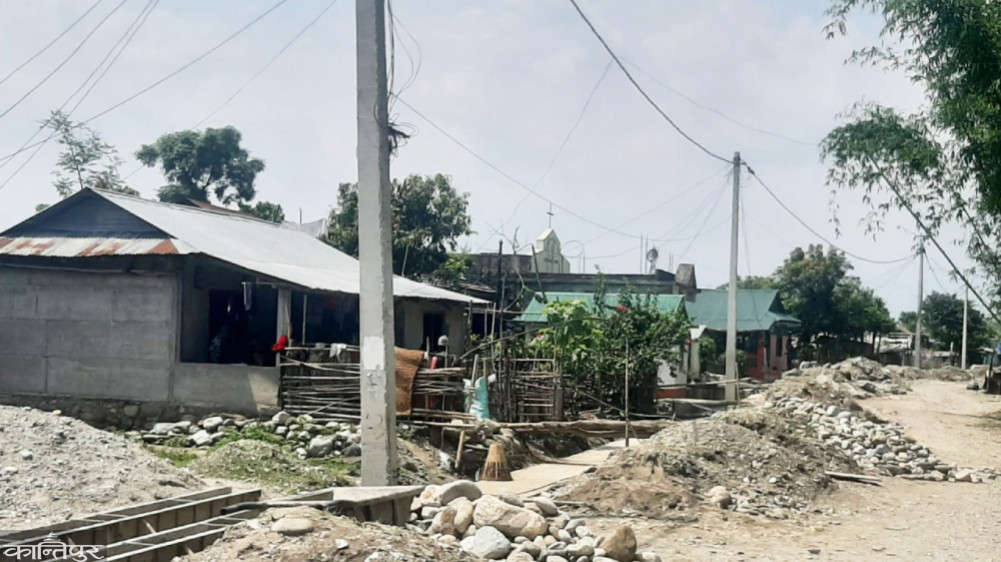
There are several houses on the banks of the river near the Chisang Bridge located in Kanepokhari Rural Municipality-5 of Morang under the East-West Highway. This settlement, which looks like the river rises and flows, is named - Chisang Basti. There are many houses in the settlement. But the life struggle and hard work of the people living there is great.
Before the sun rises, the Chisang village begins to mix sand and gravel in Chisang. 54-year-old Hark Bahadur Darzi is also found there. He has 10 dhurs of soil by the river.
Living here since his father's time, he has spent nearly four decades of his life under the guise of Chisang. Whatever his farm, enterprise or Eelam is, this is the soil. The same one-storied hut with a zinc roof has been built, but there is no Lalpurja .
'Applied twice. But Lalpurja has not come,' Hark Bahadur said, 'He does not have a single piece of land in his name . Without land, life is becoming difficult.' The government agencies have collected the details of Chisangbasti time and again to give red supplies. But they have been stuck in the same problem for years and now they can't hope have started .
'Having no land means having nothing,' Hark Bahadur said before, 'You can earn money by working hard. But when you are sick, you don't have two money to treat. Children could not be taught . When there is no land, no one believes in doing business by taking a loan.'
Hark Bahadur is inquiring whether the life of his sons would be a little easier if he got Lal Purja, even though he lived in the same soil. Not only Chisangbasti, at this time about 1.5 million landless, squatter and unorganized residents across the country are hoping that the government will give red parts like Hark Bahadur.
Article 37 of the Constitution of Nepal stipulates that every citizen has the right to safe housing, while Article 40 mentions that the state will provide land to landless Dalits once. Besides, the government had made a policy to provide land to the landless and squatters since the Panchayat period, not now. So far, 13 commissions have been formed to distribute land after collecting landless squatters. But the problem is the same.
Land rights activist and Constituent Assembly member Shyam Shrestha says that due to the extreme politics on the rights of the landless, the life of millions of families like Hark Bahadur Darzi of Chisang has come to a standstill.
'The government took the policy of distributing land to the landless and squatters right from the panchayat, the government also formed commissions to distribute land from time to time. But the one who needs to get the land has not got it yet,' says Shrestha, 'the root of this is the dirty politics in the issue of squatters.'
As Shrestha said, you don't have to go back much later to see the example of politics on the landless. The government decided to abolish the National Land Commission on March 7. The then Prime Minister Sher Bahadur Deuba-led government formed the commission on 30 August 078 with a three-year term. Keshav Niraula of Congress and Nahendra Khadka of Maoist Center were appointed as the vice-chairman of the commission.
Prime Minister Pushpa Kamal Dahal decided to cancel the same commission after breaking the alliance with the Congress. In the petition filed by the commission officials against the decision of the government, the Supreme Court has ordered not to implement the decision immediately. But with the decision to cancel the commission, almost 2.5 lakh families have been deprived of getting Lalpurja immediately, while the process of giving Lalpurja to the remaining lakhs has been stopped .
Moreover, before the formation of the Niraudala Commission, the then Deuba government also created a similar obstacle by canceling the Gyawali Commission. The then Prime Minister KP Sharma Oli formed the land problem resolution commission on 9th Chait, 076 by appointing Devi Gyawali, who was the mayor of Chitwan's Bharatpur, as its chairman.
At that time, 243 UML leaders and workers across the country understood the appointment . But as soon as Oli left the government, the Congress-led five-party coalition government canceled the Gyawali commission.
After the formation of the UML-Maoist government, Oli completed his political revenge by canceling the commission formed by Prime Minister Dahal during the Purano alliance. Now Niraula Commission spent 31 months while working and spent crores of rupees.
In the past, how many of the commissions that have been formed and dissolved many times have not even had an accounting. However, landless Dalits and squatters have not been distributed land, not even their income has been collected. Every time the government is formed, a commission is formed to distribute land to the squatters, the workers understand the appointment, and they act as if they are working . But the problem of squatters is not solved, rather it is increasing.
Landless Dalits and squatters have been deprived of their rights to land and housing due to the interference of political parties. In this way, the Niraula Commission was the 13th commission formed to address the problems of squatters. Similarly, more than 2000 leaders and workers have got political appointments in the land distribution commission formed after 048 years.
Niraula, who is currently leading the commission, is the 21st chairman. Stakeholders accuse political parties of playing tricks on the fundamental rights of landless Dalits and squatters. Saraswati Subba, president of the National Land Rights Forum, who is currently a member of the House of Representatives, says that the commission opened in the name of solving the problems of Sukumbashi has become only a means of fulfilling party interests.
'Even if the government of the party comes, they form the commission, but there are not experts, but workers are appointed. A person who doesn't understand the problem can't go there and work," she says. "A person who doesn't understand the land problem can't go there and it will be discarded." In this way, the commission has been made a political recruiting center.'
Dozens of commissions formed by the government to distribute land have already spent billions of rupees. But what is the number of such landless Dalit and squatter families who have received land so far? Not even sure. How much did the commission spend? How much work did you do? The government does not even have a list of them.
Jagat Deuja, a land rights activist and scholar of the same subject, says that although the government has formed commissions to distribute land, some of them have been found to have ignored the report. The land was distributed even before the year 048. The government does not have the data of that time,' he said, 'Since then, it seems that land has been distributed to about one and a half lakh families. There is no description of who got how much. It is difficult to study the data because some of the land distribution commissions have not submitted the report.'
The Ministry of Land Management and Poverty Alleviation estimates that about 1.5 million families are landless across the country. When the National Land Commission, which the government decided to abolish last time, collected data from 727 local levels across the country, 1.3 million 50 thousand new applications were received, while 86 thousand 400 families have submitted applications saying that they have not received Lalpurja despite having already received Nissa.
According to a survey by UNDP, 24 and a half percent of Nepal's 58 lakh 11 thousand families are landless. 44 percent of the total landless are Madhesi Dalits and 15 percent Pahari Dalits. According to the National Census 078, about 15 percent of the total population in Nepal are Dalits. The number of agricultural landless Dalits who have less than two plantations of land across the country is 77 percent . Out of the total arable land in the country, 25 percent of the land is not owned by the government.
According to Nahendra Khadka, vice president of the commission, the commission made an agreement with 728 local levels but did not collect the tax even though it had an agreement with the Kathmandu Metropolitan City. The commission has already distributed food supplies to 5 thousand 353 families who have already started the process while working for 31 months.
'Of the applications received from all over the country, we had already entered the data of 10 lakh 52 thousand 310 . Among them, 84 thousand 21 families are Dalit landless, 160 thousand landless squatters and 863 thousand 369 families are unorganized residents,' he said, 'We have measured and distributed 243 thousand 581 plots of land.'
According to him, the commission has collected more than 51 crore 38 lakh rupees by distributing Nissa. "If we had been given time till mid-June, we would have been ready to distribute Lalpurja to one and a half lakh families," Niraula, the chairman of the commission, said, "We had made final preparations to give Lalpurja to 15,000 families immediately. Until the middle of June, about one and a half families used to have Lalpurja.'
According to the Ministry of Land Management and Poverty Alleviation, so far the commission formed to distribute land has distributed 45 thousand nine hundred and sixty-four bighas of land to 154 thousand eight hundred and fifty four families. Rishiraj Lumsali-led commission is among those formed so far to distribute the most land . At that time, 21,974 bighas of land were distributed.
Then the Gopalmani Gautam Commission distributed 4,853 bighas of land. As often as the commission was formed, as many applications were collected from landless squatters. And, every time such number is different . Two lakh 63 thousand seven hundred and 38 applications were received in the commission headed by the then Minister of Agriculture Shailaja Acharya. At that time, all those requests were not addressed .
Tarinidutta Chatout Commission formed in 2055 received two hundred and sixty-one thousand six hundred and nineteen petitions. In 068, when the commission led by Bhaktiprasad Lamichhane asked for applications with a deadline of 30 days, an application of 396,344 was received.
Similarly, the number of applicants reached 861 thousand families in Sharda Prasad Subedi Commission of 071. According to the ministry, out of the commissions formed so far, three commissions have given a recommendation report to the government, while four commissions have not completed the rest of the process and distributed the land despite requesting an application.
A large number of the landless are Dalits. However, no person from the Dalit community has been chaired in the commission so far, rarely has the Dalit community been represented. The government has given an attractive service to the officials of the commission who work for the rights of the landless in the state.
The chairman of the commission has received the salary, allowance, vehicle with driver and fuel facility like the state minister . Similarly, the vice president has got the same salary, allowance, vehicle with driver and fuel facilities as the assistant minister . The members have also taken the facility of vehicles with drivers and fuel as well as the salary and allowances received by the Secretary of the Government of Nepal . The chairman of the district committee has also received the same salary and allowance as the joint secretary of the government of Nepal.
'No matter how many commissions are formed now, it seems that they are formed not to solve these problems, but to gain more power over that class,' says Kamala Vishwakarma, a rights activist and former parliamentarian. The thinking seems to work . That's why those who really need to get land have not got land yet.' According to him, political parties have only made landless squatters a vote bank.
Deuja, a land rights activist, says that the commission is formed and dissolved several times, but the real squatters do not get the land.
'Now the wrong commentary has been prepared . The number of landless people is increasing. It is being said that we cannot give land. But so far the government has given it to only one and a half lakh families,' he says, 'whereas there are data that there were 525,000 landless squatters in 0.51 lakh across Nepal. Since then, armed conflicts, disasters and epidemics have also increased the number of squatters and unorganized residents.' He said that it is also a big challenge that
commissions are formed and the final result is not coming. "Commissions have been formed, but the final result has not been reached. The main reason for that is political interference. Although the commissions formed last time were formed politically, they tried to work according to the law. If we had proceeded from this point, the problem would have been solved soon,' he added.
Commission Chairman Niroula says that he has not been able to gather good experience while working for the landless squatters in the commission for 31 months .
'Squatters used by any party . They are not close friends. They want their rightful land . It is the responsibility of the state to provide that land,' he says, 'but the state is not yet ready to solve this problem . It is in the constitution . Political programs have also been made. But not all state systems are ready to do justice to the landless. When the state is not ready, the individual cannot do anything . Laws still need to be amended.'
According to Niraula, the commission had given priority to landless Dalits and landless squatters for housing or agriculture and the management of unorganized settlements. The Commission had given the responsibility of collecting, investigating and identifying data of landless Dalits, squatters and unorganized residents to the local level.
According to the criteria, a person who has lived in a house for at least 10 years and built a terrace is an unorganized resident. Similarly, people who do not own land in Nepal or their family and are unable to manage it by earning income are landless squatters. If such squatters belong to the Dalit community, those Dalits are landless," President Niraula said. "On this basis, the local level has collected taxes."