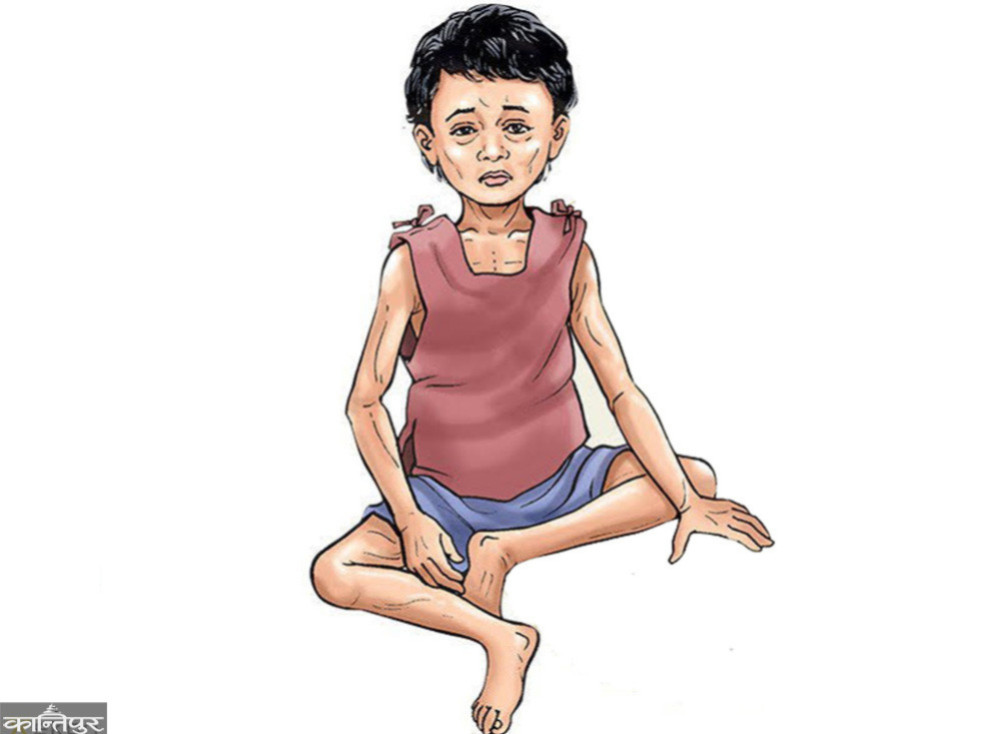
Lack of balanced diet due to poverty, lack of knowledge about nutritious food due to illiteracy and early marriage and child birth are high risk of malnutrition in both mother and child.
We use Google Cloud Translation Services. Google requires we provide the following disclaimer relating to use of this service:
This service may contain translations powered by Google. Google disclaims all warranties related to the translations, expressed or implied, including any warranties of accuracy, reliability, and any implied warranties of merchantability, fitness for a particular purpose, and noninfringement.
Four children have died in the current financial year in Makwanpur's Kailash Rural Municipality due to malnutrition. 2 girls and 2 boys under the age of five died. Krishna Yadav, head of the village health branch, said that four children from wards 3, 4 and 7 died of malnutrition from last July to January.
In Kailash and Raksirang Rural Municipality of the district, the rate of malnutrition among children, pregnant women and pregnant women is high. In Raksirang, there has been no death due to malnutrition this year, said Vijay Kapri, head of the municipality's health branch.
Since the problem of malnutrition in the Chepang community, which is under the grip of illiteracy and poverty, has not been reduced, the Kailash rural municipality has been running a campaign to eliminate malnutrition since the current year to identify and treat it. The municipality has established an outdoor health treatment center for the severely malnourished and has been regularly providing nutritious food to the moderately malnourished. The municipality has reached every village with the 'Kuposhanharhit Rural Municipality, Our Campaign' and launched a 'Find and Treat' campaign for the malnourished. Under the campaign, 34 women and 48 children were found to be malnourished in the current year. Out of which 26 people were severely malnourished and 56 were found to be moderately malnourished.
Village health branch, health post staff and health volunteers were mobilized in all 10 wards and a week-long campaign was conducted to search for malnourished pregnant and post-natal women/children, Yadav, the head of the village health branch, said. The rural municipality allocated a budget of 5 million in the current year under the title of nutrition program for poor and Chepang families. Head of the branch Yadav said that besides distributing nutritious food regularly to malnourished women and children, programs will be conducted to help them in earning income.
The rural municipality has been providing eggs, quanti, horlicks, ghee, masa dal, walnuts, cashews and cleaning insects for malnourished pregnant women and pregnant women under the 'Harek Bar Khana Char' program. Likewise, Poshan Kheer, Poshan Khichdi, Poshan Halwa are being provided monthly for malnourished children. An informative program has also been conducted with the relevant family members about cooking balanced and regular nutritious food.
Outdoor health treatment centers have been established in 3 locations of the rural municipality for the treatment of acute malnutrition. The center has been set up at Katunje Health Chowki of Ward 3, Bharata Health Chowki of Ward 8 and Niko Health Chowki of Ward 7. In case of acute malnourished patients, they are admitted and kept in the treatment center, after they are normal, they are sent with pre-prepared therapeutic food for 2 weeks. After regular consumption of nutritionally remedial food, malnutrition is reduced and health is restored," said Yadav, head of the health department. Most malnourished patients are in wards 3, 4, 7 and 8 of the rural municipality. According to the Health Branch, a treatment center has been established targeting those wards.
According to health standards, children under 5 years of age are considered severely malnourished if their arms are less than 11.5 cm, their legs are swollen and they have no appetite. Also, moderate acute malnutrition is confirmed in children under 5 years of age if the arm circumference is 11.5 to 12.5 cm. Similarly, if the arm measurement is less than 21 cm in the case of pregnant women and those who have given birth within 6 months, severe acute malnutrition is considered. If it is 21 to 25 cm, Yadav, the head of the health branch, said that the treatment method will be started after confirming that there is moderate malnutrition.
Lok Muktan, Chairman of Kailash Rural Municipality says that due to illiteracy, poverty and child marriage, malnutrition is increasing in the rural municipality. "The first thing is that they cannot eat balanced food due to poverty, due to illiteracy they do not have knowledge of nutritious food and when they get married at a young age and give birth to children, both mother and child are likely to suffer from malnutrition," said President Muktan. President Muktan said that in addition to the treatment of the malnourished, vegetable seeds and advanced breed goats were also distributed to engage them in income-generating work.
Another Raksirang rural municipality with Chepang population, which is connected to Kailash, has a significant number of malnourished children. Here, 98 children under 5 years of age are suffering from malnutrition. The municipality has arranged nutrition for them. Last year, according to the study of Wagmati Province Health Directorate, 147 children aged up to 11 months and 76 children aged 1 year to 23 months were found to be suffering from malnutrition in Makwanpur. Among the 13 districts of Wagmati Pradesh, Lalitpur has the highest number of malnourished children up to 11 months.
704 children of this age group are malnourished in Lalitpur, said Indramani Bhandari, the statistics officer of the Directorate of Health, Hetaunda. In the age group of 11 months, 207 children in Chitwan and 197 children in Dhading are suffering from malnutrition. According to the directorate, the highest number of malnourished children between 1 year and 23 months is 275 in Dhading. 220 children of that age group are malnourished in Chitwan. Rasuwa has the lowest number of malnourished children in Wagmati province. Director of Health Deepak Babu Tiwari said that there are only 8 malnourished children in Rasuwa, 2 children between 11 months and 6 between 1 year and 23 months. In Sindhuli, 135 children up to 23 months are malnourished, while Sindhupalchok has 110 malnourished children.
There are 154 thousand 759 children up to 23 months in Wagmati province, 2 thousand 595 are suffering from malnutrition. Among the malnourished children, the number of severely malnourished is 955, said Bhandari, the directorate's statistics officer. "Most of the children in the slums with food insecurity, poverty and low level of awareness have been found to be suffering from malnutrition," said Tiwari, the director of the directorate Rajkumar Malla, chairman of Rakxirang Rural Municipality, says that although the government is distributing baby food at the local level, most of the parents are not feeding the baby food. According to the target and statistics at the local level of Makwanpur, the number of children who eat baby food is very low. Health workers say that the local level had to destroy the Balvita after its expiry date as it was not consumed. Children between the ages of 6 months and under two years of age are given infant formula to protect them from malnutrition and breathing problems, and to improve their health. According to the Balvita program under Nutrition and Integrated Pediatric Management, every local level has been providing Balvita for free.
The local level distributes baby food three times, from 6 to 11 months, from 12 to 17 months and from 18 to 23 months. But according to the data of the local levels of Makwanpur, the number of parents who take children for the first time is very less than those who come for the second and third time. Health workers say that 80 percent of the brain develops within two years after the birth of a child, so Balvita helps in that too. Even though the government is distributing baby food for free, the awareness that parents should feed their children with baby food has not been developed. The women volunteers in the village do not hesitate even when they ask them to feed the children with baby food. "They don't agree even when they insist that pregnancy test should be done and delivery should be at the health post," said Kapri, the head of Raksirang's health branch.
Hetounda Hospital's pediatrician Dr. Hari Bahadur Khadka said that due to breastfeeding, food insecurity, access to health services and lack of nutrients in food, the problem of early malnutrition has emerged. He said that the condition of malnourished children who came to health organizations is improving.