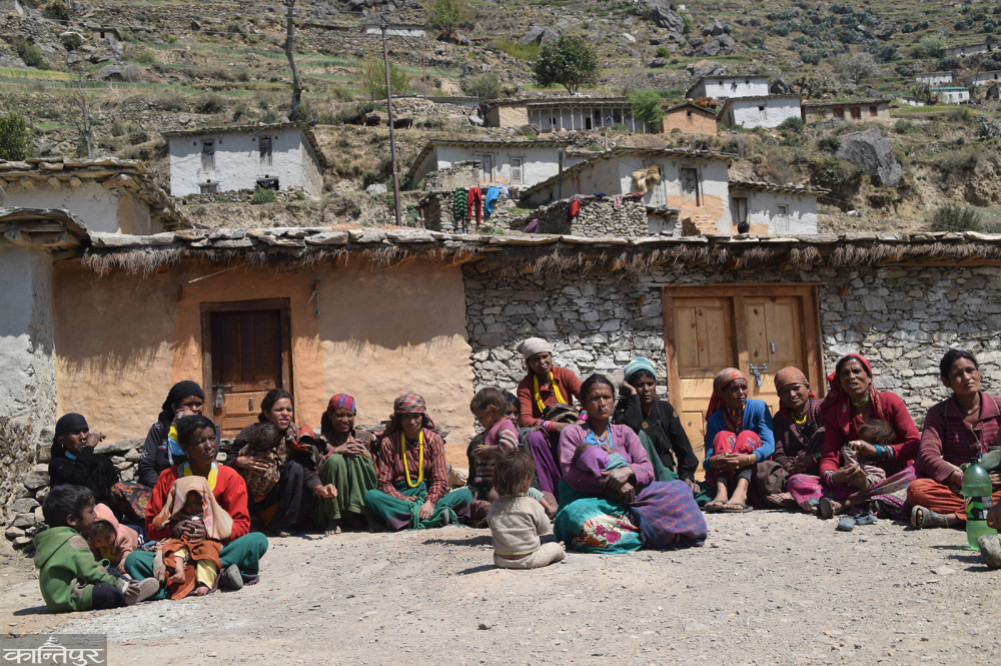
According to the Smart Survey on Nutrition, 48.8 percent of children aged 6 to 59 months in Bajura are stunted, 8.6 percent are stunted and 30.6 percent are underweight.
We use Google Cloud Translation Services. Google requires we provide the following disclaimer relating to use of this service:
This service may contain translations powered by Google. Google disclaims all warranties related to the translations, expressed or implied, including any warranties of accuracy, reliability, and any implied warranties of merchantability, fitness for a particular purpose, and noninfringement.
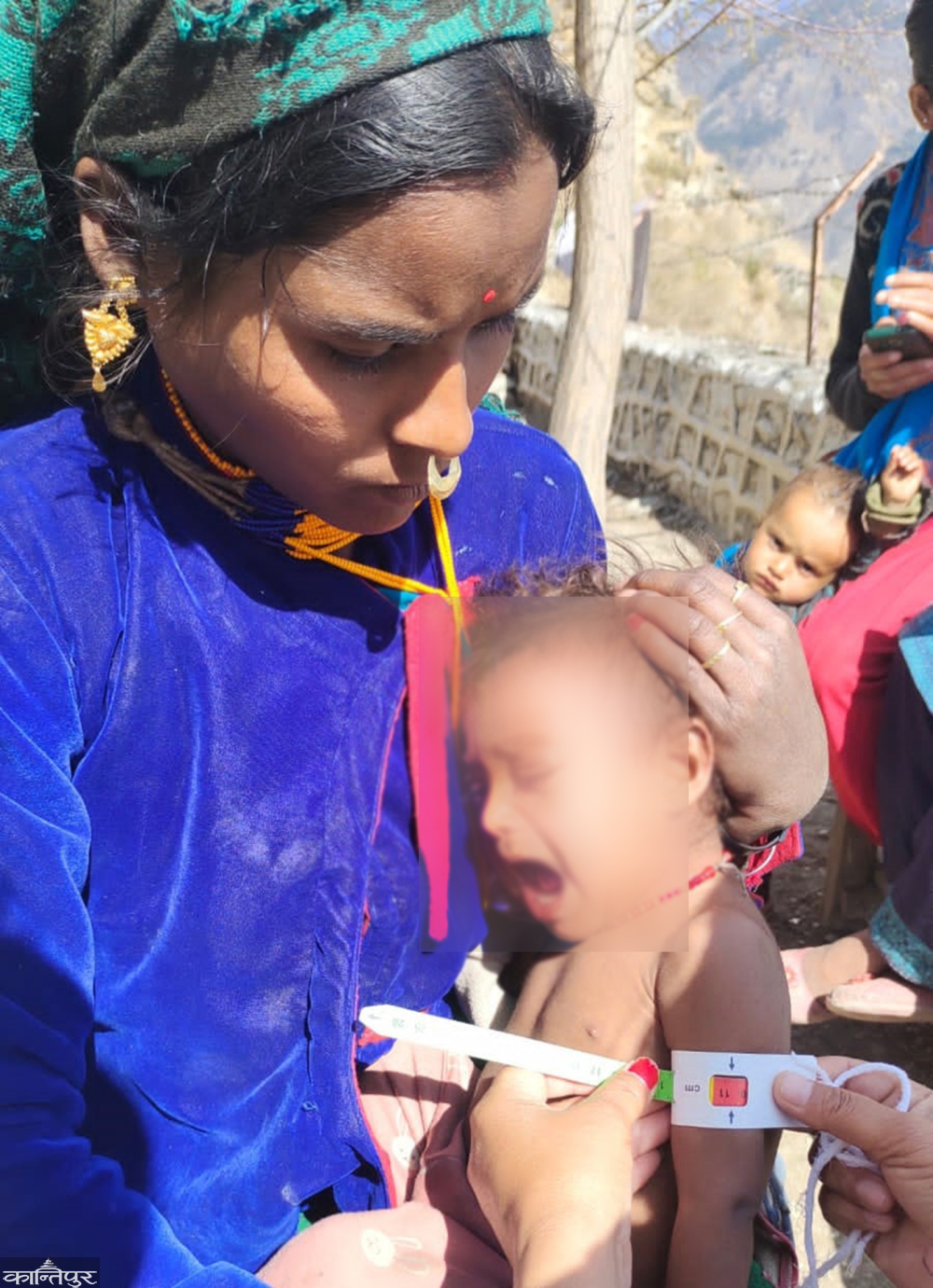
On November 17, Kamala Vick of Chiurigaon, Nalgad Rural Municipality-1 of Jajarkot, came to know that her son was suffering from moderate malnutrition after reaching the health center with her eight-month-old son who was frequently sick. Health workers advised him to eat vegetables, eggs and fruits.
Kamala, who was having a problem with waking up in the evening and morning, had only one concern, how to get nutritious food for her son? His concern was doubled later that night. Because, the earthquake on 17 November destroyed their house and they started living in a nearby pada where little grain was grown. Thirteen people from Chiurigaon lost their lives in the earthquake. 'Blessed lives have been saved,' said Kamala, who was basking her sons in the sun on the fourth day after the earthquake, 'all the food and clothes were buried in the destroyed house, these (showing the sons) are naked.'
On the other hand, the suffering of the poor family members who survive. It has been seen that many families like Kamala, who are struggling with hand-to-mouth problems, are further pushed into the vicious cycle of poverty after a natural disaster, and the problem of malnutrition is getting deeper as its direct effect is on children's nutrition. Kamala said that within a month after the earthquake, her youngest son's weight had decreased by 2 kg and 200 grams to 5 kg and 300 grams. "Earlier, I used to make a bed of corn flour and feed it, that too has been buried and mixed with the soil. The child was also malnourished, but now it is getting worse," she said.
According to the Disaster Preparedness and Response Branch of the Ministry of Home Affairs, 34,500 houses in Jajarkot have been damaged beyond habitation due to the 6.4 magnitude earthquake that passed through Ramidanda in Jajarkot on November 17. The biggest impact of the earthquake is on the poor like Kamala. After hearing about the earthquake, her husband, who was working in India, returned home empty-handed. Kamala said, "He came home in a daze. "The moneylender at the place of employment did not take into account that he had left work in the middle of the day. What to eat now? How to protect children?'
According to Nalgad health branch, 380 children like Kamala's son are malnourished in the municipality. Eight children are admitted and treated for severe malnutrition. As referred, Kamala's son is not counted in it.
Health workers say that before the earthquake, more than 300 children had moderate malnutrition in this municipality. After the earthquake, severe malnutrition has started to increase. Most of the malnourished children belong to poor families. The earthquake has also destroyed the houses of most of the poor people. Families who are unable to eat nutritious food even under normal circumstances have become more of a problem when disaster strikes," said Prachanda Karki, head of the Nalgad Health Branch, "Our efforts are to reduce the severely malnourished to moderately malnourished and to cure the moderately malnourished, but after the earthquake, the condition of the moderately malnourished has started to worsen. Instead of recovering from moderate to severe malnutrition, severe malnutrition is on the rise. He said that the parents of malnourished children living in rural areas are not even able to get treatment due to financial problems. "Families with better financial conditions and conscious families get treatment. The situation of those with low income has worsened after the earthquake. They are worried about the village, they don't care that the child should be treated," he said.
The example of Tajakot Rural Municipality of Humla is enough to understand how disaster is increasing the risk of malnutrition in Karnali and Far West. The landslide that happened on 23 October 2079 washed away the houses of 80 families here. The land was washed away, 169 houses were destroyed and 249 families were displaced. Most of the children of displaced families who lived in tents for months became malnourished. Most of them are children from Dalit families. According to the data of Tajakot Rural Municipality, 150 children were malnourished until 20th January 2080. Among them, 35 children were severely malnourished. According to Health Branch Head Dhanraj Dhakal, all malnourished children are from families displaced by landslides and most of them are from Dalit families. This data is only for children who came in contact with our health institution. If you are looking for
Malnutrition can be found in more people,' Dhakal said, 'After the disaster of 2079, it seems that the epidemic of malnutrition has spread here.' He said that the number of malnourished children is increasing unexpectedly as the landslides took away the farms of low-income Dalit families and they could not meet even the minimum nutritional requirements. Said gone. "Even the small farmlands that were there were taken away by the landslide," he said.
Lopa Damai of Tajakot-3, Chatharibada, eats rice with dal as if it was Dasaintihhar. The local Pampha Damai do not even know what nutrition is and what malnutrition is, as they are struggling to save their breath after even a small farm land was hit by a landslide. She said, 'Even if I could eat a full stomach of rice with salt and water in the evening and morning, it would be enough.' In the Human Rights Year Book 2024 of Informal Sector Service Center (INSEC), it is mentioned that 8 children died due to malnutrition in Muktikot in 2023 alone.
in which all belong to Dalit families. Remember, in the year 2078, 12 children of this village died due to malnutrition.
Muktikot, which falls under Sappata gavis of Savik, is a village that has been hit by landslides and drought for a decade. Majhwada and Bhainsikhal settlements here have been torn apart by landslides from all sides. There are 49 families in the middle of the landslide. Landslides occur during monsoons. Even in winter, dry landslides occur from time to time. 39 families have been displaced after their houses were damaged by landslides. It must have been 10 years since the drought started here. The land for cultivation is all barren," said local Baz Bahadur Wik, "Plants do not grow on the land for consumption. The landslide took away the house.
In March 2078, a study conducted by Health Office Bajura with the help of experts from various fields found that 196 women above the age of 10 were malnourished and 43 of them were in serious condition. According to the study, two out of every three mothers here have lost at least one child. During the study period, 61 children under the age of five were malnourished and 16 of them were in critical condition. According to the report, 18 families of this village are not able to eat even one day with their own produce, 186 families are able to eat for one month, 27 families have less than 3 women and only seven families are able to eat with their own produce for more than 6 months and due to the disaster, the production here is decreasing and malnutrition is increasing. It is mentioned that it is in order.
Not only in Bajura, 52 percent of the child mortality rate in Nepal is occupied by problems such as stunting, stunting, low weight according to age, which are the main indicators of malnutrition. Malnutrition increases the risk of chronic disease and perpetuates the cycle of poverty. "No country can break the cycle of poverty and achieve sustainable economic growth without improving nutritional status," the Multisectoral Nutrition Program report said.
Where the landslides are deep
According to the data of the District Disaster Management Committee, 519 families of Bajura have become completely homeless due to landslides and floods in the last three years alone, while 45 people have died due to landslides from 2064 to 2078. According to the committee's report, 16 villages in nine local levels of Bajura are at high risk of landslides and more than 44 are at normal risk. According to the report, Brahmatola, Chhatara, Kuldevamadoon, Atichour, Gudukhati Bandhu, Sappata, Kailashmadoon, Kolti, Rugin, Jugada and other villages are more at risk. In the smart survey on nutrition conducted by the health directorate of Sudurpaschim province only last year, 48.8 percent of children aged 6 to 59 months in Bajura are underweight, 8.6 percent are underweight and 30.6 percent are underweight. Whereas, the World Health Organization's threshold for acute malnutrition in children is 5 to 9. If it is more than this, the World Health Organization recognizes that it is a sign of a miserable state of malnutrition.
According to the survey report on malnutrition conducted by the Far West Province Health Directorate, malnutrition is rapidly becoming a major health problem in western Nepal, and other reasons such as climate disasters such as floods, landslides, and droughts have hindered local subsistence agriculture, and as the food crisis increases, malnutrition and child mortality rates are high. pointed out. According to the fourth (2079/80) standard of living survey recently released by the National Statistics Office, 20.27 percent of the total population in Nepal is still below the poverty line. According to this survey, the highest rate of poverty is in Sudurpaschim Province. It is 34.16 percent in Sudurpaschim Province and 26.69 percent in Karnali Province. The survey also concluded that the poverty rate did not decrease as expected due to the devastating earthquake of 2072 and the subsequent corona epidemic.
The National Planning Commission conducted a study on the nutritional status of the 14 districts most affected by the earthquake. According to the study, around 250,000 children between 6 months and 59 months of age and 135,000 pregnant and post-partum women were at risk of malnutrition due to reduced access to food in the earthquake-affected districts. Karnali and Sudurpaschim, which are also neighboring provinces, are among the areas affected by disasters and malnutrition in recent times. According to the 'Nepal Demographic Health Survey 2022' report, 36 percent and 28 percent of children under the age of five in Karnali Province and Sudurpaschim Province respectively have chronic malnutrition. This rate is an average of 25 percent across the country.
According to the Sustainable Development Goals, the government aims to reduce stunting, underweight and stunting in children under five years of age to 15, 10 and 4 respectively by the end of 2030. Sunita Rimal, who has been working in the field of nutrition for 27 years, says, 'Nepal's geography is risky, there is a risk of disaster, and there is extreme poverty. It seems that the goal of reducing malnutrition to 4 percent is ambitious.'' There is a record of the National Planning Commission that spent 1 billion 900 million. Among the donors for multi-sector nutrition planning are the World Bank's Golden Thousand Days and the Agriculture and Food Security Project, the US Development Agency's Suahara, the Farmers Project and the Sabal Project, the World Food Program's Food for Education, UNICEF's Hands on Nutrition, and the Multi-Partner Fund, Emerging Efforts Against Child Hunger and Malnutrition. , the main projects named after the European Union have been carried out.
Director of Sudurpaschim Province Health Directorate Dr. Jagdish Joshi said that last year, 106.3 million 65 thousand were allocated in the nutrition program in 9 districts of Sudurpaschim and Karnali provinces. In which 88.3 million 86 thousand rupees were allocated from donor agencies, 1 million 56 million 20 thousand rupees from local level and 2.3 million 59 thousand rupees from other sources. A total of 10 million 7 lakh 18 thousand was spent from the allocated budget, including 8 million 33 million 51 thousand from donor agencies.
Dr. Vishal Kumar Bhandari, a former development expert at the Social Welfare Council under the Ministry of Women, Children and Senior Citizens, says that if we compare the amount of money spent by government/non-government agencies in a decade and the state of malnutrition, then for donor agencies, malnutrition and poverty have become nothing more than a dish to eat. . "Programs have been brought in by the ministry for facilitation, capacity development, allowances for employees, administrative expenses, employee salaries, field allowances, conference meetings and processes from the center, but even 20 percent of the funds do not reach the community," he said. ?'
Director of Sudurpaschim Province Health Directorate Jagdish Joshi says that if the budget is invested, malnutrition will not be eradicated and it will take time. He said, "The lack of food production and food insecurity have not led to the expected improvement." The Auditor General's annual report for the year 2078/79 has pointed out that there has been no progress according to the state's goal of reducing the rate of underweight children under five years of age. "The program should be implemented in such a way that progress is achieved within a certain period of time," the Accountant General suggested to the Ministry of Health and Population. The government had set a national target of reducing the rate of underweight children under five to 18 percent by the end of the year 2078/79, but the rate remained at 19 percent. Even the government itself does not seem satisfied with the sluggish results of the multi-sectoral nutrition plan. The review report of the National Planning Commission states, "Even though the nutrition plan has coverage throughout the country, the goal of reducing malnutrition has not been achieved." "Looking at the situation in the Far West and Karnali, the frequent calamities that have caused malnutrition among children are also seen as the main reason," Gyanendra Dawadi, officer of the Far West Policy and Planning Commission, who has studied the nutrition of all the districts of the Far West including Muktikot, said, "The situation of families in poverty will become more miserable after the disaster and the children will It is seen that they become malnourished if they don't have nutritious food.''
This year, the earthquake caused loss of wealth in Karnali and far-western districts such as Jajarkot, Rukum West, Salyan, Bajhang, Doti, Bajura. Three districts of this province, Kanchanpur, Kailali and Surkhet, are flooded every year. The remaining 16 districts suffer from annual floods, landslides and droughts. Among them, four districts namely Baitadi, Acham, Dailekh and Paschim Rukum are at high risk of landslides. Darchula, Bajhang, Bajura, Dadeldhura, Doti, Jajarkot and Salyan are at high risk of landslides. According to the National Disaster Risk Reduction and Management Authority, around 50 people lost their lives in Jumla, Mugu, Humla and Kalikot districts of Karnali province and 7,775 families were left homeless due to floods and landslides after incessant rains from 17th to 24th October 2079. On November 2, 2078, landslides swept away at least 270 houses in Bajhang, Bajura and Doti of Sudurpaschim Province due to continuous rains. 39 people died after being buried in houses washed away by landslides.
National Planning Commission spokesperson Yamlal Bhusal claims that the nutritional status of the country is improving. However, he agrees that catastrophic events add to the challenge. "Disasters lead to poverty, people become malnourished because they don't have food," said spokesperson Bhusal, "The multi-sectoral nutrition plan was focused on 32 districts that were affected by the 2072 earthquake, now we are doing nutrition programs in areas affected by floods, landslides, and earthquakes like Karnali and Sudurpaschim." Karnali Province Planning Commission Vice Chairman Yogendra Bahadur Shahi said that the people of Karnali are falling into a 'vicious cycle' of poverty due to disasters like earthquakes and floods. "The houses here are on steep land, the flood has damaged all the areas here, the poverty has made it weak," he said, "When poverty increases, there is a situation where people have to eat less or cannot eat at all." We didn't make them dependent forever, now we had to make them able to produce and eat themselves.'