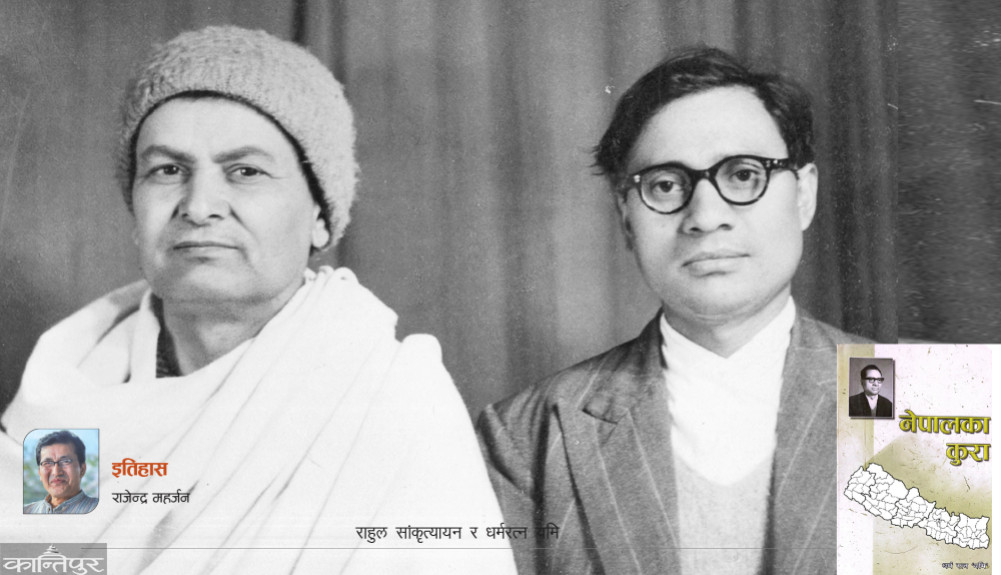
A book about rulers and leaders. Tankprasad Acharya government considered that book objectionable. And the press was raided and all copies were confiscated. KI Singh Sarkar. Ban on pen and confiscation of books, why was that case disappeared in history?
We use Google Cloud Translation Services. Google requires we provide the following disclaimer relating to use of this service:
This service may contain translations powered by Google. Google disclaims all warranties related to the translations, expressed or implied, including any warranties of accuracy, reliability, and any implied warranties of merchantability, fitness for a particular purpose, and noninfringement.
A living man walking in the twilightHe said he would change the world, but he changed himselfWrapped itself in the embrace of darknessHe said he would change the world, but he changed himself - perception
One speech when on the street, another when in government. One face when in opposition, different when in power. As you climb the ladder from the street to the government, the dialect changes. Changing from the opposition party to the ruling party, the transformation of the political leadership takes place. Seeing this transformation, history should say, 'There has been a transformation of the political leadership, the speech has also changed!' !!! No matter how much history and historians are hailed, seeing the emperor naked and writing the bare truth is not strong. An example of this is that the leaders who fought for democracy tried to impose repression on the people and democratic rights when they were in power, but history is silent. Even though the leaders who led the struggle for the freedom of expression of the people embarked on the enterprise of banning the press and confiscating the book itself, the historians' neglect is ironic.
In 1977, some history was written about Subba Krishnalal Adhikari, who was sentenced to 9 years in prison for writing the book 'Makaiko Kheti' in Nepali language and died in prison. However, little has been written about the Bagrelti author who was a victim of fines, threats, jail-nails, loss of everything and sacrifice of his life on the basis of writing in Nepali language. The leaders who fought for the right to speak, write, print and express themselves embraced the undemocratic methods and procedures of the Rana regime even after the establishment of democracy. And, history writing continued in the street of power. Even if we look at just one example of suppression of the right to write, express and publish, we can see the transformation of the political leadership towards the autocratic ruler and the indifference of most of the historians towards it.
Here we will try to look at Nepali history, heroes of history and history writing through the 'prism' of the ban on the books of such people, who have been sentenced to years of imprisonment to the positions of ministers and members of the National Panchayat. Yes, that is the name of the writer, activist and leader - Dharmaratna 'Yami', who without any degree was educated by Rahul Sankrityayan and Dr. Being initiated by Ambedkar's initiation, he wrote more than two dozen books in Nepali, Hindi and English along with Nepali language. The name of Yami's book which was published, banned and confiscated in Serofero on Baisakh Purnima in 2014 is: 'Nepalka Kura' (Critical History). This fact is not found in the histories, biographies and memoirs of the Prime Ministers who imposed bans and confiscations.
The argument of a martyr while alive
Unbelievable fact: Who suppressed the freedom of writing and expression? who fought together for democracy, spent years in prison during the Rana era From the hands of 'living martyrs' who lived together for years. Tankaprasad Acharya, who was appointed from the king to home minister to prime minister in seven years after democracy, banned his friend's writing towards the end of his tenure, repeating the Rana era trend. In order to establish the justification of that ban, Acharya said that during the meeting held on 3rd July, 2046, he had been banned on the charge that he preached that 'Moro arms would take power together'.
'How do you feel about the publication of late Yamiji's book called 'Nepalko Kura' being banned?' In response to Yami's daughter Timila Yami Thapa's question, Purvapram Acharya replied: 'I have not even seen that book called 'Nepalko Kura'. That's nothing. If the 'Nepalko Kura' arms join forces (Uydhabhach) to take power, then Vishweshwar (Chairman of the Nepali Congress), Yata Ma (Chairman of the People's Council), Utta Manmohan Adhikari (Chairman of the Communist Party of Nepal) and Dilliraman Regmi (Chairman, National Nepali Congress). Rai, Gurung and Magars have been promoted to preach against these Moro bahoons. That (the book called 'Nepalko Kura') has no significance. No one has brought importance. No one even showed importance. Even then it didn't matter. It's such a small country. What will happen if it starts to break in many ways! (Dharmaratna Yami Smriti Granth: Dhayasmrigra, Yami Thapa 2046: 124-125).'
This is a hard to believe statement by the former prime minister who led the democracy movement in Nepal. It is not easy to believe that the President of Nepal Praja Parishad, Tankak Prasad Acharya, who sacrificed three of his members, banned the book of his fellow traveler Dharma Ratna 'Yami' while he was the Prime Minister. The bitter history is that after receiving the post of Prime Minister from 13th January 2012 to 31st June 2014 from King Mahendra, the same Praja Parishad chairman Tank Prasad used the hammer of Tantra on the people. There is little truth in Tank Prasad Acharya's claim that he has banned 'Nepal's talk' because propaganda was being spread against the Bahoons in order to fight against the country. After the establishment of democracy in seven years, there is no doubt that the Bahuns are becoming more powerful than the Kshatriyas, especially in his book, Yami has taken a look at the 'Brahminical priestly state and its new rulers' established in Nepal. Yami, who criticized the behavior of Licchavi rulers who imposed the idea of Brahmin religious cannibalism and sin-virtue, was originally a Buddhist Newa: divided the community into four castes and thirty-six castes, from the 'mercenary policy' of King Siti Malla, who imposed cannibalism and untouchability, for making serious comments against the 'political polymorphism' of the then Pram Tankaprasad. There is no difference. He writes about the many forms of Tank Prasad, the 'friend of happiness and sorrow':
'Acquainted with Tank Prasad Acharya since 1997. In the Hindu state of Nepal, because cows are animals and human arms are uncut, the young friends of the Praja Parishad chose Tank Prasad as the president only because the arms are uncut. On the occasion of his ninety-seventh birthday, he even surprised us by talking to the Ranas about something. But when he was brought to jail, he thought that he was untouchable and he wrote a petition to Rana-Samantashiromani Juddhashamsher and paid 40/- (forty rupees) one stamp and eight paisa to marry him, and considered himself untouchable. Later, after 7 years of struggle under the leadership of Nepali Congress, he was released from prison and ran to Delhi, but did not find a ministerial position. Later, when the talks with the king failed, he became a Marxist who saw Mao Zedong as an opponent of the king and Nehru. From there, he became a Stalinist and joined the Communist Party. Seeing that the Nepali Congress was about to fall from the government due to mutual quarrels in the Nepali Congress, Nehru became a democrat who saw the sun. After the fall of the Nepali Congress from the government, Matrika's father became the United Democratic League since he went to the government in another form. Later, even though he did not have a state system, he became a minister as a nationalist, saying that the nation was in danger because he found the home department. After seeing that the matrika-government was about to end, he sold his wealth and the battered red flag and the presidency in one night and became a tricolor flag bearer. This is Tank Prasad Acharya's account of political polymorphism (Nepalka Kura, Yami 2014: 443-444).'
Young Maharaj Adhiraj Mahendra and Prime Minister Tank Prasad, whom he had turned around like a champ, made a precise comment, 'I thought that Maharaj Adhiraj also had an extraordinary intelligence to know people, but when he saw that he chose Tank Prasad Acharya, who was not the most political woman among the leaders, and gave him the post of Prime Minister, Maharajadhiraj was afraid of political techies. (Yami 2014: 443).'' While 'Yami' was appointed Deputy Minister of Food/Forest by Raja Tribhuvan in 2008, who was optimistic about the direct rule of Raja Mahendra in 2011 and was appointed as a National Panchayat member in the Panchayat system imposed in 2017. His "savior himself." The book "Dedicated to Shri 5 Tribhuvan" could not escape ban and confiscation.
According to Sugatdas Tuladhar, the cousin of 'Yami' and a Nepali language writer, 'Nepalka kura' and 'our nationalism' caused a stir. Why and how did it make a fuss? Yamika's colleague Kedarman writes wryly, 'His most famous history book is 'Nepalka Kura'. It is a remarkable book for Nepal. The book is more than a mirror of political, social and cultural activities. However, due to his criticism, the then government confiscated that book (Dhayasmrigr, Vyathit 2046 : 9).'
Leading the 'Prachanda Gorkha', Khadgaman Singh is among those who have been in jail for twenty years since 1988. In 1997, after Praja Parishad scandal, Yami also became his companion in prison life. Singh, who became an adviser in the direct rule of King Tribhuvan in 2009, also questioned the reason for the ban, "Dharam Ratnaji wrote another wonderful book in Nepali language, 'Nepalko Kura'." At that time Shri Tank Prasad Acharya was the Prime Minister. In 'Nepalko Kura', as well as the revelation of many great personalities, Pram Tankprasad was strongly criticized as unfit to run the government along with Brahmanism (Dhayasmrigra, Singh 2046 : 19).'
against the ideology of the Hindu state
is a highly criticized idea in 'Nepal's matter' - Brahmanism which has been promoted, protected and implemented by the state for hundreds of years and its exponents, from Manu to Ramamani etc. A.D.'s book published in the year 2010, 'Nitiko Petaro wa Bholo Kurak Naam', has advocated the distinction of caste, varna and class, in the style of Manusmriti. To some extent, in opposition to 'democracy that arouses partisanship', while standing in favor of the system that serves the interests of Arya superiority, it has been mentioned to the extent of 'Blood Purification to prevent the deterioration of caste'. Based on this ideology, Yami has discussed about the Hindu state and its old and new rulers from the perspective of the outcast community,
Nabraham Kshatran Ridhnoti Nakshatran Brahma Vardhate.
Brahma kshatran cha sampriktamih chamutra vardhate.. 9.322.
Kshatriyas without Brahmins, Brahmins without Kshatriyas cannot grow. Both are mutually beneficial. From this, none other than Brahmins and Kshatriyas could get the big status of owner, god, feudal lord, king, maharaja, dhiraja, emperor, guru, minister, priest. This means that according to this Sanatan Dharma, all other castes and sub-castes had to live in the country of Hindus under the arbitrary pressure of Bahun and Kshatriya. According to the law of Sardar Rammani Baje's Ranashahi, "Ministers should be made up of Brahmins and Kshatriyas, even if they are of a high rank". In Nepal or in the Hindu state, except for the high caste Brahmin-kshetri caste, all other people are deprived of human rights as servants. The freedom of a country is not only that no foreigner should rule, but freedom means that all the people of the country have equal rights, big and small, even if the natives rule. The people of Nepal have been oppressed by Shudras over Mlechchas, Vaishyas over Shudras, Kshatriyas over Vaishyas, Bahuns over Kshatriyas, and all these cunning slaves-Kaka Mara, Zelyaha, tyrannical feudal lords have made not only our bodies but also our intellects slaves (Yami 2014: 325-326).
As the core of this book is the Hindu-Brahmin religion, the state based on it and the dominance of the class-caste-caste nurtured by the religious state, Yami has repeatedly raised the ancient ideas of Rammani etc. Such shallowness is not acceptable for the dominant class-characters can be seen in the memory of Rammani's grandson and writer Kamal Dixit:
'Yamiji's name caught my ears and eyes with a bit of sweetness. Let's say that I got to know him only after reading his book 'Nepalko Kura', which can be accused of 'Jathva Tathwa-bole'. Apart from that, I also had to read that my father, himself, Sardar Rammani etc. had to eat communalism (p. 421).
He has spoken openly about what he thinks is right, what he believes in, without fearing that someone will get angry. The people mentioned in the book are complaining that what he said in that book is not right, not true, things are hidden. But such complaints were merely gossip in the room. In publication, no one redeemed or refute those today. I brave that I could not resist what you thought thoughts are wrong. (Bidshagle, the Linited 2046). & NBSP;
ideas were not even in democracy style instead of the Ranhaphati's style of oppression on the book. When did King Mahendra in the novel rule of salvation 'in the decidus' in the novel rule 'from the party leaders, "dismantium rule' has not even infiltrated the victims of the victims of the victim. Leaders and rulers made up to the nationalist leaders and rulers were criticized by their discourse and behavior, not also recorded. The tears of the author's tears did not even fall flowing but also confiscated, "things of Nepal 'was not restricted but also the tears of the writers even sead, as poem! Ironically, the work of seizing, the Mahachvi Larakvi Prakota Educas, Equilibrium, as ministers, as ministers. K.I.i The Singh's government was committed. Jamousa said while conversation with author Under Susternity, Jimila said: "Talks of Nepal, 'four hundred and a half books. K.I.i The lion government seized (Jammi 2046:13). '& NBSP; After taking
, the Achary government is ready to follow the Akmra government on July 2014, and King Mahendra, and Nepali Congress, Rajesh Gautam 2066: 250) . The government may have no government in Nepal, that Yami said that the Himauri Himalayas of the Surea, Surea, 2046: 71, Chandra Raghuakshi 2046: 42). "As the book was ready, Jumiji brought it from press as a model of 5-10. The government seized that the book was offensive to the book, considered the book of Nepal, "(Lions 2046:19). '& NBSP;
wash for a variety of thoughts, activities and organizational efforts from 2007, 2017 BS (2017 is an external oriented decade (2017 British in Nepali society, Malla 2073: 145). In the month, Nr. 5, not only in a book, but Mr. 5 government governments had been tied up for expression. & Nbsp;
Prime Minister Axiya took action of 34 journalists within the reign of a half-month reign, making freedom of expression, which is the number of decades. Dr. When comparing the governance period and actions. The ladest magazine of the magazine was taken care of the most largest magazine in the time of the Lion leadership government. 3 months 18 months of 18 days was suppressed 11 magazines in the regime, "and Nbsp;
(Expander Nepali Press and Freedom Freedom of Sande Press: Practice of V.S.2007-17: Media Study-8, Ramesh Pahaujuli 2070: 13). In critical books and mirror, leading leader and nationalist leaders, and the victims called the rural and nationalists, in Nationalist, in vain and nationalist, were not yet stopped yet. & Nbsp;
(Thanks: Rajesh Gautam, Pro. You are the Dilliran Yam Thapa, Dilliran-Qalyzing Prof.) & NBSP;