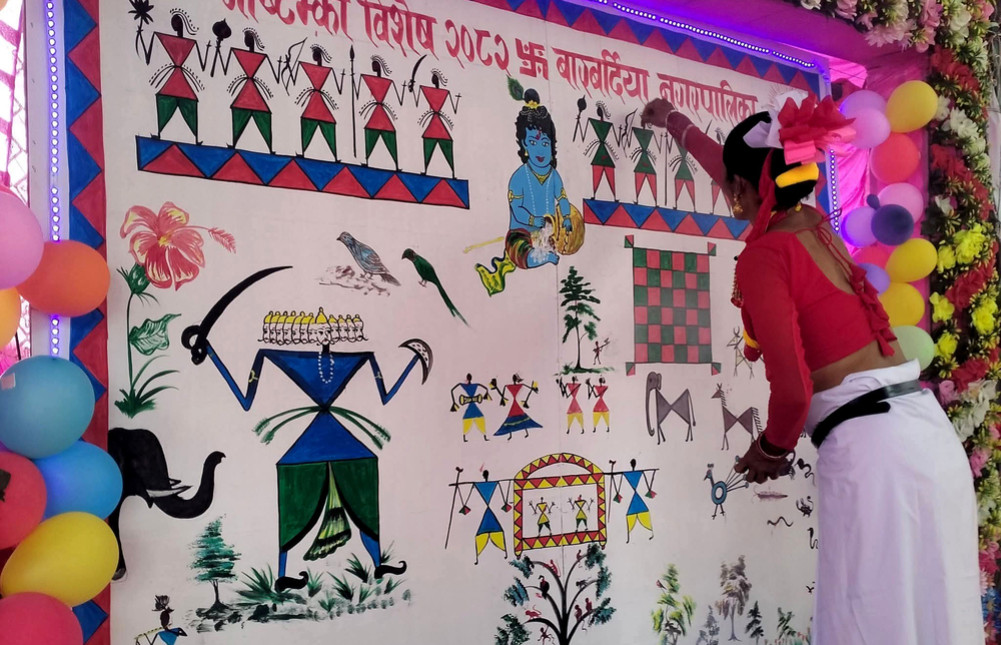
The life philosophy of the Tharus is clearly reflected in Ashtimki paintings. Tharu folk art has survived in it. However, its importance has not been explained to the new generation.
We use Google Cloud Translation Services. Google requires we provide the following disclaimer relating to use of this service:
This service may contain translations powered by Google. Google disclaims all warranties related to the translations, expressed or implied, including any warranties of accuracy, reliability, and any implied warranties of merchantability, fitness for a particular purpose, and noninfringement.
As Krishna Janmashtami approached, Ashtimki preparations began in the Tharu settlements of western Nepal. Natural colors were used for painting. Beans for green color, special wood for kathak color, powain saag for red color. For the black color, dried gourd had to be roasted in the fire.
Green, black, white and red colors are especially used in the Tharu community. These colors are also used in Ashtimki. They used to celebrate Ashtimki festival by making Ashtimki pictures on the walls of the house using the natural colors collected through pain. But, now its originality has been lost . The practice of worshiping by pasting pictures of printed Ashtimkis has become popular. Experts are concerned that the originality of Ashtimki painting will be lost.
Every year on the day of Krishna Janmashtami, especially the Western Tharu community celebrates 'Ashtimki Parva'. It is the original festival of Western Tharus. On this day, it is customary for fasting women to make a picture of Ashtimki.
Ashtimki paintings, similar to Mithila painting, have become commercialized and are no longer visible even on the walls of houses.
The importance of optimal picture
According to Shatrughan Chaudhary, who has published a book of Ashtimki songs, Ashtimki is one of the various performative aesthetic arts of the Tharus, which is expressed through paintings that have a deep connection with natural beauty and life. "On the day of Ashtimki, men and women take a bath and fast in the morning and make hand paintings on the northern wall of the bahri (generation) of the house, where human creations and natural forms are made," he says. It shows the relationship between Tharu's lifestyle and livelihood.' Dr. Tharu culturalist who studied about
Ashtimki. According to Krishnaraj Sarvahari, Ashtimki painting is not only an art, but it is a reflection of the origin, lifestyle, philosophy and culture of the Tharu community as a whole. He says, 'Ashtimki picture is made by singing the song of Ashtimki . What is said in the song is reflected in the picture. The presence of sun and moon in the picture clearly shows that the Tharus are nature worshipers.'
dr. According to Sarvahari, Ashtimki painting includes all aspects connected with the creation of the universe. The Tharu's agricultural activities - ploughing, bride and groom sitting on a doli, dense forest, animals etc. all reveal the various aspects of Tharu life through pictures. These images are made on the wall or Dehri (beggars) and fruits are eaten only after evening worship .
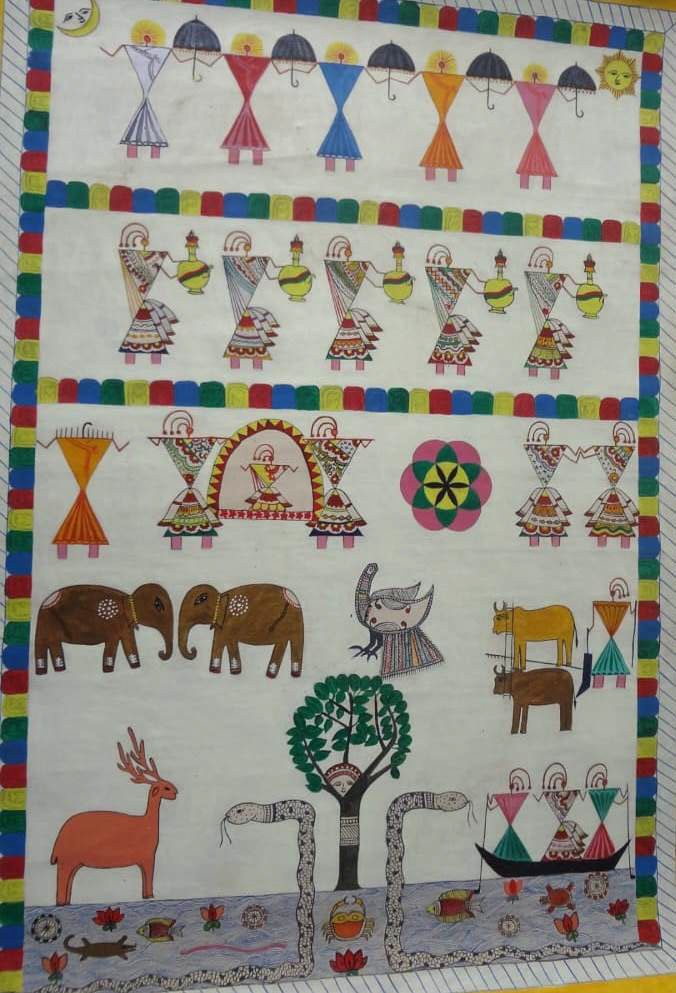
Ashtimki art is reflected in the cover of the book 'Budhani' which was published in the first week of June. Its author, Indu Tharu Ashtimki, says that the original art has been given a place in the book because the ancestors of the Tharu community have been making it since before.
'The Tharu community has its own style of painting . Be it tiger, peacock or other animals and birds . Looking at these paintings made in geometric shapes, it is clear that this is the art of the Tharu . The way it is made is also unique,' he says. He says that as soon as he sees the Ashtimki picture, he feels connected with the cultural identity of the Tharu community.
The local level in the promotion of Ashtimki painting
The local level is taking initiatives on its own behalf in promoting culture and Tharu folk painting. Workshops, competitions and seminars are being conducted to promote Ashtimki painting in Tharu-dominated areas.
The Barbardia Municipality of Bardia has put a lesson about the astimki in the local book 'Barbardia Gaurav' implemented in its municipality. Apart from this, there is practice of making Ashtimki pictures for students from class 4 and above on the occasion of Ashtimki. According to Naresh Lal Kusumya, one of the authors of the book 'Barbardiya Gaurav', this painting can be sustained and promoted through various efforts including courses and workshops.
This week, a Tharu Ashtimki painting workshop was organized in Kathmandu in collaboration with Nepal Fine Arts Academy and Agrasan Tharu Women's Society. In which the Tharu youth in Kathmandu enthusiastically participated.
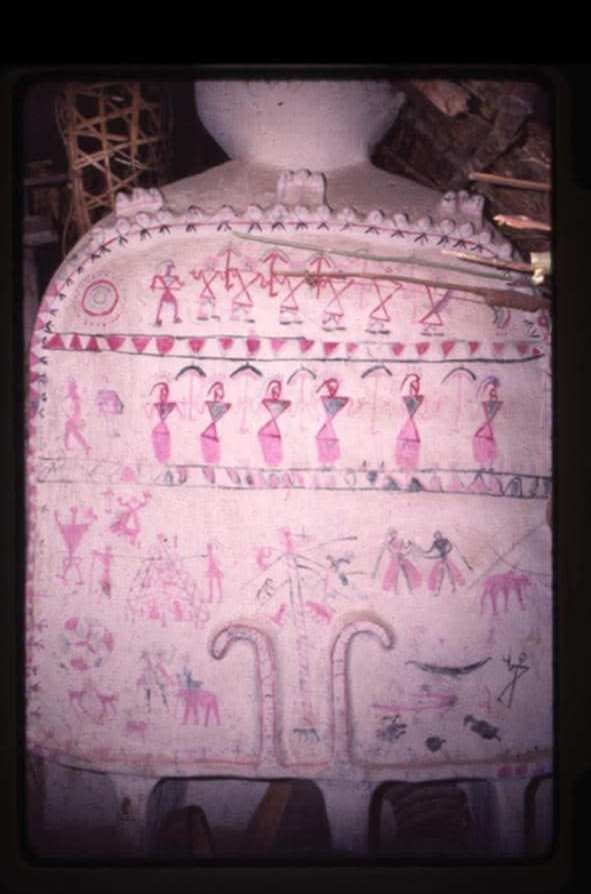 The Janaki rural municipality of Kailali has equipped its office building with the best painting. The original handicraft painting has enhanced the beauty of the municipality. The municipality organizes an Ashtimki painting workshop and competition every year at Serofero in Ashtimki. Also, the municipality has declared itself as the hub of folk art.
Ganesh Choudhary, Chairman of Janaki Rural Municipality, Kailali, says that every year the workshop is being conducted on the occasion of Ashtimki to revive the Tharu tradition. "We have been conducting workshops to preserve the tradition of making Ashtimki paintings with the aim of transferring the skills and knowledge acquired from the old generation to the new generation," he says.
Janaki rural municipality has been working on how to combine colors in paintings, how to connect them with Tharu skills and traditions in collaboration with the Nepal Academy of Fine Arts. According to President Chaudhary, there is a need for conservation and commercialization initiatives in the Tharu community's Ashtimki painting. He said that he is making a plan on how to market the painting in the future. He says that he wants Ashtimki to get a market like Mithila painting.
For this, the rural municipality has thought of putting Ashtimki paintings on exhibition from time to time and selling them by establishing Koseli house in the future.
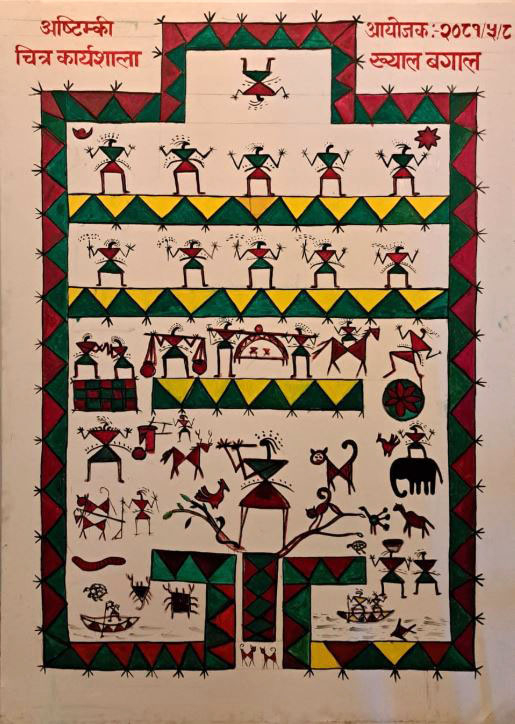
Similarly, Thakurbaba Pragya Pratishthan under Thakurbaba municipality of Bardia has also organized a three-day Ashtimki painting workshop this year. Two dozen participants have created beautiful Ashtimaki pictures from the instructors . Secretary of the foundation Khagendra Nepal says that it will be continued for another year.
Barbardia Municipality of Bardia has organized a program to preserve Tharu folk art Ashtimki and to make it widespread this year. In addition, the municipality has been conducting various programs related to the transfer of traditional skills in schools as part of extracurricular activities.
Municipal Administrative Officer Tikanath Gosain said that with the aim of preserving traditional skills, the school has included activities such as Ashtimki painting, Duna, Tapari, and Dhakia making in the educational calendar. He says that there is a plan to hold an Ashtimki workshop in collaboration with the Nepal Academy of Fine Arts in the future.
Nepal Academy of Fine Arts has been conducting various programs to preserve and promote Ashtimki painting. Devendra Kumar Kafle, member secretary of the foundation, said that the task of preserving culture and tradition is becoming challenging. "For its preservation, it is necessary to pass the generations within the relevant community," he said.
It is his experience that the effect of the facilitation done by the foundation in Ashtimki painting workshop is good. The work has been started keeping in mind the possibility of marketing and sustainable development of folk art. Such programs have tried to connect the original style of the Tharu community, folklore, Ashtimki paintings and other folk paintings with people's life and social transformation,' he said. Through the
training program, the importance and skills of Tharu painting are being transferred to local artists and the new generation. Kafle says that there is a good effect and potential from this. According to him, it is necessary to think about how to develop the folk painting as a source of income for the transmission and sustainable development while preserving the originality.
The life philosophy of the Tharus is clearly reflected in Ashtimki painting. Tharu folk art has survived in it . However, its importance has not yet been conveyed to the new generation . Artist Mitthu Tharu says that due to the lack of thinking that one can earn money by making pictures, it has not taken the path of commercialization. He has received many awards in the art of excellence.
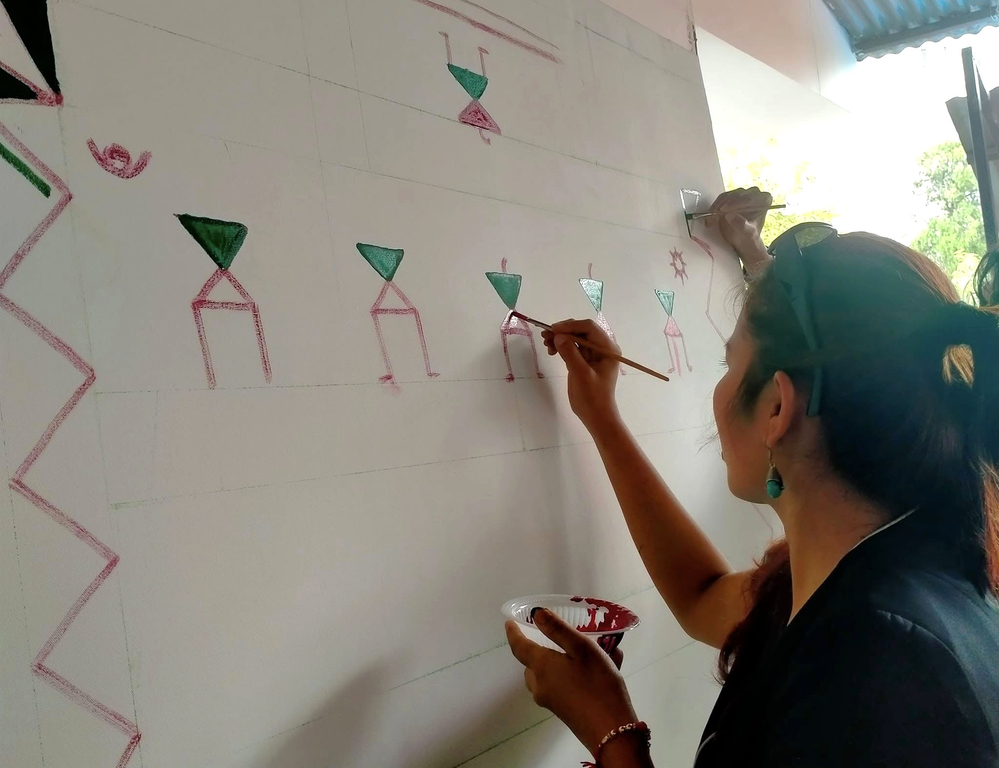
'Philete t serial jal thal dharti, dusare t serial kush kai dav' The Ashtimki song begins with a stanza saying . That is, first the earth was water, then it became land. The first plant called Kush was created . Thus, Ashtimki song has started from the story of the creation of creation.
dr. Sarvahari Ashtimki painting is not limited only to the occasion of Ashtimki but if it can be practiced at other times as well, he says that it will give the artist an opportunity to move forward . He said that if everyone supports from their place in the promotion, folk art will be saved from the danger of extinction. Not only with the intention of saving
culture, it is also necessary to turn it into an economic opportunity. Just as Mithila painting has succeeded in making its identity in the world, Ashtimki art has become limited to the walls and posters of the house . It has been too late to transfer skills to the new generation through propaganda, programs, exhibitions, campaigns and workshops for its promotion.