The attraction of Nepal's foreign employment is the attraction in Romania due to the fast, high wages and loose immigration policy through the Gulf countries.
We use Google Cloud Translation Services. Google requires we provide the following disclaimer relating to use of this service:
This service may contain translations powered by Google. Google disclaims all warranties related to the translations, expressed or implied, including any warranties of accuracy, reliability, and any implied warranties of merchantability, fitness for a particular purpose, and noninfringement.
Although the Gulf region remains the main employment destination for Nepali workers, recently Europe has also started to be seen as an alternative. Although the recruitment process has not started institutionally, Nepali workers are being attracted to go to Europe on individual initiative. A large part of foreign employment still seems to be in the Gulf region.
According to the Foreign Employment Department, 839,266 Nepali workers reached 151 countries in the last financial year. Out of which 3 lakh 59 thousand 675 people went through 1 thousand 69 manpower companies and 1 lakh 33 thousand 627 people went through individual initiative. 333,339 people returned to their previous employers after coming on leave, while the remaining 12,655 people went to South Korea, Israel and the UK.
UAE major destination
United Arab Emirates (UAE), which is a major destination for Nepalis, has 274,000 people who take work permits in a year. In which the number of Nepalis who go and find employment on their own through visit visas is not included in this. According to Tej Bahadur Chhetri, the Nepali Ambassador to the UAE, Nepali workers are given high priority here. He said that as the economy of the UAE is getting stronger, the number of employers is also increasing. UAE is seen as a major destination country for Nepalis. Apart from that, the presence of Nepali workers around the world is becoming stronger," said Chhetri, "here we are coordinating to increase the services provided by Nepalis. Currently, employers who pay less than 1,000 dirhams are not allowed to demand Nepali workers. We are strictly verifying the demand.'
Earlier, Qatar was the first destination in the Gulf region. As construction projects in Qatar have slowed down, Nepali workers have been employed less than in the past. Qatar hired only 49,000 new workers last year. While 91,000 people who were already working have continued their employment. Saudi Arabia is seen as the second labor destination. 152,000 Nepalis have gone to Saudi Arabia, the host country of FIFA World Cup 2034. After the Saudi government implemented a reform program for workers to change employers, the problems in the labor sector and the salary security system, the complaints of workers coming to the Nepalese embassy are decreasing compared to the past.
The number of Nepalis who are employed in the institutional sector of Kuwait, which is dominated by domestic female workers, has increased rapidly. 59 thousand people have gone to Kuwait. According to Meghraj Bhurtel, head of Neelkamal Human Resources, which sent the largest number of workers last year, they are ready to take Nepalis when direct access is established with the employer company. There are 3.6 million foreign workers in Kuwait, in which citizens of other countries were getting opportunities. The demand letter has increased due to the hard work of Nepali workers and the establishment of direct access," he said. "The regular contact between the Nepali and Kuwaiti governments at the highest level has also led to an increase in the quotas that Nepalis get as a matter of policy."
Malaysia, which has been closed for a year, has only hired security guards and agricultural workers in the last three months. Europe, which is an attractive destination for Nepalis, has not yet been able to recruit workers in an institutional manner. Some manpower, educational consultants and individuals are sending to Europe for high sums on individual basis after the embassies do not verify the demand. Last year, 35,000 Nepalese went to Europe. Most of them went to Romania 21 thousand, Croatia 11 thousand, Portugal 1900, Slovenia 1100 and Austria 1 thousand.
Romania is also seen as a gateway to Europe. Nepalis are going based on the demand of the private sector. Some even see Romania as a starting point for entry into Europe. As a result, Nepalis are found who pay up to 7 lakh rupees," said Bharat Rai, who is working in Romania to Kantipur. "Even though Romania is not a Schengen country, there is a place to be satisfied that it has reached Europe."
Nepali workers trying to go to Europe through illegal agents and middlemen are at high risk of fraud, fake documents and exploitation. The brokers are cheating by saying that it will cost 7 to 1.5 million rupees to go to Europe. The highest number of fraud complaints in the department is connected with Europe, said Kamal Bhattarai, director general of the department.
women workers are increasing
Last fiscal year, there were 94 thousand 455 female workers who went for foreign employment. Which is 11 percent of the total number of foreign workers. The countries with the highest number of women workers are followed by Kuwait, Israel, Japan, Maldives, Cyprus, Croatia, Malta and Jordan. According to the 2068 census, the participation of women among those going abroad was only around 3 percent. According to Saru Joshi, a women's rights activist, women's participation has increased with new job opportunities in Europe and East Asia due to changes in the way women are viewed in the Gulf region.

According to a UN Women study report, newly married women are being forced to work abroad due to limited decision-making power at home and weak economic conditions. According to a UN report, there is a high demand for women workers in fields such as domestic work, caregivers, cleaners, hotels, hospitals, and security guards in foreign employment. The money sent by women who went that way has contributed significantly to the family's daily expenses.'
Female workers are not only in domestic work as before, but also in the service sector such as caregivers, hospitals, companies, and hotels. According to the Foreign Employment Department, out of 94 thousand 455 women, 59 thousand 754 women have gone to work as skilled workers. There are 9 thousand 87 professional women workers. On top of that, the situation of being able to go to foreign employment without investment has opened more doors of opportunities for women.
24-year-old Durgakumari Kumal of Kailali said that the zero cost has paved the way for women to become independent. It was very beneficial for people like us who are in poor financial condition to go without paying a single penny. Otherwise, if he took a loan from the family, he would have to listen to the family every day. Until the debt was paid off, it always only added to the worry. There was tension in the family," said Durgakumari, who is working in the UAE, "This is an opportunity for me. I am getting to support the family.'
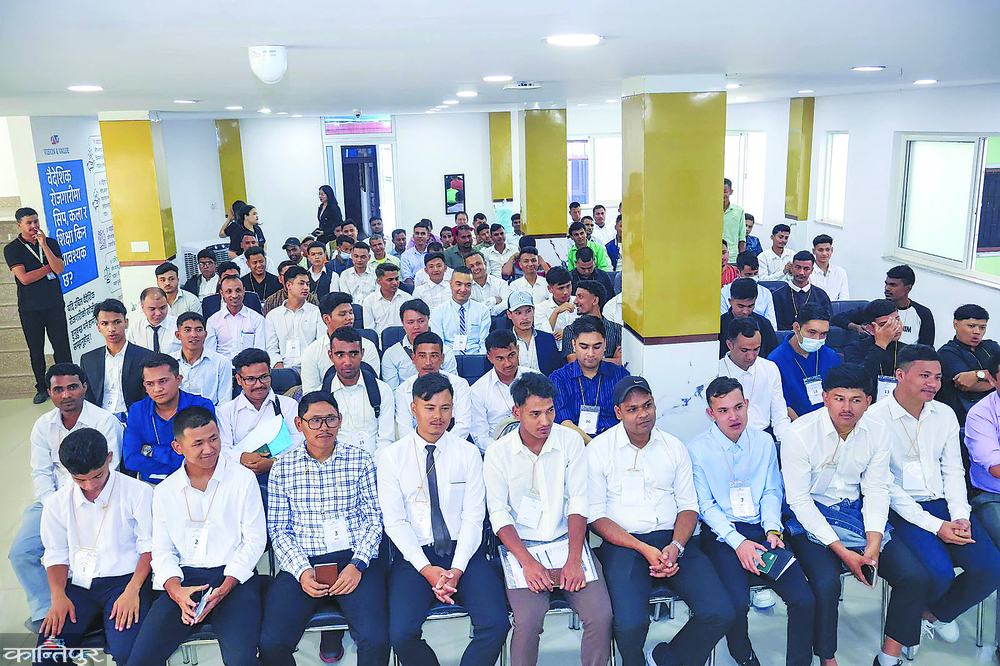
Padmaraj Poudel, president of Vision and Value Overseas, which is sending workers at zero cost, said that they have started looking for skilled female workers from employers. Employers who hire workers at zero cost have also given preference to female workers. We are getting workers according to their demand,' he said.
Madhesh Pradesh ahead
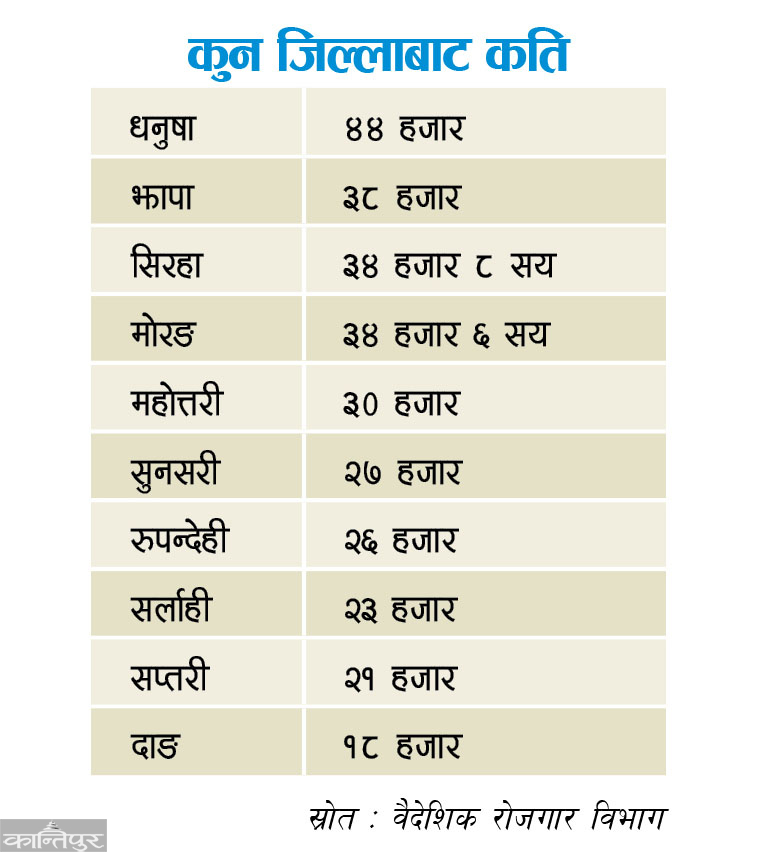
This year too, 5 districts out of 10 districts are from Madhesh Pradesh. 44 thousand have gone from Dhanusha alone. 38,000 from Jhapa, 34,800 from Siraha, 34,600 from Morang and 30,000 from Mahottari are in the second place. Then there are 27 thousand from Sunsari, 26 thousand from Rupandehi, 23 thousand from Sarlahi, 21 thousand from Saptari and 18 thousand from Dang. Madhesh province is ahead in foreign employment.
In terms of living standard survey of the national census, it has been seen that many people from Madhesh are going for foreign jobs due to poor educational quality, less formal employment opportunities, lack of alternative professions other than agriculture. Dalit, Musahar and other marginalized communities of Madhesh are improving their standard of living through foreign employment.
30-year-old Aishwarya Shah from Dhanusha is earning 43 thousand rupees per month. My husband and I are working in Dubai. My dream has always been to work and lead my own life, I am getting that opportunity now," she said. Since it came at zero cost, I have been able to save since the first month of working.'
The state has not invested in the skill development of Madhesh. According to Suryanath Mishra, the former ambassador to Qatar, foreign employment is becoming a reliable means for Madhesh. "Foreign employment has not only become the main source of financial income for the youth of Madhesh, it is also reducing the social discrimination," he said, "now the face of the villages of Madhesh has changed. Remittance is attached behind it.'
According to him, the biggest challenge for the youth of Madhesh is to ensure safe, dignified and debt-free labor migration. The government has not yet been able to effectively regulate manpower companies. There is a delay in producing skilled manpower as per the demand. Fraud and exploitation are high in the activities of unauthorized brokers, he said, "There is a need to regulate many labor sending agencies." Upasana Khadka, director of
Migration Lab, said that the result of foreign employment should not be allowed to become like a lottery. Since the management of foreign employment is not transparent, the result of foreign employment is uncertain for every worker, so it is like a lottery. "Nepalese are attracted to foreign employment for local benefits," she said. Most of the prestigious establishments in the destination country should create an environment that will take Nepalis.'
Labor Secretary Krishnahari Pushkar has claimed that attention has been paid to policy reforms, mentioning that workers have fallen into 'six types of traps' in labor migration. "In labor migration, workers are subject to loans, digital fraud, marital breakdown, death, disputes and exploitation of illegal brokers," he said, "Employer should bear the recruitment costs and make the monitoring system effective with bilateral agreement." should be made We are paying attention to the strengthening of diplomatic missions to protect workers' rights and solve problems.'