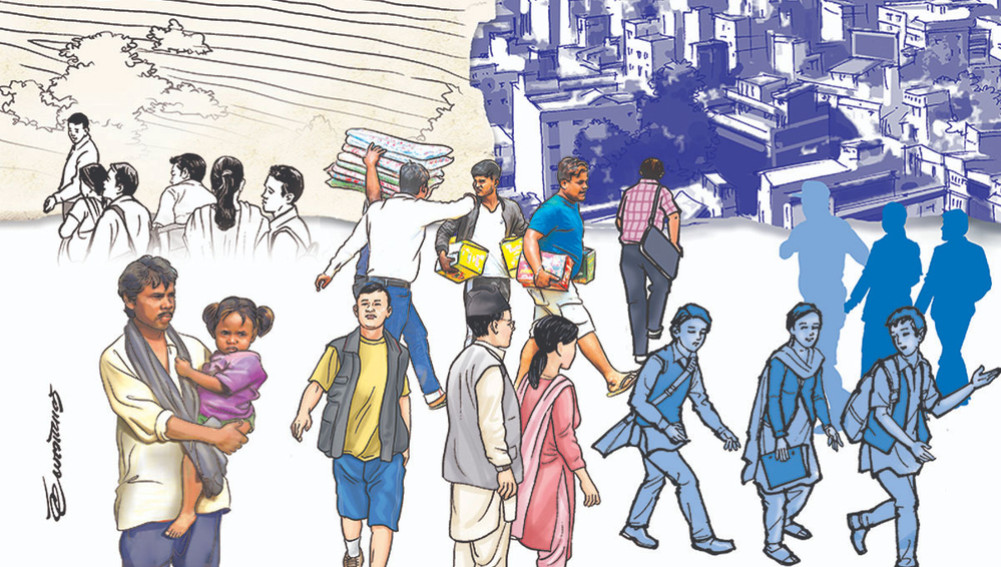
Bagmati Province was the first choice of total migrants, where 57.3 percent of males and 50.6 percent of females migrated from elsewhere.
We use Google Cloud Translation Services. Google requires we provide the following disclaimer relating to use of this service:
This service may contain translations powered by Google. Google disclaims all warranties related to the translations, expressed or implied, including any warranties of accuracy, reliability, and any implied warranties of merchantability, fitness for a particular purpose, and noninfringement.
According to a government study report, the rate of migration to another place within Nepal is more than 29 percent. The internal migration report of the National Statistics Office has indicated that there is 29.2 percent internal migration in Nepal and the highest 32 percent internal migration population is found in the hills.
Similarly, 28.9 percent of people migrated from Terai and 13.8 percent from Himalayan region. "Highly 37.6 percent of internal migrants are women and the rate of men is 20.6 percent," said the report, "The population migrating from Anyantra to Terai was 4 lakh 10 thousand 64 in 2028". This number has increased to 2084 thousand 505 people in 2078.'
Similarly, the number of people migrating to the Himalayan region was 9 thousand 698 (2.25) in 2028 and 75 thousand 542 in 2078. However, the report indicates that the net migration is negative by 543 thousand 966 due to the high number of emigration from that area.
"In the Himalayan region, there are more migrations from that region than arrivals," the report says, "in the hilly regions, In 2028, 6 percent migrated, while in 2078, 30 percent was observed, which was actually affected by the number of people who migrated to Kathmandu, Pokhara and Chitwan in the hilly areas.' In which there are 11 lakh 54 thousand nine hundred nine women and 9 lakh 87 thousand 454 men.
During that period, 11 lakh 50 thousand 6 hundred 26 people migrated to Bagmati province . The report mentions that net migration is negative by 3 lakh 43 thousand 50 people in Gandaki and 3 lakh 18 thousand 796 people in Koshi province.
The number of migrants has increased in Bagmati province, but the number of migrants in Gandaki and Koshi provinces has been negative. The first choice of total migrants is Bagmati province where 57.3 percent of males and 50.6 percent of females seem to have migrated from other places . Apart from Bagmati, women are the maximum in the number of migrants in six other provinces.
Among the migration from one province to another province, the highest number is seen in Gandaki, where 23.5 percent of men and 25.7 percent of women migrated,'' the report says, '17.6 percent of men and 20 percent of women migrated from Koshi province.' is . In 2018, this value was only 4.7 percent .
"When doing a comparative analysis of all 77 districts of the country, it appears that 18 districts have lost 20 percent of the population born in their districts," the report says, "There is no situation that there is no migration out of any district". Less than 10 percent from Bahr Ota district Parsa, Rautahat, Nawalparasi (East), Bhaktapur, Nawalparasi (West), Lalitpur, Kanchanpur, Kathmandu, Kailali, Ruppandehi, Banke and Kapilstu have migrated to other districts. According to the 2078 census, 57.2 percent have migrated to Kathmandu district. Bhaktapur has 50.2 percent and Lalitpur has 46.2 percent which is the highest rate of permanent residence . Apart from these three districts, net migration rate is positive in 16 districts. However, the net internal migration rate of 58 districts seems to be negative, that is, emigration is more than inflow, the report has pointed out.
Similarly, as indicated by the 2078 census, 25.9 percent of those who migrated were dependent, 24.9 percent for marriage, 19.2 percent for job opportunities and 14.1 percent for study/training.
31.3 percent of those who migrated to Terai were married and 26.7 percent were dependents. Analyzing state-wise, job opportunities are the main reason in Bagmati and Gandaki, while marriage is the main reason in the remaining five provinces," the report said. People below four years old and above 75 years old have migrated with their families because they are dependents, while women aged 20-24 years have migrated due to marriage and maximum work in the age group 35-39 years has been observed.'
Similarly, after the first, 10-year conflict, peace process and restructuring of the political system, a large population seems to have permanently migrated to Kathmandu Valley and other cities. Basically security and job opportunities are the factors that create this status .
Secondly, the fear of the aftershocks after the 2072 earthquake and the uncertainty of the living conditions in the mountainous areas have increased the trend of migration to the valley and nearby urban areas. In 34 districts of mountains and hills, the population growth rate is negative.
Thirdly, the trend of coming to Kathmandu Valley for work opportunities and then seeking opportunities abroad (for work and study) has become widespread. As a result, there has been an unprecedented change in the structure of the population, according to the report.