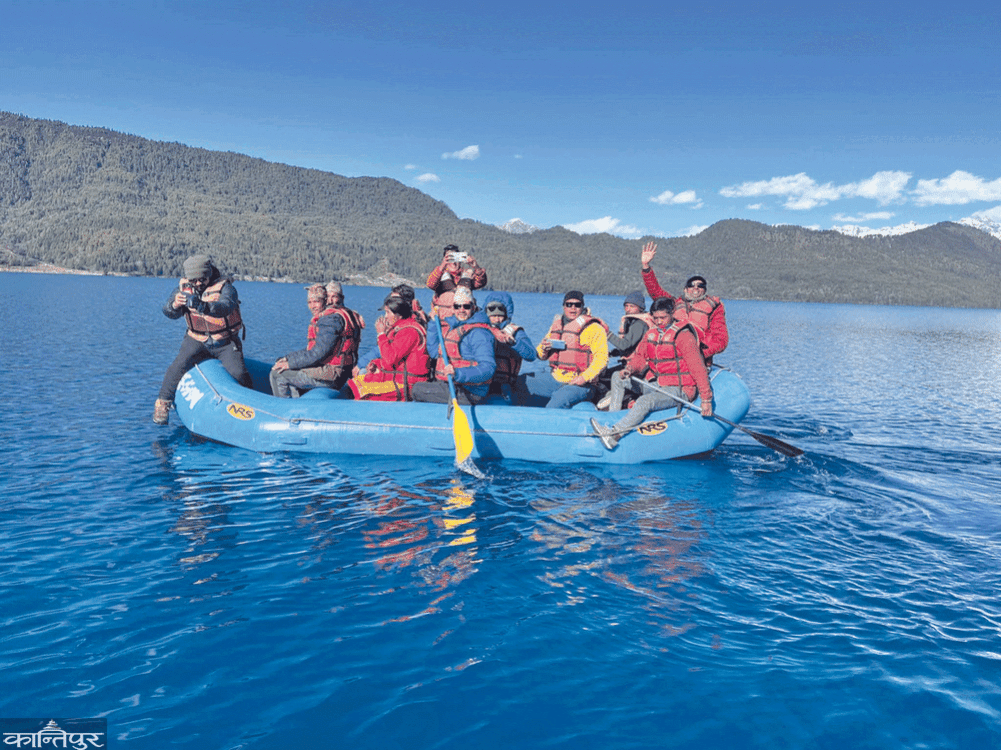
With the increase in investment in the hotel business, the increase in the consumption of local products, the trend of youth employment also increased
We use Google Cloud Translation Services. Google requires we provide the following disclaimer relating to use of this service:
This service may contain translations powered by Google. Google disclaims all warranties related to the translations, expressed or implied, including any warranties of accuracy, reliability, and any implied warranties of merchantability, fitness for a particular purpose, and noninfringement.
Senior eye surgeon Dr. who reached Dolpa some time ago. Sanduk Ruit was amazed at the potential of tourism. He led the camp to check the eyes of Dolpali and told the local people how to develop the She-Foksundo area as a 'UNESCO Heritage Site'.
"The state should take the initiative to submit it to the UNESCO heritage by giving ownership and rights to the locals," he said, "Dolpa is a place where both bon and wisdom are mixed." Animals found in rare places in Nepal are found in Dolpa.'
Dr. According to Ruit, Dolpa is a supernatural natural object that can be seen with the eyes, thought with the mind, heard with the ears, and breathed with the nose. 'Turquoise color' can be seen in Phoksundo. For this, the Ministry of Tourism should show interest and take the proposal to UNESCO Heritage, he says. Shey-Foksundo rural municipality has also started some efforts for this. Village Chairman Tora Samduk Gurung said that they are coordinating with the Department of Archeology to put She-Foksundo in the world map.
Hundreds of tourists arrive in Dolpa, a difficult high Himalayan district, for work or sightseeing purposes. They are fascinated by the tourism, mountain lifestyle, culture there. The Ministry of Industry, Tourism, Forestry and Environment of the province has said that 1,822 Nepalis, 20 from SAARC countries and 323 foreign tourists from outside SAARC have visited Dolpa in the current financial year alone.
16 thousand 414 tourists have entered Dolpa since 2076/77. A large amount of royalty has also been collected from this. Despite being geographically remote, Mugu and Dolpa come from abroad to see Rara Lake and She-Foksundo, Tripurasundari Temple.
17,297 Nepalese and 323 foreign tourists have visited Rara Lake, located within the Rara National Park, so far this fiscal year. There are many people who know Rara as a synonym of Karnali. Rara Lake is reached through Gamgarhi, the headquarters of Mugu, by road and air transport. Due to the development of transport network, the number of tourists in Rara is increasing every year. The number of tourists visiting Rara and She-Foksundo is increasing.
Hindu devotees reach the Limy Lapcha area of Humla to visit Mansarovar, a religious site located in the Tibet region. Due to Mansarovar, there has been increased activity in Simkot, the headquarters of Humla. Those who cannot easily go to Tibet visit Kailash from Limy Lapcha in Humla. Since 2079, about 2500 foreign tourists have reached Humla to visit Kailash.
Chief District Officer of Humla Narayan Pandey says that there will be an influx of foreign tourists by emphasizing on tourism infrastructure to visit Kailash Mansaror. "Government should take initiative to create an environment to reach Humla from Surkhet and reach Mansarovar," he says, "Even if the road here is connected to the central road network, it has not been reached yet." From the state capital Surkhet to Kuvinde Dah in Salyan, Panchkoshi shrine in Dailekh and Jumla-Sinja, the number of tourists is increasing. Local tourism businessmen say that behind the increase in the number of tourists coming to Panchkoshi this year, there is also a petroleum exploration project. Surkhet's Kankrevihar and Bubble Lake are major attractions. Kankrevihar has become orderly after the renovation.
Bubble Lake has become the choice of tourists after increasing the size of the lake and bringing motorboats into operation. According to Birendranagar municipality, about 2 lakh domestic and foreign tourists visit Kankrevihar and Bubblele every year. All district headquarters except Humla headquarters in Karnali are connected to the national road network. In Karnali, Surkhet, Dolpa, Muguko Talcha, Jumla and Simkot airports are operational. In addition to the road, the Himalayan district can also be reached by air from Nepalgunj and Surkhet.
The tourist spots of Birendranagar become the prime choice of those who come to the state capital for various purposes. Here Shaheed Park, Ghantaghar, Deutibajyai, Gadhi are the main tourist destinations. Kotgarhi, Belaspur Temple, Panchadeval, Shirasthan, Navisthan, Kotila, Dhuleshwar, Paduka are the main tourist spots of Dailekh headquarters passing through Surkhet. With the help of the Chinese government, the Department of Mines and Geosciences has launched a petroleum exploration project in Dailekh Jaljale, and tourism has increased in the Panchkoshi area of Dailekh.
'After federalism, Dailekh headquarters started to become deserted, after the petroleum exploration project came into operation, the number of domestic tourists who come to see the project is also high,' says Basana Thapa, owner of Hotel Park Inn at Dailekh headquarters, 'This has increased business activity, this place has become a new destination. has reached.'
Sinja Valley is becoming the main choice of tourists reaching Jumla via Kalikot on the Karnali Highway. This area, which is the birthplace of the Nepali language, is famous as the birthplace of the Khasarya community. Many Nepali speakers come to Sinja to see their ancestral land. Niraj Shrestha, information officer of the Ministry of Industry, Tourism, Forest and Environment of the province said that the number of internal and external tourists is increasing due to the promotion and development of tourist destinations.
Ministry of Tourism of the state Kuvinde Dah in Salyan, She-Fosundo National Park in Dolpa, Tripurasundari Religious Tourism Area, Sinja Civilization in Jumla, Dudul Stupa, Limi Valley in Humla, Mugu Raratal, Pachal Falls in Calikot, Jajarkot Palace, Panchkoshi Tourism Area in Dailekh, Kotagadi Surkhetko bubble lake, Along with classifying Kankrevihar, Gadhi and Gotamekot in Rukum West, Chitripatan adventure trail as main tourist spots, tourism infrastructure plans are being implemented.
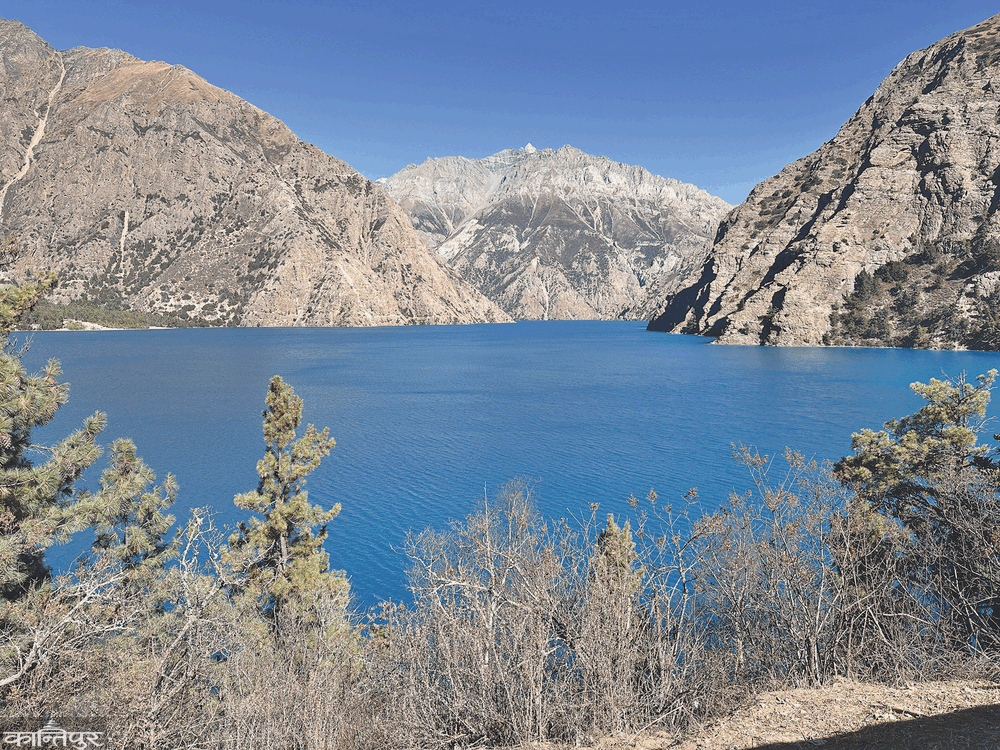
According to the ministry, 60 percent of the tourists who come to Karnali come for holidays or leisure, while 16 percent come for religious visits. From the point of view of Bon, Buddhism and Khasa (Hindu) religion, the historical and archeological subject is considered important for tourism in Karnali region. Of the nine Buddhist circuits in Nepal, two were chosen from the Karnali region.
The two circuits connecting the Buddhist and Bon shrines are the Kailash Jano Mani Padme Hoon circuit (connecting Lumbini to Kailash via Kankrevihar, Dullu, Sinja), the Dolpo Buddhist and Bon heritage circuits. Karnali region is also known as a scenic area for Buddhist, Bon and Khasa religious practitioners.
Increasing investment in hotel business
Due to the development of tourism in Karnali, investment is increasing from tea shops to star hotels. Opening of large and medium-sized hotels is increasing in Birendranagar. IME Group is building a hotel structure with an investment of 1 billion 10 million in collaboration with non-resident Nepali in Murmattop of Rara. Hotels are also being opened around the Karnali highway.
Pauwa, Valleyview has also expanded its branch in Jumla. With the opening of new hotels, the local youth have got employment opportunities. According to Padma Bahadur Shahi, president of the State Federation of Industries and Commerce, Tourism is a sector that gives quick returns after the production of Raithane crops and provides support to the economy with the creation of fast jobs in Karnali. President Shahi says that although there is great potential in the field of tourism, the necessary infrastructure has not been built.
``If Karnali can be made economically viable, it is necessary to build tourism infrastructure,'' he said. Big revenue can be collected from here. There are big hotels like Siddharth, Shubh, Valleyview, Namaste Nepal, Dinamaste and dozens of high-class restaurants have opened in Surkhet.
It is the claim of hoteliers that the consumption of local products will increase and the youth will get jobs in their own backyards. Locals say that the expansion of the road network and the various activities of tourism promotion in Karnali have increased the activity and business has spread.
Till November 2081/82, royalties of Rs. She-Foksundo National Park has set a ticket fee of 100 rupees for Nepali tourists and 1500 rupees for foreigners.
Although geographically difficult and difficult, a large number of tourists come to Dolpa every year to observe the Himalayan footpath and the She-Foksundo lake. According to the statistics of the Ministry of Industry, Tourism, Forest and Environment of the province, 68 lakh 64 thousand amount has been collected from 2076/77 till now. During this period, 16 thousand 414 tourists have entered.
According to the ministry, 13 million 27 thousand 400 royalties were collected from 78 thousand 944 tourists in Rara since 2076/77. Puspakeshar Khanal, the internal auditor of the revenue branch of Birendranagar Municipality said that since 2076, Rs.
According to Khanal, revenue from tourist spots has become the main source of income for the city. But the collected revenue is collected and used by the related local level and federal agencies. The state government has not yet been able to collect revenue from the tourist sites within the state. Economic Affairs and Planning Minister of Karnali Province Rajeev Vikram Shah says that the revenue collected from the tourism sector has not been utilized by the state government. "Now the revenue raised has gone to the name of the local and federal governments," he says, "the province has not been able to benefit from the revenue raised from the tourism sector."
Shah said that even though the local level of production and employment of the youth is linked to the hotel and tourism business, the provincial government is not getting direct benefits from it. The local level collects the income from the tourist areas managed by the local level and the federal government collects the income from the tourist areas operated within the park. The revenue collected from the Rara and She-Foxendo National Parks in Karnali is deposited with the federal government.