We use Google Cloud Translation Services. Google requires we provide the following disclaimer relating to use of this service:
This service may contain translations powered by Google. Google disclaims all warranties related to the translations, expressed or implied, including any warranties of accuracy, reliability, and any implied warranties of merchantability, fitness for a particular purpose, and noninfringement.
Due to the Birgunj customs targeted sit-in during the Madhes movement and the Indian undeclared blockade, there was a huge contraction in imports from the two customs points of Birgunj. The import through the two customs points here was reduced by around 35 percent in the year 2072/73.
According to the data of the Customs Department for the fiscal year 2072/73, a total of seven billion 74 billion 71 billion worth of goods and goods were imported into Nepal.
Due to the Madhes movement that lasted from October to January and the undeclared blockade, the share of Birganj customs office in the total import was 23.50 percent and the share of another dry port customs office here was 12.23 percent. With the closure of the checkpoint due to the
movement, not only the imports from here decreased, the imports from here also shifted to the Bhairahawa Customs Office. In the same year, 24.07 of the total imports from Bhairahawa Customs Office, i.e. 1 trillion 86 billion 48 million worth of goods and goods were imported.
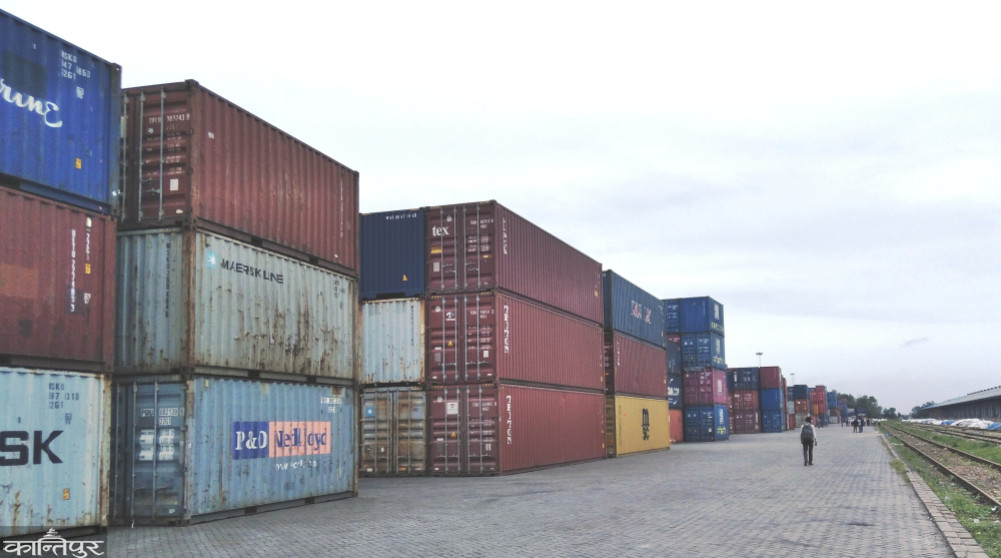
Nine years after the promulgation of the constitution, the total import goods coming through the Birgunj customs office have again seen the same boom as before. Currently, about 50 percent of the total imports are being imported from the two big customs points of Birganj.
Madhes movement and embargo brought down the imports from Birgunj customs and dry port customs in the fiscal year 2080/81, out of the total import of 15 trillion 92 billion eight crores, the contribution of Birgunj customs is 34.30 percent and the contribution of dry port is 12.78. The contribution of Bhairahawa Customs Office to the total import is 15.23 percent.
Hari Gautam, the senior vice president of the Birgunj Chamber of Commerce and Industry, said that after the Madhes movement and the undeclared blockade that occurred after the promulgation of the constitution, even though imports have returned to their old rhythm, there has been no improvement in industry and business.
'Due to infrastructure such as a well-equipped dry port and integrated check post in Birgunj, imports from here have returned to their old condition,' he said, 'Industrialists, businessmen and markets who were displaced due to the movement after the promulgation of the constitution have not yet returned.'
Senior Vice President Gautam Madhes also complains that after the Madhes movement, industries concentrated in Birgunj are slowly moving towards Bara and Hetauda. "It seems that the import of vehicles from Birganj Customs Office has shifted to Bhairahawa Customs Office," he said, "Political stability and industry-friendly environment will also have a great meaning."
Chief Customs Officer of Birgunj Customs Office Rajendra Dhungana said that more than one-third of the total imports, Birgunj Customs Office They say that it will happen. "Out of the total import, the contribution of the import from Birgunj seems to be satisfactory," he said.
According to him, mainly petroleum products, industrial raw materials and vehicles are imported through the Birgunj Customs Office. According to the data of the customs department, there has been a significant improvement in imports from both the customs offices of Birganj since the financial year 2073/74.
In that fiscal year, the contribution of Birganj Customs Office was 34.12 percent out of 9.84 billion 300 million imports, while that of Sukkha Port Office was 11.76 percent. In the same fiscal year, Bhairahawa customs was 18.55 percent.
Similarly, in the financial year 2074/75, it seems that goods worth 12 trillion 45 billion 10 million were imported into Nepal. In this, the share of Birgunj Customs and Dry Port was 33.89 and 10.49 percent respectively. In which the contribution of Bhairahawa Customs was 17.99 percent. According to the
department, in the financial year 2075/76, goods and materials worth Rs 14 trillion 18 billion 53 were imported from foreign countries. In which the contribution of Birgunj customs was 34.73 percent, the contribution of Bhairawa customs was 16.92 percent and the contribution of dry port was 10.92 percent.
Since the first week of March 2076, due to the ban imposed to control the epidemic of Covid-19, there has been a contraction in the overall import across the country compared to the previous year. In that financial year, goods and goods worth 11 trillion 96 billion 79 million were imported into Nepal.
Out of the total imports, 34.37 percent passed through the Birgunj customs checkpoint. Similarly, it is seen that 13.84 percent was imported through dry port and 16.61 percent through Bhairahawa.
Due to the epidemic of covid-19, imported goods and materials worth Rs.
Out of the total imports, one third i.e. 33.23 percent passed through the Birgunj customs post. It is seen that 12.30 percent of the total import goes through the dry port and 18.29 percent of the total import goes through the Bhairahawa customs point.
With the reduction of the impact and impact of Covid-19, in the financial year 2078/79, imports equal to 19 trillion 20 billion 44 million 83 lakh 49 thousand. In which 36.78 percent i.e. 7 billion 3879 million 67 thousand worth of import was done through Birgunj customs office.
Likewise, 11.35 percent of the total imports through the dry port ie Two billion 17 billion 98 billion 34 lakh 30 thousand were imported. Similarly, 15.40 percent of the total import was imported from Bhairahawa Customs Office, which is equal to two billion 95 billion 67 million 10 lakh 51 thousand. According to the data of the
department, the total import was 16 trillion 11 billion 73 million 17 lakh 70 thousand in the financial year 2079/80. Of the total imports, 36.82 percent passed through Birgunj customs. Similarly, it is seen that 12.55 percent of the total imports were imported through the dry port customs office and 15.19 percent of the total imports were imported through the Bhairahawa customs office.
Kumar Temani, President of Madhes Province, Nepal Chamber of Commerce and Industry, said that due to the policies adopted by the government after the Covid-19 epidemic, the industry and business sector has not yet returned to business. "After the covid-19, the policy introduced by the National Bank caused huge problems in the economy," he said.
Birgunj Chamber of Commerce Senior Vice President Gautam also complains that even after the end of the Covid-19 epidemic, the industry is barely running at around 30 to 40 percent. 'After the epidemic of covid-19, large industries are producing only 30 to 40 percent,' he said, 'Industries/factories are also facing problems in meeting expenses. After covid-19, only a negligible amount of industries have been added in Bara-Parsa.'