We use Google Cloud Translation Services. Google requires we provide the following disclaimer relating to use of this service:
This service may contain translations powered by Google. Google disclaims all warranties related to the translations, expressed or implied, including any warranties of accuracy, reliability, and any implied warranties of merchantability, fitness for a particular purpose, and noninfringement.
Rani Kumari Tiwari, Minister of Education of Madhesh Province, has been complaining that the budget of her ministry is only 6 percent, even though problems such as poverty, unemployment, and health are connected with education. He also has another complaint, "Employees do not show interest in spending the allocated budget to improve the quality of education and create a conducive environment." Instead, they are encouraged to spend the budget placed on the infrastructure of education.
In the current fiscal year 081/082, only 2.90 billion rupees have been allocated to the Ministry of Education out of the total budget of 43.89 billion rupees of Madhesh province government. This is only 6 percent of the total budget of Madhesh province. Among all the seven provinces, Madhesh province's literacy situation is the worst.
In Madhesh province, where only 64 percent are literate, the literacy status of women is very low compared to men . Among the literates, 72 percent are men and only 55 percent are women . The most literate district in Madhesh province is Parsa and the least literate district is Rautahat. The government of Madhesh province has rushed to declare a fully literate province . However, no attention is paid to increasing the literacy rate.
Before the first Madhesh movement (around the year 060), Madhesh was the fertile ground of education. 'Sah, Yadav and Karn Sir' who taught in the mountains of the country belonged to Madhesh . Lately, Madhesh province has not only become a source of manpower for the Gulf countries, but they are also forced to educate children in Kathmandu, Biratnagar, Sindhuli and Hetaunda.
"When I was teaching at Rarao Campus in Janakpur, students from 54 districts were studying," former Vice Chairman of Policy and Planning Commission of Madhesh Province. Bhogendra Jha told Kantipur, 'Now the students here are forced to study after reaching Sindhuli.' According to Jha, the government has become insensitive to education.
``In the financial year 079/80, 2 billion rupees were allocated to improve the education of Dalit and underprivileged children . When I was the vice-chairman of the commission, I had advised the then Chief Minister Lal Babu Raut,'' Jha said, 'There was a plan to send money directly to the accounts of the parents of Dalit and poor students going to school . But, that plan was not implemented.'
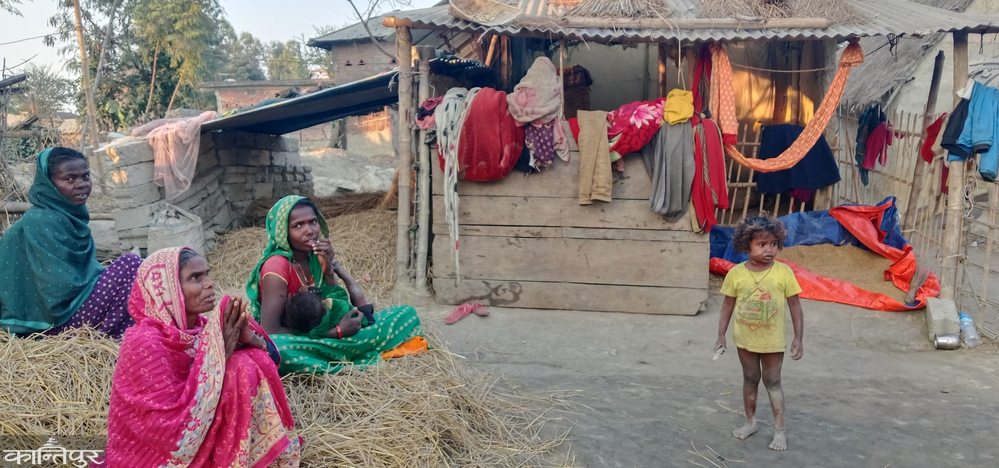 Lahan municipality-22 House of Musahar community in Jahdi (Saday) settlement. Photos: Ajit/Kantipur
Deputy Chairman of Policy and Planning Commission of Madhesh Province. Sohan Sah claims that education in Terai-Madhesh has become problematic since the restoration of democracy (048 years). According to the data given by Sah, in the census of 2048, only one of the districts of Terai-Madhesh was less literate. In the census of 058, 4 districts of Terai-Madhesh became less literate.
According to the calculation of 068, 9 districts are less literate and according to the calculation of 078, 7 districts of Madhesh province are classified as less literate . "I don't believe that the state government has not been working since the government came," said the vice-chairman of the commission, "501 schools in 13 municipalities of Madhesh have been improved". The state government has invested in school infrastructure during the 7-year period.'
Madhesh province is at the bottom of the seven provinces in the human development index. The human index of Madhesh Pradesh is only 0.51 percent. Madhesh province is only 0.929 percent in gender development index. It is also the last compared to other provinces. In terms of gender inequality, Madhesh province is the third highest province with 0.503 percent. After Madhesh, there are Karnali and Sudurpaschim provinces .
In Madhesh province, which is going through a miserable situation in education, the condition of health is also critical. It seems that 2,361 women in the age group of 15 to 49 years have died in Madhesh province. 67.9 percent of women die during childbirth. 27.6 percent of women died during pregnancy and 4.5 percent during child delivery.
In Madhesh province, the number of children who have not reached their height according to their age is 687. The number of children who are underweight for height is included in this . The number of underweight children is 691. The rate of mild and moderate anemia in children is highest in Madhesh province.
Half of the samples taken in Madhesh province, 50.6 percent, i.e. 619 people, were found to be anemic. The rate of stillbirth and death of newborn babies is also high in Madhesh province. Madhesh province has the highest stillbirth rate of 29.2 percent and infant mortality rate of 30.6 percent.
According to the economic survey of the current fiscal year 081/082 of Madhesh Province government, the death rate of children under 5 years of age is also high in Madhesh Province. 43 children die per thousand live births. Even though Madhesh Province is at the bottom of the two pillars of human development, education and health, it seems that not enough work has been done to improve them.
Although there has been some improvement in health indicators compared to the past, the situation is still bad, said Sah, the vice president of the commission. "However, we are in the process of improvement," he said, "the health sector has 20 percent of the budget this year." It is a challenge to bring the Dalit, poor, Muslim community into the mainstream.'
Sah said that the provincial government is preparing to bring both equity policy and education policy together to strengthen the overall index of Madhesh province. Sah informed that there are different problems in Madhesh province in every age group.
'There is a problem of nutrition in Muslims, Dalits and marginalized communities,' said the vice president of the commission, 'There is a problem of malnutrition in the age group of 6 to 14 years, while there is a problem of children over 15 years of going to school but dropping out in the middle.' For the 15 to 19 age group, it is scary. According to Sah, in this age group, there is a greater risk of child marriage of teenagers and teenagers going to work abroad or falling into the family.
The poverty gap is also deep in Madhesh province. In Nepal, 17.4 percent about 49 lakh 80 thousand people are below the poverty line . The highest poverty in Nepal is about 12 lakh 96 thousand people living in Madhesh province. In terms of percentage, 24.2 percent of the population of Madhesh province is below the poverty line. Which is less than Karnali (39.5∞) and Sudurpaschim Pradesh (25.3∞).
In the economic survey released for the first time by the government of Madhesh province in the financial year 079/080, the intensity of poverty (a measure of how far one is from the poverty line) is the highest in Madhesh province at 43.3 percent . Here, there is an improvement in the situation where one out of every two people is poor.
Although there has been an improvement in the situation of poverty, which was at the bottom until 2014, the decreasing order of poverty is more in Madhesh than in Karnali and Sudurpaschim. Madhesh province has a poverty rate of 24.96 percent in rural areas and 21.71 percent in urban areas.
'The intensity of poverty in Madhesh Province is 45.3 percent in 2014 and 43.9 percent in 2019,' said the first economic survey of Madhesh Province Government, 'In Madhesh, there were 2.6 million 59 thousand poor people in 2014, that in 2019 The number has decreased to 11 lakh 67 thousand . However, although the number of poor people has decreased in Madhesh province, the number of poor people is the highest here.'
Dalit population is about 19 percent in Madhesh province. The population of Muslim community is 12.50 percent . The problem of Dalit and Muslim community is the same. The population of these two communities with extreme poverty, illiteracy and deprived of the main stream of the state is the highest in Madhesh province . According to Jha, the former chairman of the commission who is also an analyst, the social index of Madhesh province will remain weak unless the policies and programs to uplift the Dalit and Muslim communities, who occupy about 32 percent of the population, are prioritized.
"Making the Chief Minister a Muslim will not benefit that community," Jha said, "The Dalit and Muslim communities, who are far away from poverty, unemployment, illiteracy and health services, must be brought into the mainstream." To strengthen the overall situation of Madhesh province, work should be started from this weak link. Which does not seem to be a priority of Madhesh province government.'
The unemployment situation is also terrible in Madhesh province. 6 districts of Madhesh are among the 10 districts that take the most labor permits in Nepal. During the last three years, maximum labor approval has been taken from Dhanusha. The unemployment rate of Madhesh province is almost 20.1 percent. Out of the seven provinces, Madhesh has 33.1 percent unemployed in the age group of 15-24 years. Similarly, 18.9 percent are unemployed in the age group of 25-39. 14.9 percent in 40-59 years and 11.2 percent of those over 60 are unemployed .
About 50 percent of the 19 lakh 87 thousand workers in Madhesh province are illiterate. The main destinations for foreign employment from Madhesh province are the Gulf countries and Malaysia. In terms of going to and returning to foreign employment, Madhesh province has the highest number.
During the last two years, 65 thousand 925 people have returned to Madhesh province from foreign employment. Madhesh province has not benefited much from the Prime Minister's employment program. The beneficiaries of this program are relatively few in Madhesh. Out of the 136 local levels of Madhesh, the Prime Minister's Employment Program is being implemented in 111 municipalities.
3 governments were formed in Madhesh province in 7 years. The party led by Upendra Yadav, who emerged from the Madhesh movement demanding federalism, held the reins of government in Madhesh province for 6 years and 5 months. Dr. who emerged as a new force in Madhesh from the last general election. CK Raut's Janmat Party has been in government in Madhesh for 7 months. Even though the parties of Yadav and Raut came to power on the strength of the movement saying that the poor, disadvantaged, Dalit, Muslim and Madhesi communities were discriminated against, the state government under the command of those parties does not seem to be doing enough for these communities. 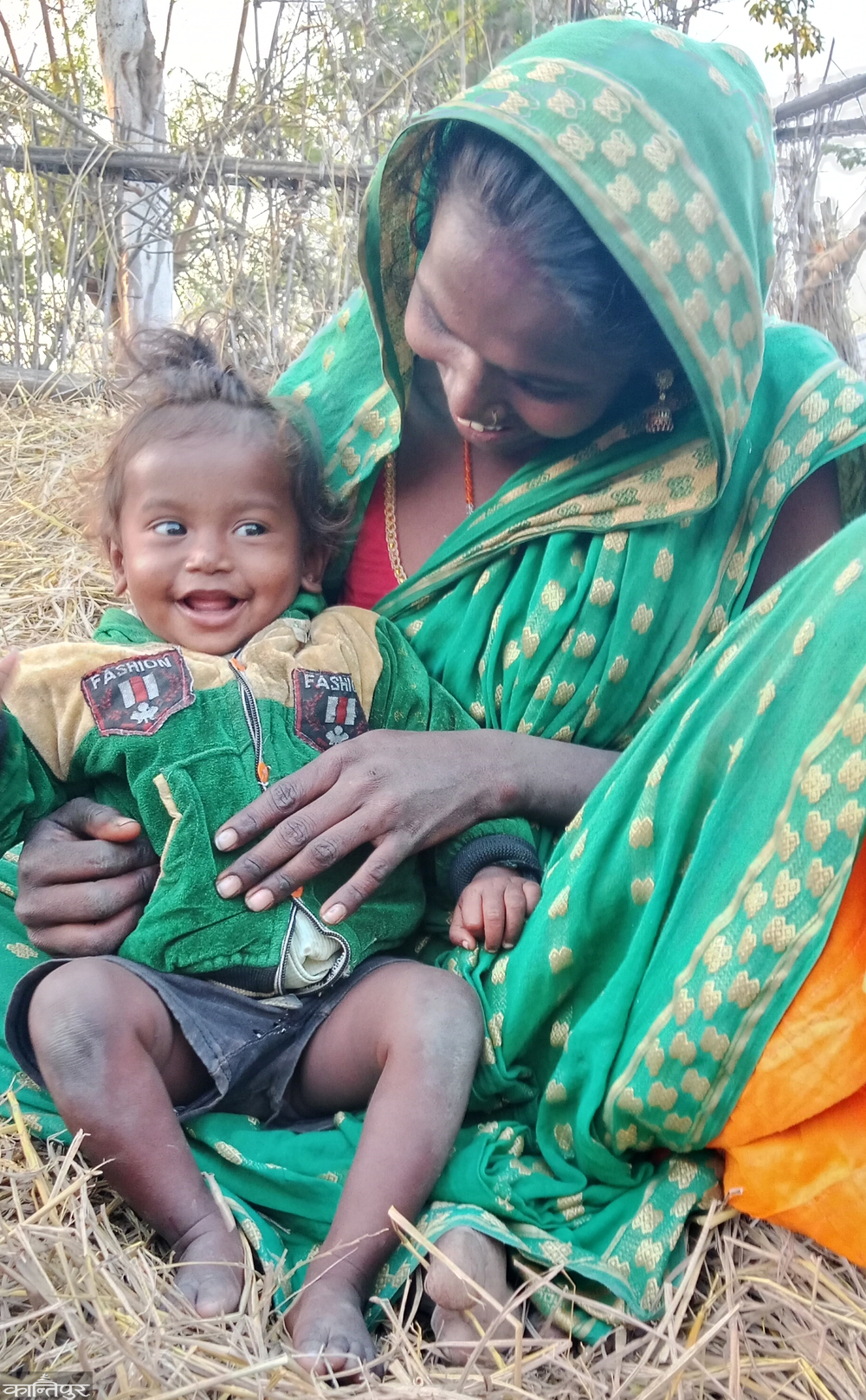 A mother from Musahar community enjoying with her child in Lahan Municipality-22 Jahdi (Saday) settlement of Siraha.
Chandrakishore, an expert on Madhesh affairs, sees two reasons for the provincial government not being effective. First: It was made so that it would not be effective when the provincial structure was created and second: The provincial government will continue the distributive budget without looking at its priorities.
'Most of the laws have not been made by the union. The province was created. However, the infrastructure, staff, structure and budget were not given enough," said analyst Chandra Kishore, "the legal way to coordinate and cooperate with the local level is not open. So the index does not seem to have improved . The provincial government also did not understand its opportunity.
Another analyst, Bhogendra Jha, says that even though Madhesh is the foundation of federalism, the leaders here have not embraced federalism. Although the government of Chief Minister Satish Kumar Singh has adopted the policy of doing development works through tenders in the financial year 081/082, under the pressure of the alliance party, it is bringing a resolution proposal to start the work through the consumer committee . "Government is not serious about bringing programs targeted at the poor and underprivileged," Jha said.