Those who own the land do not know the extent of their land, but those who are plowing the land do not have real estate and ownership.
We use Google Cloud Translation Services. Google requires we provide the following disclaimer relating to use of this service:
This service may contain translations powered by Google. Google disclaims all warranties related to the translations, expressed or implied, including any warranties of accuracy, reliability, and any implied warranties of merchantability, fitness for a particular purpose, and noninfringement.
Kalika bazaar is scattered on the roadside - the white leaves of the queen of the night flowers. Its fragrance is pungent and amazing. Lalupa and syapatiri are also blooming, but they are withered due to the cold weather of Pus.
Flowers and colors are supposed to bring spring to the hearts of the villagers, but there is a feeling that the fragrance has never come to their hearts.
The water that flowed in Trishuli and Betraganga did not return that way . Mohi's tears from Kalika, Dhaibung, Laharepauwa and Bhorle villages on that river continue to return the same way .
Due to the uneven distribution of land, the life of some farmers in Rasuwa is always marginal. Due to land ownership, livelihood and power-relationships are at the bottom of the society, which also determines their socio-economic status . Like: Due to Birta problem, some farmers of Rasuwa, Nuwakot are living a difficult life .
A study by District Land Rights Forum Rasuwa-Nuwakot says that 718 families in Rasuwa and 1558 families in Nuwakot are still plowing land. About 4 thousand 957 ropani in Nuwakot and 2 thousand 389 ropani in Rasuwa are under land acquisition.
According to agronomist Jagat Deuja, out of the land cultivated by the farmers and their children who have made Bhirpakha arable, after the abolition of Birta, some fields and fields have been registered in the name of the farmers, but the cultivated land and fields are being registered and distributed by Birtawal alone. .
The farmers of Birta land are cultivating the land, but they do not have the share of the land owner . The farmers who are plowing the land are willing to pay the land tax, but they have not been able to pay . Landlord has also not paid tiro . Due to this, the revenue of the state is also affected.
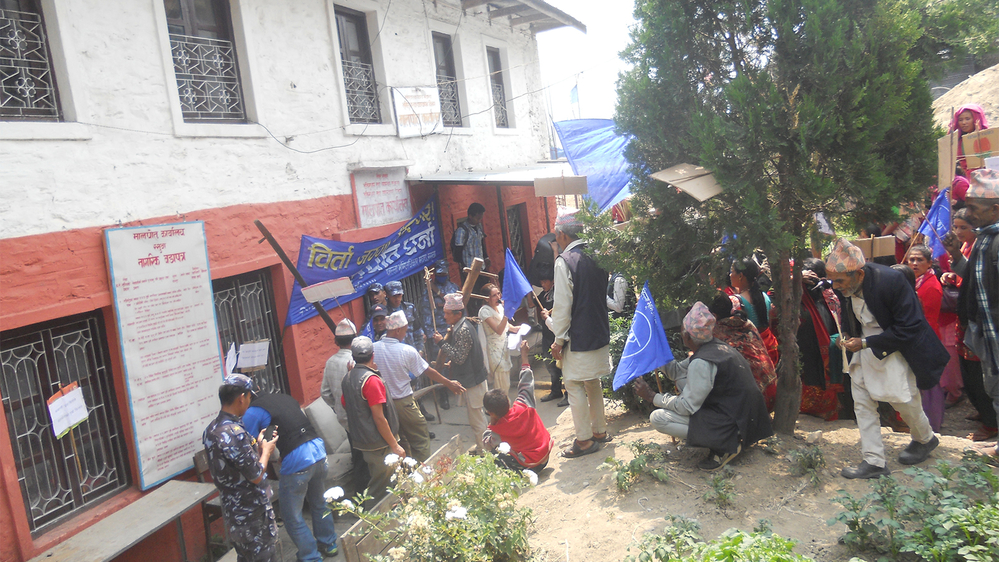
Farmers' long efforts to register the land that their forefathers have been plowing for centuries have not been successful. However, after a very long movement, in 2067, 500 families of Rasuwa were successful in registering the Birta land with Raker. At that time, Dumbar Shrestha was the land reform minister. However, the rest of the farmers have to plow the land immediately. Geologist Deuja says, 'This is a black mark of democracy.' However, the cultivators were not given correct information about the land. Even those who get the information were not allowed to write their names saying 'I am the landlord'.
The family of Ramchandra Thapa Magar of Uttar Gaya-5, Pareveshi Rasuwa is dependent on Birta land. Ramachandra is 34 years old, who does agriculture but on the land of Birta. His ancestors have been oppressed for hundreds of years. He thinks that he has always walked the path of suffering in life. His suffering never ended . First the house was destroyed by the earthquake, then a new one was built. The landslide on July 22, 2074 also washed away that house. Along with the house, 4 people including his father, sister-in-law, nephew and one who works in the house were swept away by the landslide. All died . Due to the pain of the landslide, the farmers of Parebesh are drowning in tears.
Ramchandra went abroad after studying till 12th standard. He was 19 years old at that time . After working in Malaysia for 10 years, he returned to the country, thinking, "Let's stay here and do farming". However, all his land is either private or public property. That land will be shared among his 5 brothers .
Landslide washed away two houses built with Malaysian earnings. Earnings are all in the soil . 'When the land is still available, farmers like us have a lot of problems,' says Ramchandra, 'We wanted to stay in the village and do something, but when we see that we don't have land in our name and we have to struggle for it, it is starting to feel like we should not stay here, we should move abroad.' ;
In the name of his late father, there is 30 ropani land, all of it belongs to Birta . Landslides happen every year in that land. "He built a house with a loan, but that too is swept away by a landslide," he says. We are also in a dilemma to cultivate . Now Birtawala's agents (brokers) have also come and started causing a lot of trouble . Therefore, we have started to think that we should not do farming now.'
``There is a lot of trouble for farmers like us when the land is still available,'' he said to stay in the village and do something.
- Ramchandra Thapa He told me that when he was busy with work in the third week of November, the land was not in his name and he could not even cultivate it confidently.' And beautiful family . He was still thinking about the memory of that night that was destroyed by the landslide . Remembering his father and grandfather, Ramchandra was saying, "Our ancestors struggled a lot to get a portion of the land, but they could not get the red portion". Our forefathers achieved success by dreaming of owning the land they plowed themselves.'
Uttar Gaya-5, Shyamaya Ghaleni of Pareveshi Rasuwa is also suffering. Birta is in a lot of trouble because of her . Pareveshi's entire village and household land is Ailani, while cultivated land is all Birta . Those farmers of Pare village have been cheated by nature, Birtawal and the government too . Shyamaya said, "We should get the ownership of the land that we have been cultivating and earning a living for hundreds of years."
It has been 20 years since we have been protesting that we need red parts of the land we mined. But, we farmers, unfortunately, the government did not listen. We are saddened by this," Shyamaya says, "We are worried about whether we should give half to the owner of the land we mined. We are like squatters. We who farm, we who dig the spade, we who plow the plough, but another Birtawal who lives with red parts ?'
After the 2074 landslide washed away their houses and farms, they are working hard to re-cultivate the fields that have turned into wasteland.
The desire of the farmers here to have the land cultivated for generations in their own name has always been limited to a dream . The farmers are also upset that applying to the district revenue office and waiting is a failed attempt. Birtawal has registered how much land in his own name without informing the tenant.
000
The story of Tankal Bahadur Nagarkoti of Rasuwa's Kalika Rural Municipality-2 Kavre is different. The land cultivated by him is from the time of his ancestors. They took great pains and made that dry land a paddy field (gahra) . Continued farming, but they had no right to it. Couldn't say it was theirs since there were no parts. The victims together started the movement through Bhoomi Adhikar Mancha. However, the land owner made his own part of that land, which he did not know . After the movement, in 2066, the government released the Birta notice . And, he also filed an application in Malpot to 'get land'. At that time, he found out that Lalpurja Birtawal has taken over his land. However, they could not come to the village. After the
, Kaisang Tamang, who has an accounting business in Malpot, has sold Rasuwa Haku Gogane to Chheku Lama, through Birtawal . Tankal Bahadur thinks that Malpot and Rekhandas did it together. Cheku came saying 'I am the man who buys the land', showing Lalpurja in his name . His house, 15 ropani fields and 19 ropani fields growing rice are in the same area. He thinks, the middleman trapped . When Chheku came to measure the land, the villagers resisted together . Later, Chheku sold 2 ropani land to another person from Nuwakot . Tankal has submitted an application to the Judicial Committee of Kalika Rural Municipality to 'use the land he plowed'. "My father passed away saying that he would get a portion of this land," he said, "What kind of era is this?" What is the law? One's land can be bought and sold by another! Our father's property, the land made by our suffering should be returned to us free of charge.'
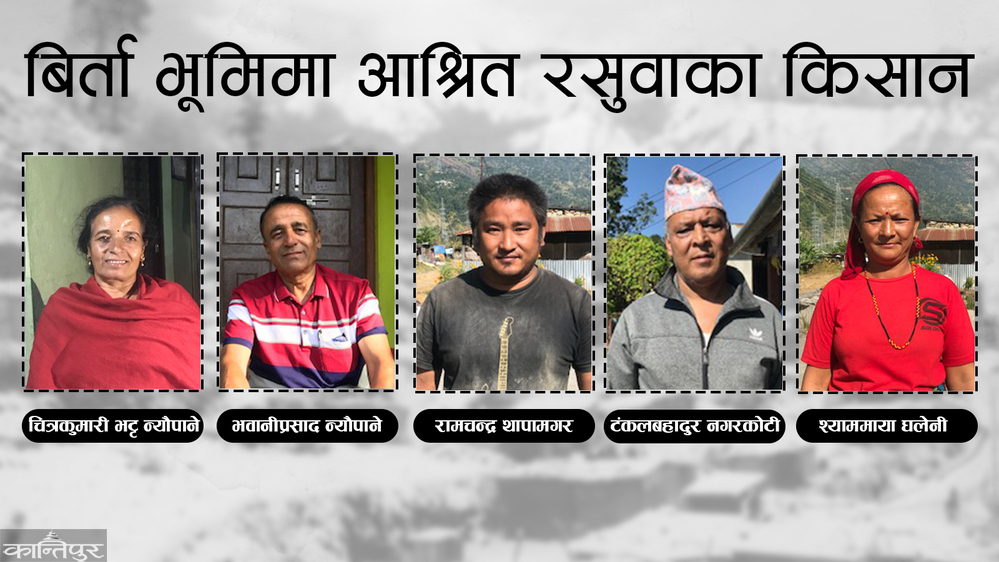
There are many stories in Rasuwa that the land plowed by the farmer was plowed by Birtawal without his knowledge. Land expert Deuja says, 'In this way, there is a danger that a large number of farmers will become squatters.' As far as he could remember, in the year 2036, government people came to measure the land . However, his father's land was not measured. He found out the reason - the land was not measured because the fathers did not pay the tiller. 5 muri of paddy per year should be paid from his house alone.
He went to Kathmandu to search for Birtawala's house with his father - at the house of Birtawal Homanath Upadhyay living in Mahabuddha. Until then, I didn't know what Kathmandu was like. We did not take paddy/rice there . At the rate of one rupee per person, we went to pay the money in the form of money. About 25 Muri have to be paid for 5 years.'' Many won the elections, but did not pay attention to solving the farmers' suffering. All they need is a chair.
’
– Chitrakumari Bhatt Neupane, former president, Bhoomi Adhikar Manch Rasuwa
Birtawala said, “Don’t give money, bring rice as a gift”. They went to Asan to buy rice. There was not enough money to buy 50 pieces of rice. Birtawala said "any way you want rice" and did not give a receipt to measure the land . They returned disappointed . According to Bhawani, those in power in the panchayat measured the land in their name and made a racket. Sojhasidha farmers have been asked to measure in the name of the farmer saying that they should be measured in Birta. He remembers that his family had to make big sacrifices when Birtawala came. To some extent, they had to leave the kitchen for cooking. Around the year 2038 Birtawala came to his house and sat down and wore urdi to pay kut to his uncle. Bhawani cautioned, "We will not pay you."
After that incident, he realized that farmers are being treated unfairly due to the Birta problem. And he went into rebellion . He started to warn through politics that 'the farmer does not have to pay kut'. In 2043, he was elected as a ward member during the Panchayat period, in 2049 he became the ward president, in 2054 he was elected vice president of Dhaibung gavis and in 2074 he was elected vice president of Kalika Rural Municipality.
In the year 2052, they formed a struggle committee to solve the Birta land problem. The land rights movement is still ongoing. Through that movement, about 500 families were also able to get food supplies. They say, 'We are constantly struggling to solve the remaining Birta problem.' According to
Bhawani, there are still about 1,000 families dependent on Birta land in Uttargaya, Kalika and Naukunda Rural Municipality of Rasuwa. "Some agents sent by Birtawala come and give trouble, show various temptations," says Bhavani.
History says - during the unification of Nepal, B.S. After winning the Nuwakot state in 1801, Prithvi Narayan Shah, while starting the state work, distributed the land to his then allies as farmers' land.
was . After conquering Nuwakot, thousands of ropani lands of the then Dhaibung, Laharepauwa and Bhorle VDCs of Rasuwa were set aside for the temple's source of income.
Prithvi Narayan Shah entrusted the management of about 17 thousand ropani land to Jaimangal, brother of Mukhtiar Ranganath Sharma Poudel. The land given for temple management and operation was gradually given to farmers by the children of Jayamangal's brothers-nephews to be plowed by taking 'Char Dam Theki'. And, those hardworking farmers made land for growing Bhir, Pakho, Chaur, Bagar. Even before Prithvi Narayan Shah went to Nuwakot, farmers had been living there for farming and living. Even the said land was distributed to his allies as a gift by the king's order.
At the time of the rule of the ruler, some limited class as farmers owned a large part of the farmer's land, but the farmers didn't work on that land, nor did they cultivate . However, farmers have been without ownership for 280 years.
In course of time, the ownership of that land was transferred to Jayamangal's descendants and there is still no Lalpurja in the name of the farmer who tilled the land . "There is no labor of the farmers on that land, so the ownership of the land should belong to the farmer," says author and land rights activist Biswas Nepali, "When the farmers, who have been paying bribes to the farmers for a long time, found out that they have been cheated, they stopped paying for the last 35/40 years. are struggling for .'' "Birtawal, a rich man from Kathmandu, has passed the land cultivated by Jotaha in his own name without going through the legal process."
He has small farms and fields, where livelihood does not go on without production . His family has taken a lot of pain to make that land fertile. He is very saddened that the land that he suffered in this way could not be made in his name. 12 Ropani land is distributed. Also, 5 plantation fields were swept away by the landslide . The husband and father-in-law passed away, but the red portion of the land was never theirs .
'When we got the trick of being cheated by the carrier, cheated by the state and started the movement . We sat on a sit-in at the District Malpot Office, Dhunche, for 1 week,' she says, 'the broker of the owner of the spare parts has come to the village and started causing trouble . We are in big trouble . We ran into the government many times. How many memorandums have we submitted? I thought it would happen after the local government came. We have not told anyone but we have not been able to get the parts. We called the Minister of Land Reforms here twice and expressed our pain. No one says no, but the problem is not solved either.' Many won the elections, but did not pay attention to solve the suffering of the farmers . "The only thing they need is a chair," she says in a tired voice. Neither we know Birtawala, nor they know us . Those who live as tenants have no idea where their land belongs.'
The Birta Abolition Act 2016, made during the BP Koirala-led government, was sealed on November 25 and published in the gazette on December 1. In that act, it was arranged that such land would be taxed. At that time, more than one-third of the arable land was under the jurisdiction of Birtawal.
The study shows that more Birta land is in the name of Shah-Ranas. Artist Neer Shah's mother Bodh Kumari Shah had 95 ropani land in Laharepauwa gavis. She reached Rasuwa in 2067 to pass that land in her name. Farmers did not leave the land that farmers were making a living from, later it was registered in their name . Nir Shah returned immediately.
Late Birtawal Mohanraj Aryal has 52 Ropani Birta – Paihrebesi Rasuvama . Mohanraj's son Pradeep Aryal says, "We went to Dhunche to pay the rent for our land, we also went to the rural village." The employee did not agree to take the tiro under the pressure of the magicians.'
Father's land has not come to his name. All the land will be shared among the four brothers of his father . Pradeep says, "I don't have any land in this world, if we give the remaining land to Mohi, what will we eat?" What should I do if I don't get that part or part of the land left by my grandfather?'
Rasuwa has 600 ropani Birta land in Jibjibe, Banuwa, Paihrebesi - Birtawal Senior Advocate Purnachandra Paudel . After the death of his father Pandit Gopal Prasad Paudel, Purnachandra did not take paddy and rice as a gift from Mohi. As far as he can remember, he was swept away by the flood in Trishuli in 2019. He called Mohi and told him to register the land in his own name. We have left the land to Mohi, we have not taken it. I am not thinking of going to Rasuwa and taking land,' says Purnachandra, 'I don't need Birta, I am ready to fully support them to pass the land in the name of Mohi.' ; In his opinion, Birta should be in Mohi's name. They say, 'Birta should be abolished. Dual marriage must end . The land should be in the hands of the farmer. I have not taken ownership of Mohiyani land . Plowing the land, building a house. The land should go to the hands of the farmers.'
Jagat Deuja, Krishnaraj Khanal and Gopal Giri's 'Field study report on Birta problem in Nuwakot and Rasuwa' has identified Birtawals of that area who are now living in Kathmandu . Among such Birtawals are Jagat Prakash Sharma Poudel, Gaurinath Poudel, Gunanath Neupane, Rudranath Neupane, Homanath Poudel, Bhadrakumari Poudel, Chetkumari Dhakal, Ghannath Thakur Upadhyay, Dillinath, Laxman Prasad Bhattarai, Veer Bahadur Nagarkoti, Anuprasad Poudel, Krishna Prasad Lamsal, Chandrasekhar Lamsal, Govinda Prasad Sharma Lamsal, Durga Prasad. , Tankprasad Sharma, Phanindrashamsher, Thirshamsher, Cholakumari Paudel, Dambarshamsher, Chandrashamsher, Arjun, Bhim Bahadur Thapamgar, Bodhkumari Shah, Netrarajalakshmi Shah called Jayarajalakshmi, Vasantaram Bhandari, Khemrajshamsher Rana, Gunanath Aryal, Rameshwar Paudyal, Vishnu Prasad Bhattarai, Kanakaram Bhandari, Dhruvanath Upadhyay, Kalyanath Upadhyay, Balgopal Jha, Shivprasad Bhattarai, Subarsharaj Bhattarai, Keshav Bhattarai, Wilbhadra Bhattarai, Hari Bahadur Bhattarai, Krishna Bahadur Bhattarai, Vishwambhar, Achyut Lamsal, Surendra Prasad Lamsal and Siddhibabu Aryal are .
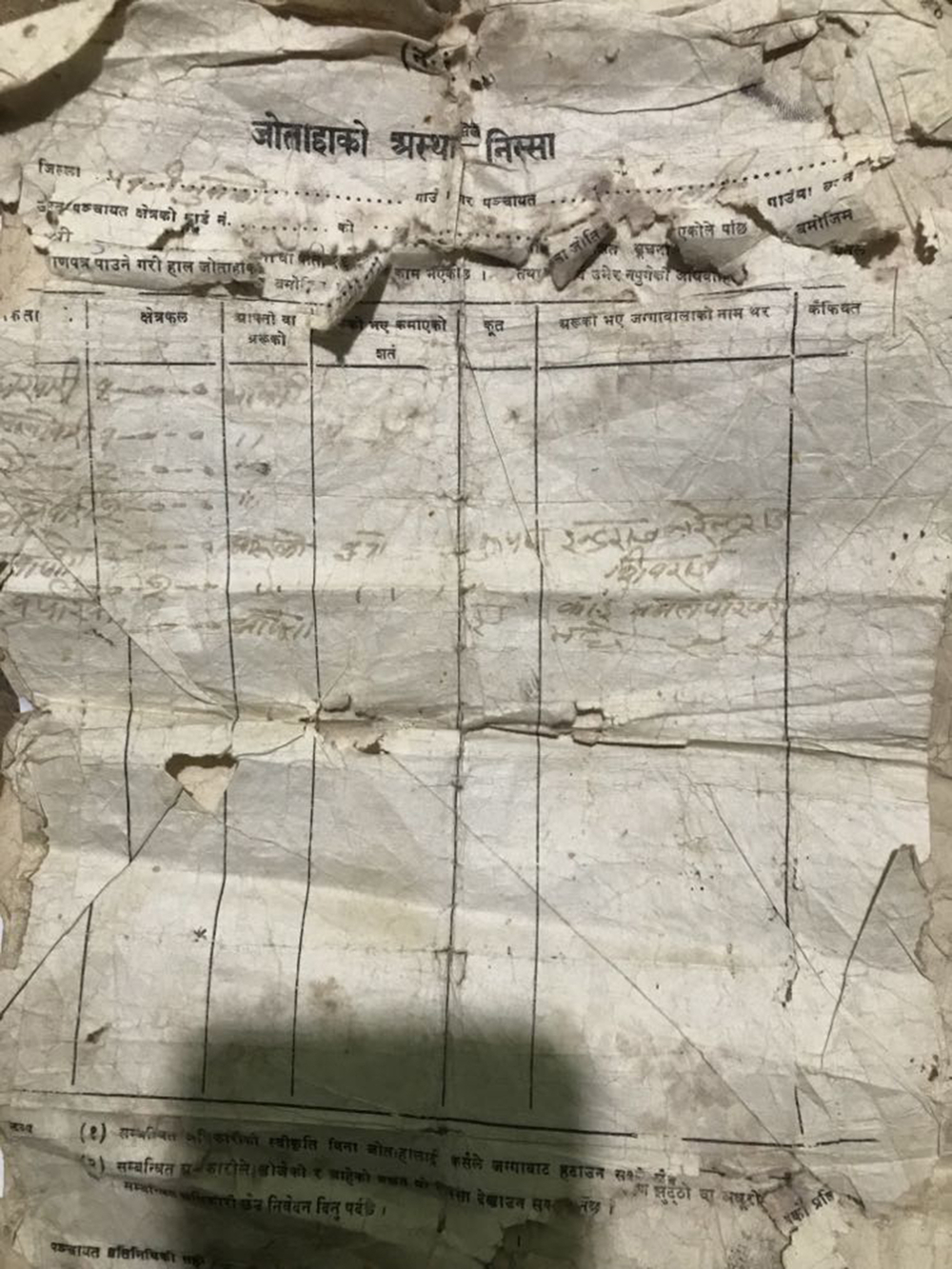
According to economic historian Maheshchandra Regmi's book 'Land Tenor and Taxation in Nepal', in Nepal till 2007, 700,000 hectares of land was under Birta ownership and Raker ownership was 900,000 hectares.
Birta's complicated problem not only explains the knot of Nepal's land problem, it also explains why those who are doing politics and making policies are not serious about the problem of thousands of farmers trapped in this problem .

