The government is positively studying whether the existing legal provisions provide a sufficient basis for private sector participation in electricity trade or if new laws are necessary: Energy Minister Biraj Bhakta Shrestha
We use Google Cloud Translation Services. Google requires we provide the following disclaimer relating to use of this service:
This service may contain translations powered by Google. Google disclaims all warranties related to the translations, expressed or implied, including any warranties of accuracy, reliability, and any implied warranties of merchantability, fitness for a particular purpose, and noninfringement.
Minister for Energy, Water Resources and Irrigation, Biraj Bhakta Shrestha, has said that private sector participation in electricity trade is becoming increasingly necessary to expand Nepal’s clean, green, and reliable energy competitively in the regional market. He stated that the government is studying whether the existing legal provisions provide a sufficient basis for this or if new laws are required.
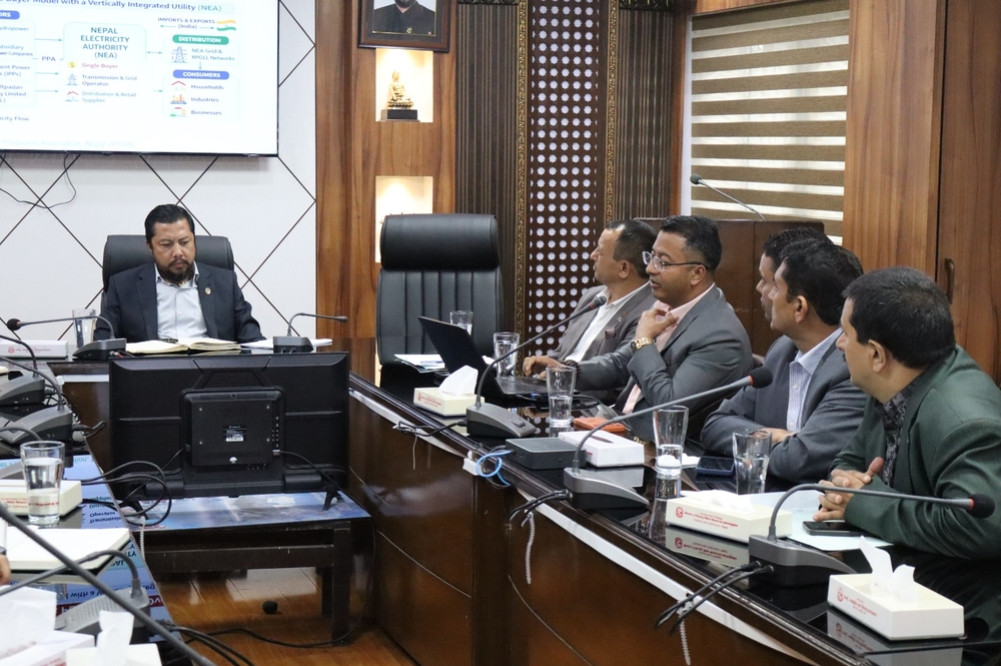
In a discussion with officials from the Independent Power Producers’ Association Nepal (IPPAN) at the ministry on Friday, Minister Shrestha noted that although the private sector has made a significant contribution to electricity generation, sufficient opportunities have yet to open up in the area of trade. He said that, considering the changing energy market and the prospects for regional electricity trade, it is necessary to make timely decisions regarding private sector participation.
Minister Shrestha informed that he is positive about granting the necessary permission for the private sector to seek international markets through a business-to-business (B2B) model in coordination with the Nepal Electricity Authority.
He said that, at a time when the energy consumption and export strategy is in the implementation phase, electricity trade could become a new investment and business opportunity for the private sector. He emphasized that, while involving the private sector in trade, the role, authority, and responsibility of the Nepal Electricity Authority must be safeguarded and the state’s returns must not be affected.
Energy Minister Shrestha also mentioned that detailed studies are needed on issues such as open access systems, the use of shared transmission infrastructure, liability sharing, and digital management of electricity trade.
Expressing confidence that the expansion of the energy sector will make a significant contribution to the country’s gross domestic product (GDP), he said the energy sector could be decisive in achieving the national goal of reaching an economy of ten trillion rupees. He stated that the government has prioritized the expansion of transmission lines in the current fiscal year and will focus on strengthening the distribution system in the coming year, so the private sector should also prepare for commercial activities.
In the discussion, former Energy Secretary Dinesh Ghimire said that private sector entry is necessary to build a competitive electricity market. He said that involving the private sector in trade would be a positive step for the effective marketing of surplus electricity during the rainy season, managing pressure related to power purchase agreements (PPAs), and determining appropriate electricity prices.
Ghimire urged that electricity trade should not be viewed as limited to exports only, and said that with the expansion of the domestic market, electricity demand within the country would also increase significantly. He suggested that, if necessary, the private sector could be involved in trade through the creation of new laws or amendments to existing ones.
IPPAN President Mohan Dangi said that private sector participation in electricity trade and transmission systems has now become a necessity rather than an option, and stressed that the government should adopt policies to encourage genuine investors. In the program, IPPAN Senior Vice President Uttam Bhloan, in his presentation, said that with multiple sellers and buyers, a competitive market would help determine appropriate electricity prices and expand the market.
Stating that it is immediately necessary to establish a system to sell Nepal’s electricity in the regional market according to time, price, and demand, Senior Vice President Bhloan urged the government to open a legal pathway for private sector entry into electricity trade, even if it requires amending some Nepal Acts.
Former IPPAN President Ganesh Karki noted that many hydropower projects with investments of billions of rupees are still awaiting PPAs, and expressed the view that if the private sector is allowed to trade electricity, the pressure on the government regarding PPAs would also be reduced.
Participants in the discussion shared the view that if the experience gained by the private sector in electricity generation can now be utilized in trade and market expansion, Nepal’s energy sector will become more competitive, investment-friendly, and export-oriented.