In 2025, the average stay of foreign tourists reached 16.34 days, setting a new record. However, their average daily expenditure dropped to 33.09 US dollars, the second lowest level in history.
We use Google Cloud Translation Services. Google requires we provide the following disclaimer relating to use of this service:
This service may contain translations powered by Google. Google disclaims all warranties related to the translations, expressed or implied, including any warranties of accuracy, reliability, and any implied warranties of merchantability, fitness for a particular purpose, and noninfringement.
Foreign tourists visiting Nepal have started staying for the longest periods in history, but their daily spending has been declining. Government statistics reveal the reality that Nepal has not been able to attract high-spending tourists.
According to government data, in 2025 the average stay of foreign tourists reached 16.34 days, the highest ever. However, their average daily expenditure was limited to 33.09 US dollars. This is the second lowest level in history. In the South Asian region, the average daily spending of tourists is between 100 and 150 dollars.
This data shows a growing imbalance in Nepal’s tourism sector. Although tourists have started staying longer due to trekking, mountaineering, and recreational visits, businesspeople say this has not been converted into higher tourism income.
According to the Ministry of Tourism, in 2003 the average daily spending of tourists had reached 79.1 dollars. Since then, spending has been continuously declining.
The lowest daily spending in history was 31.9 dollars in 1996. At that time, 393,613 foreign tourists had visited Nepal. That same year, the then Maoists launched the ‘armed people's war’ with the aim of ending the monarchy and establishing a republic. During the Maoist conflict led by Chairman Pushpa Kamal Dahal, police posts in various districts were attacked.
The Ministry of Tourism has stated that since 2025, the duration of tourist stays has been calculated through the Central Electronic Tourism Management Information System, making the data more reliable.
According to the ministry, tourists have started spending more time observing Nepal’s natural and cultural destinations. It is claimed that the length of stay has increased due to effective improvement and promotion of tourism services.
Generally, longer stays are considered positive, as it is expected that more will be spent on accommodation, food, transportation, and various activities. However, according to hotel operators, the corresponding economic benefit has not been realized.
Hotel operator Yogendra Shakya says, “To be clear, Nepal’s air and road transport are not safe. That’s why wealthy tourists hesitate to come to Nepal. To attract high-spending tourists, the first thing that needs to be improved is the transportation sector.”
According to him, although there are international standard luxury hotels and resorts in Nepal, the inability to meet international quality standards is preventing affluent tourists from coming here.
Since December 2013, Nepal has been on the European Commission’s aviation safety ‘blacklist’. As a result, Nepali airlines are not allowed to fly to Europe, and concerns about Nepal’s aviation safety remain.
In 2025, 1.5 million foreign tourists visited Nepal. Of these, 91 percent arrived by air, while 146,630 entered Nepal by land.
For the third consecutive year, more than one million tourists have been arriving, but the pre-COVID level of 2019 has not yet been reached.
According to tourism entrepreneurs, frequent plane crashes, weak highways, and Nepal’s weak international promotion have undermined Nepal’s competitive capacity.
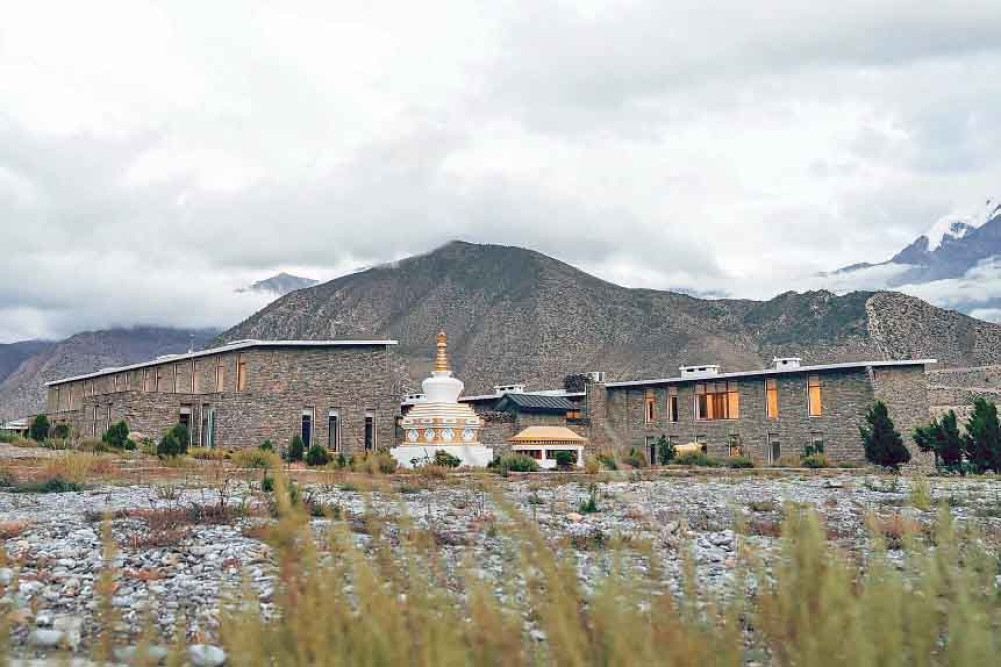
Meanwhile, in recent years, high-end hotels such as Shinta Mani Mustang, Dusit Thani Himalayan Resort & Spa, The Terraces Resort & Spa in Lakuribhanjyang, and Kavya Resort in Nagarkot have come into operation. More projects are under construction.
In partnership with CG Hospitality, Marriott International is constructing two ultra-luxury hotels in Kathmandu, including the Ritz-Carlton, at a cost of 15 billion rupees.
However, many such hotels have not been able to achieve the expected occupancy.
According to hotel operators, plane crashes, weaknesses in road safety, political instability, and last year’s ‘Gen-Z’ movement during the main tourism season have had a negative impact on bookings and tourist spending.
According to an official at Dusit Thani Himalayan Resort & Spa, the resort was hit hard during the Gen-Z movement. Currently, however, the number of tourists coming from India to celebrate weddings and anniversaries has been increasing. Indian tourists usually book three-night packages.
According to tourism experts, although Nepal has great potential in luxury tourism, natural disasters, plane crashes, and political instability have weakened tourists’ confidence.
Mid-range hotels, however, still depend mostly on domestic tourists.
According to Yogendra Shakya, the average length of stay has increased mainly because the number of Indian tourists coming for trekking and mountaineering has risen. However, he says there are still doubts as to whether all the spending by Indian tourists in Nepal is conducted through the formal banking system.
According to Mani Raj Lamichhane, Director of the Nepal Tourism Board, Nepal has become a cheap destination for foreigners because the Nepali rupee is weak compared to the US dollar. This may be the reason for the decline in daily spending.
He said that as the number of hotels and resorts has increased rapidly, unhealthy price competition has also intensified.
Especially luxury hotels are offering rooms at much lower rates than before COVID in order to attract guests.
Currently, there are 1,600 hotels in Nepal, including 222 star-rated hotels, providing a capacity of about 64,000 room-nights.
According to the government’s latest report, in the fiscal year 2024-25, travel services became Nepal’s largest service export. This generated an income of 88.66 billion rupees, which is 37.15 percent of total service exports.
However, due to global uncertainties including the conflict in West Asia, international tourist spending has remained at pre-COVID levels, and the tourism industry has become increasingly dependent on domestic tourists.
According to Shakya, hotels and resorts in the Kathmandu Valley and other tourist destinations are currently more dependent on domestic tourists.
According to him, global inflation has reduced consumers’ purchasing power, so tourists have started opting for budget-friendly travel. As airfares and fuel prices have risen, spending on accommodation and food has also decreased. The increase in short-term visits has affected the business of full-service hotels.
“After airfares became expensive, both the number and length of stay of Indian tourists reached record levels,” Shakya said.
The ruling Rastriya Swatantra Party has set a target of increasing annual tourist arrivals to about 2.5 million within five years and significantly boosting tourism income.
However, according to tourism entrepreneurs, although private sector investment in hotels and resorts is increasing, unless the government improves transport safety, infrastructure, and international promotion, it will remain challenging for the thousands of newly built rooms to be filled by high-spending foreign tourists.