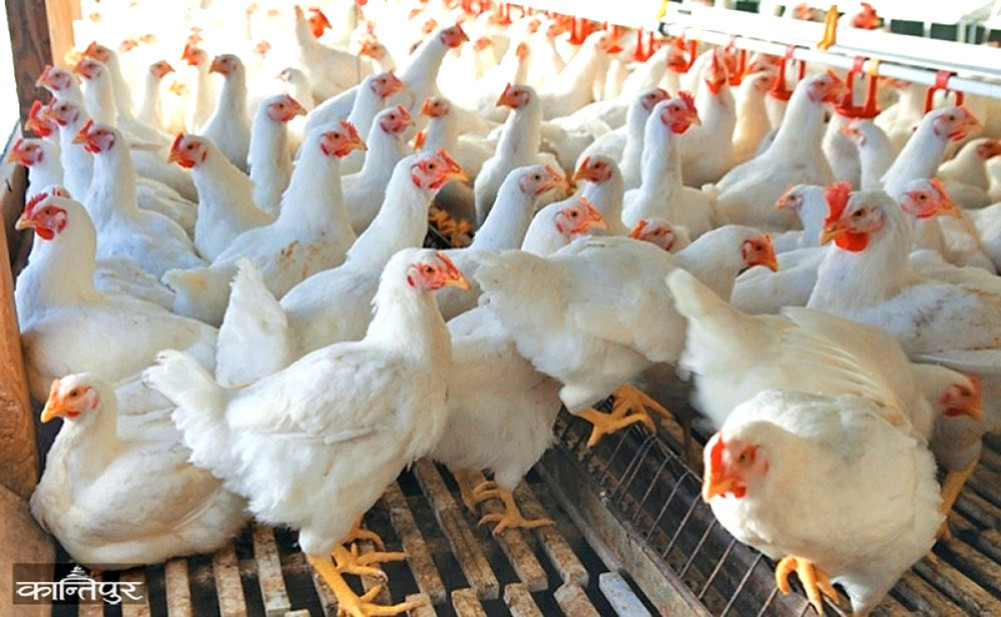
To control the infection, 835,000 birds, 1,225,536 eggs, and 264,213 kilograms of feed destroyed
We use Google Cloud Translation Services. Google requires we provide the following disclaimer relating to use of this service:
This service may contain translations powered by Google. Google disclaims all warranties related to the translations, expressed or implied, including any warranties of accuracy, reliability, and any implied warranties of merchantability, fitness for a particular purpose, and noninfringement.
In the past four months, 162 poultry and bird farms have been affected by bird flu infection. Of these, compensation totaling NPR 507,115,704.25 has been distributed to the bank accounts of 104 affected farmers and farms, according to the Department of Livestock Services.
Senior veterinarian Mukul Upadhyaya of the Department of Livestock Services stated that at the end of the fiscal year, the government allocated NPR 500 million for compensation through the Ministry of Agriculture, Forestry and Environment, and that amount has already been provided to the farmers as compensation. For the first four months of the current fiscal year, the department has a budget of NPR 20 million, he said.
Upadhyaya said that since more claims are expected, it is estimated that about NPR 100 million will be needed for compensation. “Since mid-July, the infection has tested negative,” he said, “and farmers are also receiving compensation. We expect the infection to continue to decrease.” According to Upadhyaya, compensation is not provided for birds that die on their own, and compensation is only given for birds destroyed by the government. “Not all affected farms receive compensation. Some birds have already died on their own. The government only provides compensation for birds it has destroyed.”
During infection control efforts, 835,563 birds have been destroyed. Additionally, 1,225,536 eggs and 264,213 kilograms of feed have been destroyed, according to data released by the Department of Livestock Services. Since the first confirmation on February 16, 2024 (4th of Falgun, 2082) in Sundarharaicha-4 and Urlabari-8 of Koshi, a total of 162 farms in 12 districts have been affected up to the end of June (Asar).
Bhaktapur has had the highest number of farms affected by bird flu infection. In Bhaktapur, infection has been confirmed in 45 farms. According to the data, there have been 32 cases in Kathmandu, 27 in Kavrepalanchok, 23 in Sunsari, 15 in Lalitpur, 11 in Morang, 4 in Jhapa, and cases have also been reported in Chitwan, Nawalparasi West, Bara, and Mahottari.
The highest number of birds destroyed due to infection has been in Kathmandu. In Kathmandu, 111,407 birds have been destroyed; in Bhaktapur, 135,158; in Sunsari, 285,531; and in Morang, 104,659 birds have been destroyed. Bird flu has been confirmed in 119 locations in Kathmandu Valley and Kavrepalanchok alone.
According to the Bird Flu Disease Control (Fourth Amendment) 2017, compensation of up to 75 percent of the assessed value is provided to the owner for birds, bird products, and bird production materials destroyed based on verified loss details. According to the “Guidelines for Providing Relief for Items Destroyed During Bird Flu Control 2022,” a committee is formed in each district under the chairmanship of the Chief District Officer to determine the compensation rate based on the quantity destroyed. Compensation is provided only for items destroyed by the committee.
Tilchand Bhattarai, a member of the Nepal Poultry Federation, stated that although his farm in Sunsari suffered a loss of NPR 180 to 200 million when 150,000 chickens were destroyed, he received NPR 100 million in compensation from the government. “The money has just arrived. It seems we received around NPR 100 million in compensation. This will certainly provide some relief to the business.”
The department has stated that although bird flu infection is under control, the risk remains. The main risks identified are the presence of wild birds nesting in tall trees near farms, farms located near wetlands, lack of compliance with biosecurity standards, uncontrolled movement of vehicles and visitors, and the reuse of egg crates without proper disinfection.