Capital expenditure for 2008/09 is the lowest in 6 years, with only 190 billion rupees spent as of 31 Ashar out of the 407 billion rupees allocated.
We use Google Cloud Translation Services. Google requires we provide the following disclaimer relating to use of this service:
This service may contain translations powered by Google. Google disclaims all warranties related to the translations, expressed or implied, including any warranties of accuracy, reliability, and any implied warranties of merchantability, fitness for a particular purpose, and noninfringement.
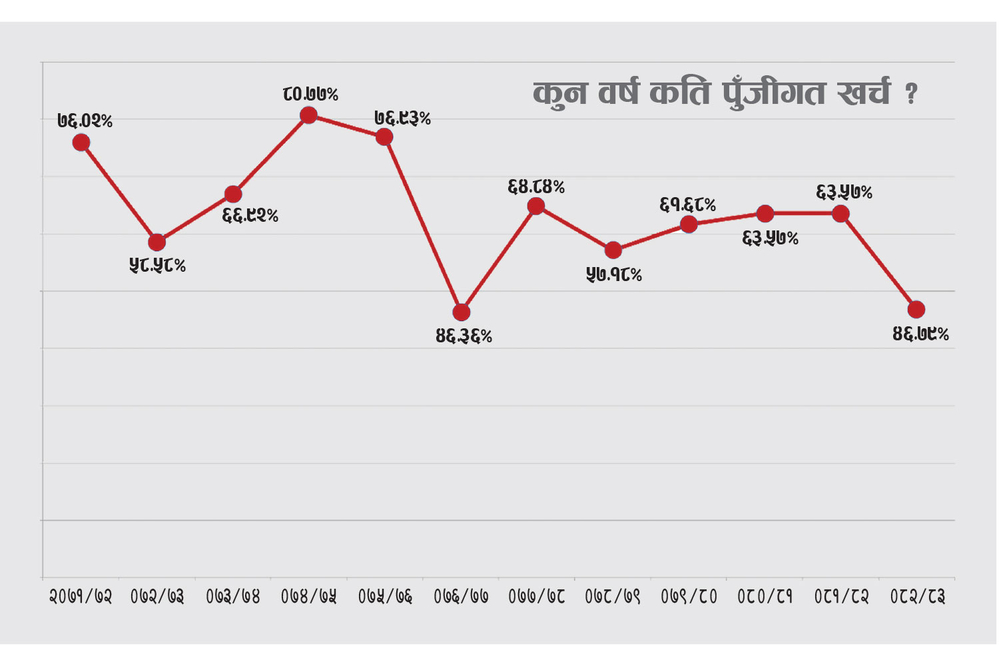
In the fiscal year 2082/83, the government could not spend even half of the budget allocated for capital expenditure. Of the Rs 47.88 billion allocated by the government for capital expenditure, only Rs 190 billion has been spent till 31 Ashar. This is only 46.79 percent of the annual target.
The capital expenditure for the fiscal year 2082/83 is the lowest in 6 years. Earlier, in the fiscal year 2076/77, only 46 percent of the annual target was spent on capital expenditure due to Covid and other reasons. In that year, only Rs 189 billion was spent out of the Rs 48 billion allocated for capital expenditure. Since then, capital expenditure has been 57 percent in one year and between 60 and 65 percent in the remaining four fiscal years.
The Gen-G movement of last Bhadra, the House of Representatives elections held on 21 Falgun under its banner, and the formation of a new government are considered to be the reasons for the low capital expenditure in the fiscal year 2082/83. Government officials say that the disruption in the supply of construction materials due to the ongoing conflict in West Asia is another reason for the low capital expenditure.
Economists have commented that the government that came to power after the Gen-G movement demanding corruption control, good governance and improvements in public services has not been able to increase government spending as expected. Economist Dilliraj Khanal said that there is no sign of improvement in capital expenditure as the new government has completely ignored development and good governance.
‘There was a Gen-G movement in the country to maintain good governance and against corruption. The government of the Rashtriya Swayamsevak Sangh (RSS), which emerged as the largest party in the elections, forgot development and good governance, so capital expenditure could not increase,’ he said.
Economist Khanal said that there is a high risk of repeating this trend not only this year but also next year. ‘Because the budget has not been allocated in a way that controls financial mismanagement and maintains good governance,’ he said, ‘While the budget should be formulated in a way that guarantees implementation, that has not been done in the upcoming budget either.’
The government in Nepal has been seen as weak when it comes to capital expenditure. Looking at the data for the last three decades, on average, only about 60 percent of the annual capital expenditure has been spent. Experts say that structural changes are necessary in policies, regulations, and procurement processes to solve this problem.
‘We are saying that we cannot spend through structural reforms, but every year we are saying that sometimes we cannot spend capital by giving various excuses like earthquakes, sometimes Covid, sometimes Gen-G movements,’ an official from the Ministry of Finance said, ‘All these are excuses to hide from our weaknesses. Comprehensive structural reforms are essential to increase capital expenditure.’
In the current fiscal year 2082/83, only about 47 percent of the capital expenditure was spent as of 31 Asad compared to the initial allocation, which is relatively low, Finance Ministry spokesperson Amrit Lamsal also admitted. He said that capital expenditure is likely to increase by a few percent when the data for 32 Asad is added.
‘Due to the damage to various government offices in the Gen-G movement of last Bhadau, regular work was disrupted for some time. In the elections of 21 Falgun, employees, construction entrepreneurs, and everyone went there,’ he said, ‘Due to the conflict in West Asia, construction was affected by the shortage of construction materials and price increases. This is why capital expenditure has been low.’
Due to the conflict in West Asia, there has been a shortage of some construction materials, including bitumen, while the prices of many have increased. The Ministry of Finance has given the authority to transfer budget amounts to the concerned ministries to increase capital expenditure, and has been repeatedly urging and facilitating the increase in expenditure, said Spokesperson Lamsal. He claims that the government has prepared a strong foundation and that the pace of capital expenditure will increase from the beginning of the new fiscal year.
In the fiscal year 2082/83, revenue collection was Rs 124.8 billion. This is 7 percent compared to the previous year and 82.76 percent of the annual target. In the fiscal year 2081/82, 80.35 percent of the target, or Rs 114.36 billion, was collected.
'The target was to collect Rs 14.8 billion in revenue in the fiscal year 2082/83. Till Wednesday, Rs 12.25 billion has been collected. There was a plan to reach at least Rs 13 trillion, but that possibility is becoming less,' said Spokesperson Lamsal, 'But revenue has increased by seven percent compared to last year. If capital expenditure had increased, revenue would have also increased. Revenue has been affected due to failure to increase capital expenditure.' He claims that even though revenue has not increased as per the target, the state treasury is not under much pressure.
In the fiscal year 2082/83, the current expenditure was 88.51 percent of the annual target, i.e. Rs 1045 billion 250 million. This is more than the current expenditure of the same period of the previous fiscal year. The government had spent some amount from current expenditure and other miscellaneous headings for the elections held in Falgun last year. That is why the current expenditure increased.
In the fiscal year 2082/83, the government spent Rs 347 billion 330 million (92.56 percent of the annual target) on the principal repayment of government loans and investment in government institutions (financial arrangements). In the previous year, Rs 320 billion or 87.14 percent of the target was spent on this.
In the fiscal year 2082/83, the government received Rs 31 billion 250 million 410 million in foreign grants. This is 58.5 percent of the annual target. The previous year, the government received Rs 23 billion 201.6 million or 44.34 percent of the target in foreign grants.
Looking at the government's income and expenditure as of 31 Asad, the government has a deficit of about 358 billion 61 million rupees. The government has earned 1264 billion 10 million rupees and spent 1583 billion 42 million rupees. In the fiscal year 2081/82, the government had a deficit of about 347 billion 75 million rupees.
The government had initially announced a budget of 1964 billion 11 million rupees for the fiscal year 2082/83, but it had fixed it at 1688 billion 32 million rupees through the half-yearly review. After failing to raise and spend resources, the then Finance Minister Rameshwor Khanal reduced the total allocated budget by 275 billion 783 million rupees in the half-yearly review of the budget. This budget was made public by Bishnu Prasad Poudel, who became the Finance Minister from UML.
In the half-yearly evaluation report of the budget for the fiscal year 2082/83, the current expenditure was reduced from Rs 1180.98 billion to Rs 1125.97 billion.94 million.
While Rs 47.88 billion was allocated for capital expenditure, it was reduced to Rs 243.30 billion.34 million. That target was also not met. Similarly, the allocation for financial management was reduced from Rs 375.22 billion to Rs 319.43 billion.