Due to the country's recent developments, the demand for credit in the financial sector has not increased due to the failure to create an investment environment.
We use Google Cloud Translation Services. Google requires we provide the following disclaimer relating to use of this service:
This service may contain translations powered by Google. Google disclaims all warranties related to the translations, expressed or implied, including any warranties of accuracy, reliability, and any implied warranties of merchantability, fitness for a particular purpose, and noninfringement.
In the 11 months of the current fiscal year (Shrawan-Jesht), banks and financial institutions have extended additional loans worth Rs 323.88 billion. However, this is about Rs 73.65 billion less than the same period last year. In the same period last fiscal year, banks and financial institutions had extended additional loans worth Rs 397 billion.
Experts say that banks and financial institutions have not been able to expand loans as expected due to the long-term sluggish economy, industries operating at less than half capacity, and the failure to create an investment environment.
Compared to last Ashar, the growth rate of loan expansion is 5.8 percent until Jetht. There was a 7.7 percent expansion in the same period last year. However, compared to the 11 months of last year, there is a 6.2 percent loan expansion in the same month of the current fiscal year.
The Rastra Bank has set a target of 12 percent loan expansion for the current fiscal year. Considering the situation up to 11 months, there is no possibility of meeting the annual target, said Santosh Koirala, President of the Nepal Bankers Association. It is said that loans will be expanded by 11 percent in the coming fiscal year. This means that an additional loan of Rs 6.5 trillion will have to be disbursed.
The recent developments in the country have not created an investment environment, and the demand for loans in the financial sector has not increased. Experts say that the new government should work hard to increase their confidence as the confidence of the private sector has dropped significantly.
In the 11 months of the current fiscal year, the loans invested by banks and financial institutions have expanded by 15.1 percent in the construction sector, 13 percent in the consumer sector, 12.5 percent in the transport, communication and public services sector, 6.8 percent in the industrial production sector, 4 percent in the service industry sector, and 0.6 percent in the finance, insurance and real estate sector. However, the loans disbursed to the agricultural sector have decreased by 2.4 percent during that period.
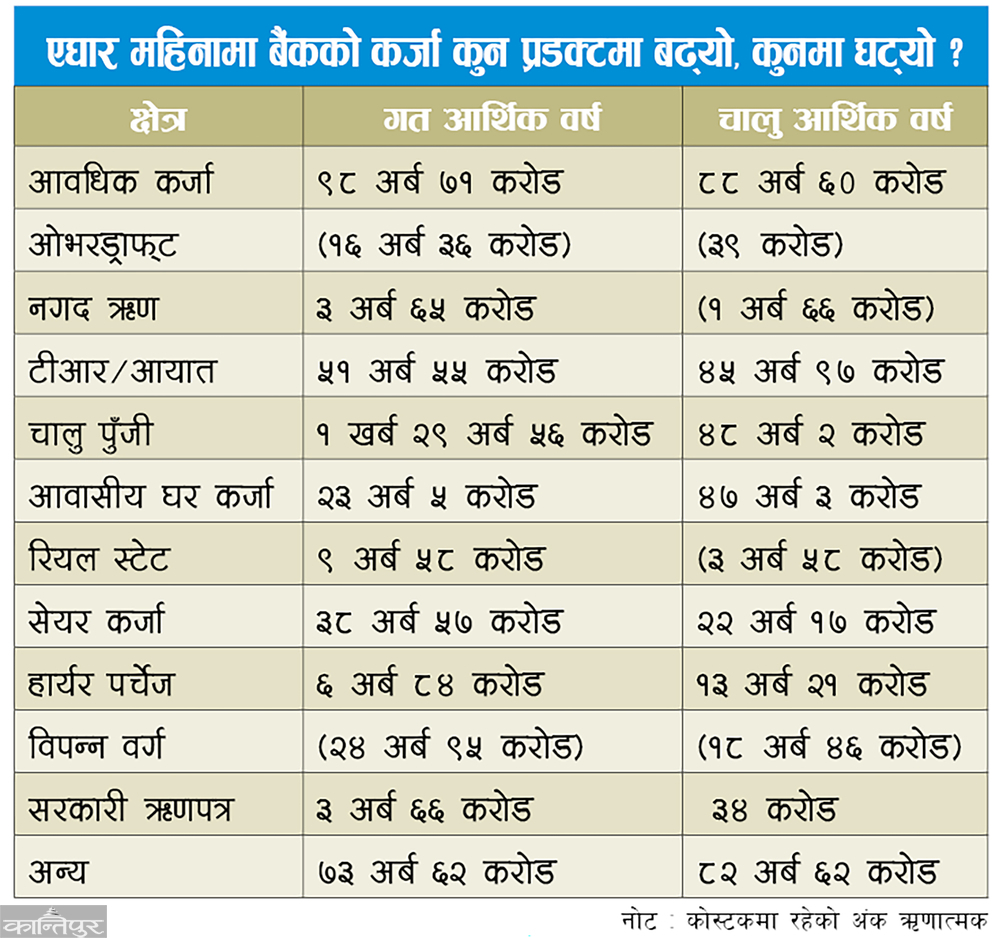
During the review period, the loans disbursed by banks and financial institutions have increased by 36.7 percent, margin loans by 15.8 percent, hire purchase loans by 10.3 percent, real estate loans (including personal residential housing loans) by 6.3 percent, demand and other working capital loans by 5.8 percent, and term loans by 4.3 percent. However, during that period, ‘cash credit’ loans and overdraft loans decreased by 0.3 percent and 0.4 percent, respectively, according to the data of the National Bank.
As of mid-Jeshta 2083, 14.7 percent of the loans invested by banks and financial institutions were secured by current assets (agricultural and non-agricultural goods) and 63.6 percent were secured by real estate collateral. In mid-Jeshta 2082, the share of loans secured by such collateral was 14.5 and 65.0 percent, respectively. In the last 11 months, the share of loans secured by commercial banks, development banks and finance companies increased by 6.3 percent, 5.6 percent and 3.9 percent, respectively, according to the report of the National Bank.
As the economy has not become dynamic and there is no demand for loans, banks are not in a position to provide more loans even if they want to, said Koirala, Chairman of the Nepal Bankers Association. ‘Industries are operating at less than half their capacity utilization, new businesses have not opened. "As the demand for credit in the economy has not increased, there has been less credit flow than expected," he said. "Economic activity must increase for credit to increase, and government spending must increase for economic activity to increase. Only then will bank credit flow increase." He said that even though banks are prepared for credit flow, they have not been able to do so due to low demand. However, he also informed that since Ashar is the last month of the fiscal year, banks are focusing on loan recovery.
About 1.5 trillion rupees (excess liquidity) have accumulated in banks and financial institutions for about 12 months (Ashar 25) of the current fiscal year. Total deposits are 8.2 trillion rupees. The credit-deposit ratio (CD ratio) during the same period is 71.77 percent. Liquidity has been accumulating in banks since three years ago. The increase in remittances in recent days has accelerated the accumulation of money in banks.
According to the directives of the Nepal Rastra Bank, banks and financial institutions can lend up to a maximum of 90 percent of total deposits. During this period, the total credit flow of banks and financial institutions is 5945 billion rupees. Based on the aforementioned data, banks and financial institutions have an amount of 1495 billion rupees available for lending (excess liquidity) as of mid-Ashar. However, banks and financial institutions must keep 20 percent of their total deposits in cash in the bank. Thus, the amount that all banks and financial institutions must keep with them to maintain 20 percent liquidity is about 1 percent of the CD ratio. Based on this, although banks are allowed to lend up to 90 percent of deposits, in practice they are only allowed to lend up to 89 percent.