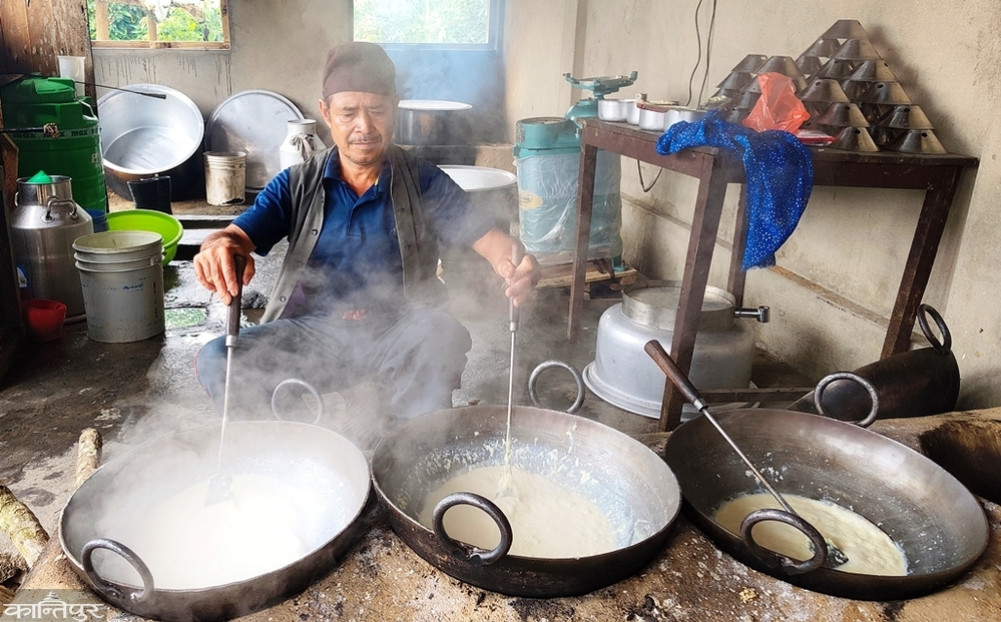
After serving in the Nepali Army for 17 years and retiring, he chose to transform his ancestral livestock farming into a modern business. His hard work has also inspired other farmers in the village.
We use Google Cloud Translation Services. Google requires we provide the following disclaimer relating to use of this service:
This service may contain translations powered by Google. Google disclaims all warranties related to the translations, expressed or implied, including any warranties of accuracy, reliability, and any implied warranties of merchantability, fitness for a particular purpose, and noninfringement.
Shiva Bahadur Basnet of Dandagaun, Mahalaxmi Municipality-3, sets out early in the morning to collect milk from all over the village. Then, his day is spent boiling milk in a large pot, working for hours to make kurauni, packaging it, and delivering it to customers.
After serving in the Nepali Army for 17 years, he retired and instead of relying on a pension or choosing foreign employment, he chose the path of transforming the village's ancestral animal husbandry into a modern business. Now, the dairy industry he runs has provided employment to his family as well as locals. The kurauni produced in his industry reaches from Dhankuta to Kathmandu and Sankhuwasabha.
Basnet himself raises advanced breeds of cows and buffaloes and also collects milk from farmers in the village. All family members are active in this business. One of his two sons is in foreign employment, while the other son is involved in everything from milk collection to kurauni, chhurpi production and marketing. His wife and two daughters-in-law help in the production, while some local youth have also found employment in the industry.
Initially, he only produced kurauni. But as the milk production increased, the unsold milk began to spoil, so he also started producing chhurpi and ghee. Now, he is processing about 250 liters of milk daily as per the order. ‘No matter how many orders come in,’ says Basnet, ‘but due to road problems, it is not possible to deliver the goods to all places on time.’
The kurauni produced in Dandagaun now reaches the local market in Dhankuta as well as Kathmandu and Sankhuwasabha. Basnet says that the demand for kurauni, which is sold at Rs 700 per kg, is increasing every day.
Mahalaxmi Municipality is a well-known area for dairy production. To convert this potential into a business, Basnet has cultivated grass on 20 ropanis of land. He has solved the problem of grass and feed management, which is considered the biggest challenge in animal husbandry, with his own efforts. ‘We have planted grass in our own fields. There is no shortage of grass for animal husbandry,' he said.
Basnet's hard work has also encouraged other farmers in the village. Farmers who previously had to wander around looking for markets to sell milk are now able to sell milk in the village. With the establishment of an industry in the village, the milk produced is now being processed locally.
To expand this potential, Mahalaxmi Municipality is also running various programs with the support of the federal and provincial governments, prioritizing dairy production. Mahalaxmi Municipality-1, 3 and 6 have been declared cow-buffalo pocket areas and improved cows and buffaloes have been distributed to farmers on a cost-sharing basis.
According to municipal mayor Dhruvraj Rayamajhi, in the fiscal year 2080/81, improved cows were distributed to 25 farmer families of ward number 1 with a conditional grant from the federal government at a cost-sharing rate of 50 percent. Then, in the fiscal year 2081/82, 50 buffaloes were provided to 50 farmer families of ward number 6 through a conditional grant from the provincial government.
In the current fiscal year, with the support of the federal government, 25 farmers of Ward No. 3 Dandagaun have been given a subsidy of Rs 100,000 each for the purchase of improved cows and improvement of the cowshed. The municipality has stated that the farmers also share 50 percent of the cost in this. According to Basnet, the municipality's support has been of great help in expanding the business. 'The purchase of cows, improvement of the cowshed and other support have made it easier to move the business forward,' he said.
Local farmer Ranjita Basnet said that along with the subsidy for the purchase of cows, she also received support for a grass cutter machine and improvement of the cowshed through the Cow Pocket Program. According to Mayor Rayamajhi, solar systems for cooking cowsheds and heating water have also been distributed to reduce the cost of production for farmers. 'It is our policy to prioritize the areas where there is potential. The municipality always supports farmers who want to engage in production,' he said.
According to him, the Ghumune, Murtidhunga, Marek and Katahare areas of Mahalaxmi Municipality are the main areas for animal husbandry, dairy production and vegetable farming. Turmeric cultivation and rotation have been implemented in the Melangchung area of Ward No. 5 and vegetable pocket programs have been launched in Murtidhunga. He said that there are plans to further develop Ward No. 6 as a buffalo pocket area and Ward No. 3 as a cow pocket area.
Not only milk production is currently taking place in Mahalaxmi, but its processing and marketing chain is also expanding. As the value of milk produced by local farmers has started to increase in the village, the dairy business is becoming a reliable basis for the rural economy.