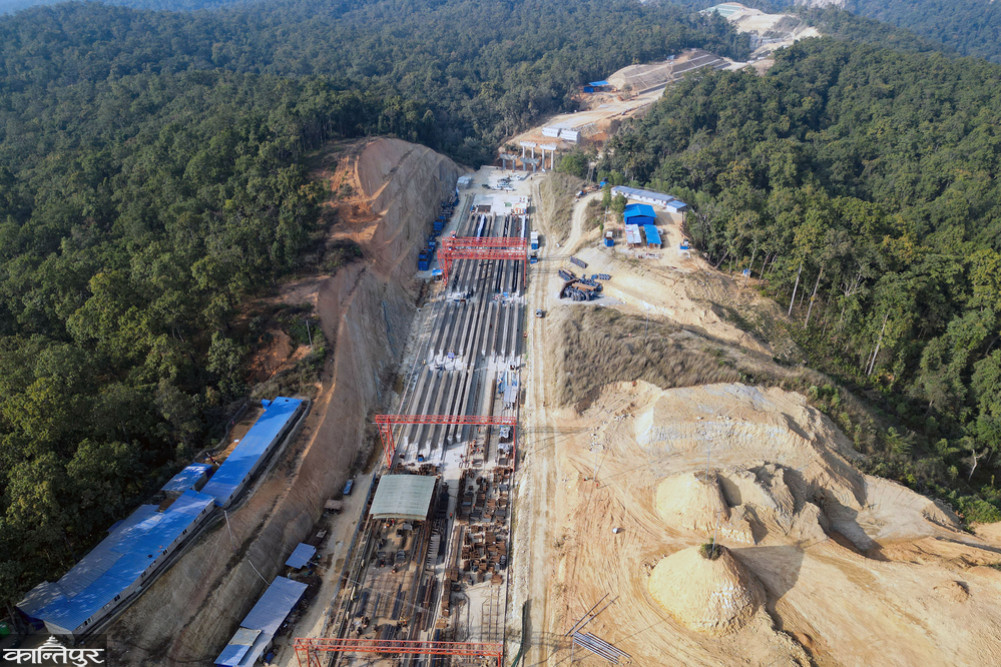
After work on the 6.5 km section of the Khokana section could not proceed for a long time, work towards Farsidol is being moved forward, saying that the problem in that area will be resolved later.
We use Google Cloud Translation Services. Google requires we provide the following disclaimer relating to use of this service:
This service may contain translations powered by Google. Google disclaims all warranties related to the translations, expressed or implied, including any warranties of accuracy, reliability, and any implied warranties of merchantability, fitness for a particular purpose, and noninfringement.
Preparations are underway to move forward with the work on the Farsidol-Dukuchhap section of the Terai/Madhesh Fast Track, which starts at Khokana in Lalitpur, by putting aside the dispute over the 3.3-km section. The initial Detailed Project Report (DPR) is being revised to construct two concrete bridges at 3.2 km of the section.
After work on the 6.5 km section of Khokana could not proceed for a long time, work on the Farsidol section is being moved forward, saying that the problem in that area will be resolved later. To move forward with work on that section, the DPR in the Ministry of Defense should be sent to the Office of the Prime Minister and Council of Ministers and a decision should be taken there.
After the Khokana dispute had not been resolved for years, the then Prime Minister Sushila Karki had directed on 5 February to move forward with an alternative plan. Accordingly, two bridges should be constructed on that section. Similarly, a toll plaza (toll collection house) should be constructed at Farsidol, 3.3 km from Khokana.
The proposal to approve the DPR with amendments for the construction of the bridge was submitted to the Prime Minister through Karki, but it was returned without a decision, said Secretary of the Ministry of Defense Kedarnath Sharma. ‘The starting point has not changed,’ he said, ‘It is where it was said when the initial DPR was made.’ He said that the DPR will be amended in the Dukuchhap-Pharsidol section and discussed about building a bridge and then sent to the Council of Ministers again. He said that there are complaints that the starting point should be changed.
Even after eight years since the Nepal Army took over the responsibility of construction management, the problem of the Khokana section has not been resolved yet.
There is a large landslide downstream of Dukuchhap. The previous DPR mentioned building a road from there. When studying the area now, it was found that the village itself would be at risk of landslides if the road was built. According to military sources, the DPR was made to build a bridge in the Bagmati. Where a 500-meter-long bridge will be built. ‘This will suffice if there is less land. "After the bridge was built, there was no need to prevent landslides, which is also a good thing," said a military source. "The DPR has been prepared to build bridges at two places in Dukuchhap." A military source said that the contract process will be moved forward after the DPR is approved.
The Council of Ministers had decided on 21 Baisakh 2074 to give the responsibility of managing the construction of the fast track to the army. The Ministry of Physical Infrastructure and Transport (currently Infrastructure Development) handed over the project to the army on 27 Shrawan 2074. Accordingly, its construction is being carried out under the management of the army. The total distance of the fast track is 70.977 km.
It was said that all the work would be completed by Mangsir 2081 when the army took over the management. Since it was not completed within that time, the deadline has been extended to Chaitra 2083. The Nepali Army claims that it was not able to start work immediately after taking over the management as it took time for the DPR to be approved by the Council of Ministers. The work on the DPR began on 16 Asoj 2075 and was ready on 19 Magh of the same year. Then it was approved by the Council of Ministers on 1 Bhadra 2076. The first revision of the DPR of the project was made on 30 Shrawan 2080 and the second revision was made on 25 Kartik 2081.
Locals have been adamant that projects including Smart City, Outer Ring Road, and Fast Track should not be built in one place, saying that archaeological and cultural heritage will be destroyed if they are built in one place. The project is being constructed in 13 packages. National Planning Commission member Arjun Jung Thapa said that it is being divided into parts and contracted until the problem in the Khokana section is resolved. ‘There will be one part from Dukuchhap to Farsidol, and from there to Khokana, there will be another part,’ he said. ‘For this, the Kathmandu-Terai/Madhes Expressway Project had sought approval from the Council of Ministers through the Ministry of Defense. The Council of Ministers has already given its opinion to the Ministry of Infrastructure Development as it has been sought.’
He said that the layout is being changed in accordance with the demand of the locals so that there will be less damage in the Dukuchhap section. ‘Out of the 6.5 km, two sections have been made to start work on 3.2 km so that the entire section is not stopped,’ he said, ‘The road is being built up to Farsidol, and once the work starts, there is pressure on those who obstruct the construction.’
Although the expressway’s deadline is only until Chaitra 2083, there is no plan to complete the work within this period. The concerned bodies have suggested that at least three years should be added. So far, the physical progress of the project construction is 48.12 percent.
There has been no change in the starting point and the DPR of the Dukuchhap-Farsidol section is in the process of being revised, said Army Spokesperson Assistant Lieutenant Colonel Rajaram Basnet. A study report on the alternative starting point conducted by a professor from Pulchowk Engineering Campus and a technical team from the Road Department was submitted to the Ministry of Defense, Physical Infrastructure and Transport in Chaitra 2080. Although the report, which took 9 months to prepare, mentioned that the Khokana area would be suitable, no work has been done on it so far. Another option is to build a bridge over the Bagmati so that it does not fall in the Sikalighat area. But the study has pointed out that this may cause social and cultural problems.
Another option is to build a four-lane corridor road starting from Bungmati and acquire new land for that. This does not fall in the Sikalighat area. For this, new land will have to be acquired on the right bank of the Bagmati River. The study says that two-lane roads can be built on both sides of the Bagmati River corridor starting from Bungmati.
It is said that additional land will be acquired on the left bank starting from Bungmati. The report mentions that another option is to use the right bank of the Bagmati River starting from Dukuchhap and acquire some land for that. No work has been done on these options so far.
‘The starting point has not changed yet, no decision has been made on this,’ said Army Spokesperson Basnet, ‘A report has been received on various options studied, and a decision will be made after discussion on which option is best.’ The total cost of the project, including VAT, is estimated at Rs 211.93 billion, of which Rs 82.97 billion has been spent so far.