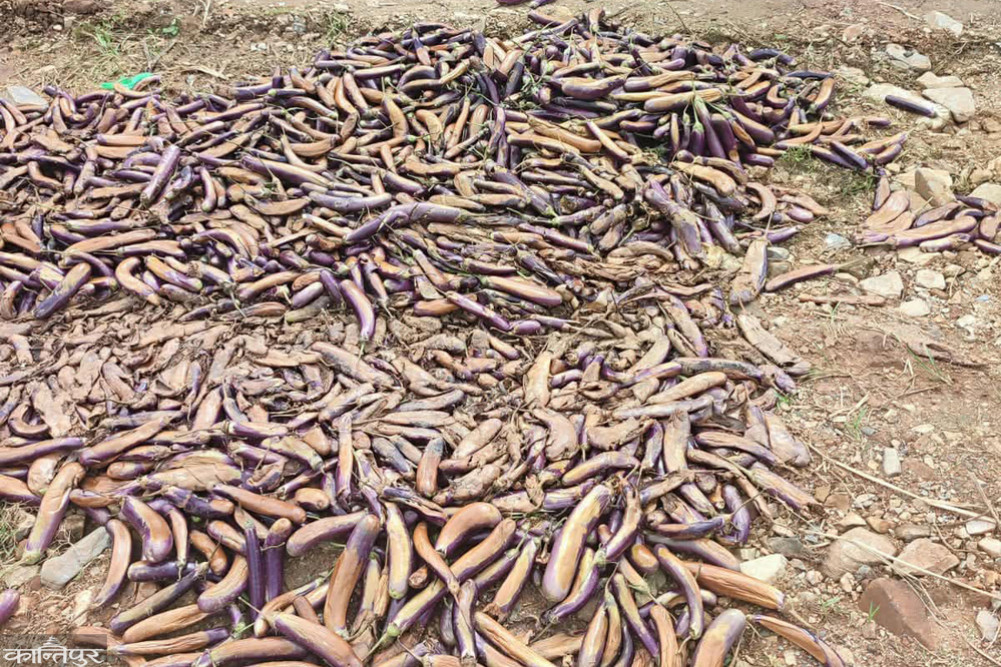
Farmers in Ghyalchowk have said that they had to throw the bhang they produced on the street when traders tried to buy it at a price much lower than the cost.
We use Google Cloud Translation Services. Google requires we provide the following disclaimer relating to use of this service:
This service may contain translations powered by Google. Google disclaims all warranties related to the translations, expressed or implied, including any warranties of accuracy, reliability, and any implied warranties of merchantability, fitness for a particular purpose, and noninfringement.
Devendra Bhujel of Gandaki Rural Municipality-8, Ghyalchowk, picked 2 quintals of yams for Rs 600 to send to the market for sale. Adding Rs 30 for the sack and Rs 50 for the farmer's lunch, he had already spent Rs 680 on it by the time he sent it to the market. But when the trader said that he would buy the yams produced by Bhujel for only Rs 5 per kg, he threw them on the road. He threw the yams on the road in the deep boring area of Ghyalchowk 4 days ago.
'Rs 680 has been spent just on sending them to the market. Now, selling 2 quintals would bring in around Rs 1,200, but instead of paying for all his own expenses and fertilizer, he has to sell them out of his own pocket,' said Bhujel. 'I have been farming since 2076 BS. This problem happens every year,' Traders always try to buy at a low price, farmers always get hurt.'
Farmers of Gandaki Rural Municipality 7 and 8 Ghyalchowk have been cultivating vegetables commercially for 3 decades. The vegetables produced here reach Kathmandu directly. But this time, the price of bhanta has been very low. Farmers have expressed concern that the cost will not even rise.
Bhujel said that bhanta has been selling for 5 to 7 rupees per kilo since the beginning of Ashar. This year, he has planted bhanta at 4 ropanis and 8 annas. 'I am very sad, I sent 2 quintals of bhanta yesterday, but I have no savings,' he said, 'There is also a little bit of body and cucumber.' Bodi and cucumber are also not getting good prices, cucumber is being sold for Rs 10 per kg and Bodi is sometimes being sold for Rs 5 and sometimes for Rs 10. Even then, selling it does not make you sad.'
Farmers are very sad, sometimes they do not get fertilizer, they have to stand in line all morning to get 10 kg of urea, and even after production, the sale is difficult Ishwar Adhikari of Ghyalchowk has protested by uprooting the Bodi from the plant after not getting a price. He said that the Bodi planted in 2 ropanis will not even cover the cost of the Bodi. In Asoj last year, farmers in this area had been getting up to Rs 180 per kg of Bodi. Farmers say that the price of vegetables has been very low since the beginning of Asad this year.
‘It seems like it would be easier if the government fixed the price in a way that farmers do not suffer losses, but in this way, farmers never got the real price,’ says Bhujel. Farmers engaged in commercial farming are facing problems as they do not get the price for their vegetables. ‘Farmers are very sad, sometimes they do not get fertilizer, they have to stand in line all morning to get 10 kg of urea, and even after production, they have to wait in line to sell,’ he said.
In the Ghyalchowk area alone, around 1,000 farmers are engaged in commercial vegetable farming. This year, the risk of not even covering the cost of the vegetables produced has increased, said Bhumi Regmi, advisor and former president of the Collective Agricultural Production Cooperative. ‘You should be paid Rs 5 to 600 for picking the vegetables in the morning, why sell them if you get the same amount when you sell the vegetables,’ he said, ‘In previous years, you would get a good price, but this year, traders have come to collect them for a very low price.’
Vegetables produced by farmers in the Ghyalchowk area are sent to Kathmandu daily in 3 large vehicles. There are Jankalyan Agricultural Cooperative, Collective Agricultural Production Cooperative and Fresh Vegetable and Fruit Cooperative in Dhading to facilitate farmers. The cooperative has been facilitating farmers with essential things such as fertilizers, seeds and pesticides.