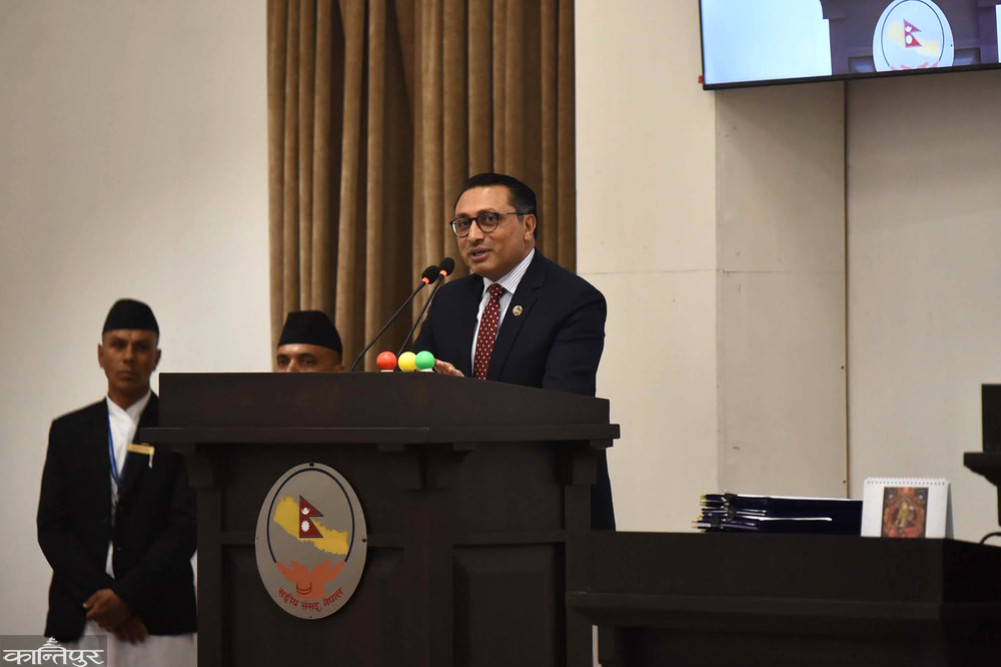
The stock market is continuously declining, and there has been no improvement in the real estate sector, but Finance Minister Wagle has been claiming that a lot of work has been done to improve the economy.
We use Google Cloud Translation Services. Google requires we provide the following disclaimer relating to use of this service:
This service may contain translations powered by Google. Google disclaims all warranties related to the translations, expressed or implied, including any warranties of accuracy, reliability, and any implied warranties of merchantability, fitness for a particular purpose, and noninfringement.
Finance Minister Swarnim Wagle, while taking charge as the Finance Minister of the new government on 13 Chaitra 2082, had said that economic reforms, a private sector-friendly environment, and legal reforms would be prioritized. However, despite the initiation of legal reforms during his 100-day tenure, there has been no tangible improvement in the economic situation and confidence in the private sector.
Citizens had high expectations from a powerful government with a two-thirds majority in the elections held on the basis of the Gen-G movement. Accordingly, economists say that the economy has not improved. According to them, neither capital expenditure has improved in the first 100 days of the government nor has revenue collection increased as expected. Although the trillions of rupees accumulated in banks and financial institutions remain intact, loan demand has not increased, the stock market is continuously declining, and there has been no improvement in the real estate sector. However, Finance Minister Wagle claims that a lot has been done to improve the economy.
Economist Dilliraj Khanal said that the work done by the government in the first 100 days is disappointing. "The NCP's pledges, the government's 100-point agenda on good governance, etc., had raised a lot of hopes. But neither the confidence of the private sector has increased to the point where there has been a sense of change, nor has the capital expenditure situation improved, nor has the money accumulated in banks decreased, nor has there been any improvement in the stock market," he said. "Industrialists are in fear. Not only foreign, but also domestic investment has not increased, so there has been no fundamental change in the economy in the last 100 days." He suggested that the government should evaluate its performance and improve itself in the coming days. Khanal said that the initiatives taken during this period to improve public service delivery and control corruption were positive. "Unnecessary ministries have been abolished to reduce expenditure. Duplicative and obstructive laws have been repealed and amended. Law amendments to attract investment, emphasis on maintaining good governance, etc. are positive aspects," he said. Former Deputy Chairman of the National Planning Commission Prakash Kumar Shrestha said that the economy has remained stable in the past 100 days. In terms of investment and economic activities, the economy is still in the same state as it was when this government came to power. ‘It seems that imports have started increasing during this period. But to see the level of improvement in imports, we need to look at what kind of goods (consumables or machinery) have been consumed,’ he said. ‘Bank loans have not increased, the stock market is continuously declining. The situation of capital expenditure and revenue collection is weak. There is also no improvement in the real estate sector. The morale of the private sector has not increased.’
Shrestha said that although the expected improvement in the economy has not occurred during this period, the economy has not recovered further. The government was told to start returning the money of savers of problematic cooperatives within 100 days. This work has already started. The Problematic Cooperative Management Committee has already started returning the money of savers of some cooperatives. Accordingly, as of 15 Ashad, the committee has returned 26.39 million savings to 1,754 savers, said Dilliram Acharya, Chairman of the Problematic Cooperative Management Committee.
The Rashtriya Swayamsevak Sangh (RSS)’s pledges, the government’s 100-point agenda on good governance, etc. had raised a lot of hopes. But neither the confidence of the private sector has increased nor has the capital expenditure situation improved to the point where there is a sense of change, nor has the money accumulated in banks decreased, nor has there been any improvement in the stock market. Industrialists and businessmen are in fear. Not only foreign, but also domestic investment has not been able to increase, so there has been no fundamental change in the economy in the last 100 days.
The stock market has been open for 25 days since the government was formed. Of these, NEPSE has increased only on 7 days, and decreased on all the other days. NEPSE, which was at 2,755 points when the government was formed, has fallen to 2,653 points by Friday. The government has appointed the chairman of the Securities and Exchange Board of Nepal (SEN) only last week after two months, and has opened applications for the chairman of the Insurance Authority. Due to the failure of the private sector to increase its confidence, about 1.2 trillion rupees of investable money has been accumulated in banks and financial institutions. Although the government's revenue has increased by single digits, it is far below the target, while the capital expenditure situation is critical. On 15th Jestha, the government introduced the budget for the upcoming fiscal year. Although the budget seeks to provide relief to the middle class, the lower class has been neglected. Value Added Tax (VAT) has been imposed on electricity, while taxes on education and health appear to be trying to recover the exemption given to the middle class through a roundabout way through the income tax limit. Finance Minister Swarnim Wagle has become very controversial for allegedly changing tax rates. The controversy arose after Wagle later revised more than half a dozen rates in the economic bill presented in Parliament on 15 Jestha. -Economist Dilliraj Khanal
Economist and former Executive Director of the Rastra Bank, Nar Bahadur Thapa, has commented that the government has made a good start to reforms in the first 100 days. The first of the main good reforms made by the government during this period is the emphasis on good governance. The government is working hard for this and is amending laws as needed. Second, it wants to encourage the digital economy. Bringing it under the Prime Minister's control confirms that the digital economy is the government's priority. Thapa says that the government is trying to maintain good governance through the digital economy and include the youth living in the country and abroad.
In number 11 of the government's 100-point agenda, it was said that a high-level task force consisting of representatives from the Office of the Prime Minister and Council of Ministers, the Ministry of Finance, the Ministry of Industry, Commerce and Supplies, and the Ministry of Federal Affairs and General Administration would be formed to conduct a comprehensive evaluation of the unproductive, dual-scope and unnecessary financial burden-creating boards, committees, projects, and institutional structures under the government, and to abolish, consolidate, or restructure them, and that it would submit a report with clear recommendations within a month. This work has not been done.
In point 45, it was said that Nepal Rastra Bank would establish a coordinated digital asset register covering bank accounts, digital wallets, share investments, and other financial activities within 100 days to make corruption control systematic, implement a risk-based signaling system in it, and automatically identify suspicious transactions and proceed with the investigation process through the concerned agency. This work has not even started.
In agenda number 53, it is said that the employees working at the Single Point Service Center in the Department of Industry will be delegated additional powers to make the process of industry registration, approval and operation simple, fast and transparent to improve the investment environment in the country. For this, it has been said that after the first few months of work, it has not been possible to move forward effectively and even though a focal person has been appointed in each of the ministries and departments concerned and a single point service has been started at the Investment Board, the system has not been able to provide that service digitally due to the Gen-G movement, according to Investment Board spokesperson Sunita Nepal.
In point 54, it was said that the investment structure of all projects of national pride operating in Nepal and registered with the Investment Board will be determined compulsorily to make the country's infrastructure development fast, systematic and investment-friendly. For this, the National Planning Commission, Investment Board Nepal and the Ministry of Finance were asked to work jointly within 90 days. Although the study committee submitted a report in this regard, it has not been finalized yet.
 Although point 56 states that a startup fast track system will be implemented to promote entrepreneurship, improve the investment environment and make the business registration process simple, fast (within two days) and hassle-free in the country, no work has been done.
It was said that Nepal Rastra Bank would make arrangements to reduce the current risk burden in the flow of credit to small and medium industries, agriculture and information technology sectors to an appropriate level within 30 days. Work has been done on this. On the instructions of the government, the Rastra Bank has reduced the risk burden of SME loans.
Although point 58 of the agenda states that business registration, tax registration, bank accounts and other necessary permits will be integrated and services will be provided through a single platform within 45 days, no work has been done. In point 63, it is said that the Ministry of Finance and Nepal Rastra Bank will issue a concession and resettlement package for businesses affected by the Gen-G movement. Some work has been done for this. The government has also made arrangements including tax exemptions, while the Rastra Bank has also brought some facilities.
Point 78 stated that in order to effectively utilize the state's dormant resources, the details of bank and financial institution accounts that have been dormant for 10 years or more should be collected, the amount not claimed by the beneficiaries should be brought to the state treasury after completing the legal process, and other resources should be identified and managed within 90 days. This issue became controversial. And, work on this issue has not been done.