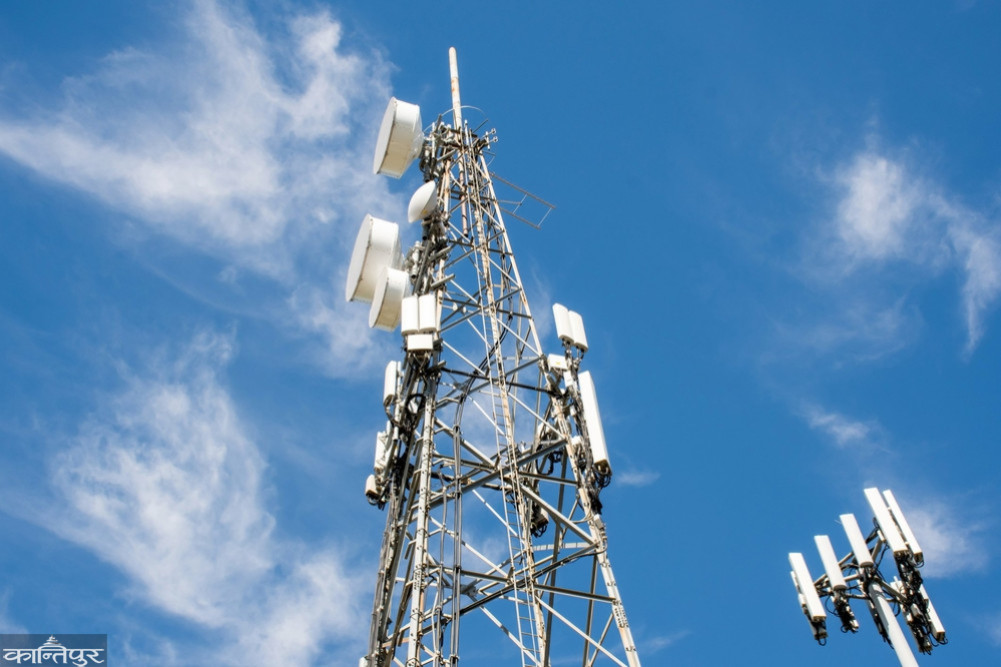
Nepal, which was not included in the index for three years due to lack of data, is making a comeback this time and is appearing on the world map.
We use Google Cloud Translation Services. Google requires we provide the following disclaimer relating to use of this service:
This service may contain translations powered by Google. Google disclaims all warranties related to the translations, expressed or implied, including any warranties of accuracy, reliability, and any implied warranties of merchantability, fitness for a particular purpose, and noninfringement.
Nepal has scored 68.1 points in the 'ICT Development Index 2026' released by the International Telecommunication Union (ITU), the umbrella organization of the telecommunications sector under the United Nations. Nepal, which was not included in the index for three years due to lack of data, is making a comeback on the world map this time. Since 2023, Nepal had not been included in the index due to failure to submit timely and complete data.
Nepal has been listed this year after providing at least 5 out of a total of 10 official indicators. However, there is a gap between the expansion of infrastructure in Nepal's digital development, which is in the group of low-middle-income countries, and its actual use. Nepal's score in the two pillars of the index, 'Meaningful Connectivity', is 83.7, and 'Universal Connectivity' is 52.5. This gap of 31.2 shows that although the access to internet infrastructure and networks has increased in Nepal, its actual use and adoption is slow.
Under Meaningful Connectivity, the ITU measures things like infrastructure expansion, devices, accessibility, digital skills, online security, etc., while Universal Connectivity measures the state of internet usage and how consumers have used or adopted the internet. According to the report, the ‘usage gap’ is the lack of people using the internet despite the availability of infrastructure.
‘The gap between these two pillars narrows as income increases,’ the report says. ‘In high-income countries, such a gap is only 4 points, while in some developing countries where the usage gap is high, there is a gap of 24 points.’
The regulator Nepal Telecommunication Authority has admitted that there is still work to be done to increase the use of information and communication technology. "Although our infrastructure expansion looks promising, we still need to work on the usage side," said MENR spokesperson Min Prasad Aryal. "We plan to move forward by making a special strategy and action plan based on various indicators to improve where we are now." According to him, infrastructure alone is not enough, its productive use and quality are equally important.
Nepal's overall score in information and communication technology development is 68.1, which is lower than the global and regional average. The world's average score is 79, while the average score for the Asia-Pacific region is 80, according to the report. Spokesperson Aryal says that a special strategy and action plan are now needed to bring Nepal to the forefront of the digital map. He says that attention should be paid not only to infrastructure expansion but also to its productive use and quality.
Nepal is in a medium position in digital competition with South Asian countries. Bhutan is at the forefront in this area with 86.4 points, while Sri Lanka is in second place with 78.2 points. Bangladesh's score is 68.9 and Pakistan's is 67.7. India is not included in the index. The leap forward made by Bhutan and Sri Lanka in digital development can be a lesson for Nepal.
According to Aryal, there is a challenge to further strengthen the legal system and implementation to improve Nepal's situation. The report measures the state of information and communication technology based on 10 different indicators. Accordingly, 48.4 percent of Nepal's people use the internet, while 73.1 percent of Nepal's people own their own mobile phones.
In terms of household access, 52.5 percent of households have access to the internet. Similarly, 90 percent of Nepal's population has access to 3G mobile networks, while 81.6 percent use 4G/LTE. The mobile broadband subscription rate is 55.4 per 100 residents. It is seen that the average monthly data consumption per mobile broadband subscription is 17.6 GB and per fixed broadband subscription is 43.7 GB.
The cost of high-consumption mobile data and voice services is 2.9 percent of Nepal's per capita gross national income. The cost of entry-level fixed broadband services under the fixed broadband basket is 1.1 percent of Nepal's per capita gross national income. Data on average data consumed per mobile broadband subscriber, fixed broadband internet traffic is not available.
The ITU has also used estimated data on internet users, home internet access and mobile ownership. The ITU has stated that it keeps estimated data based on the World Bank, previous year's trends and other details. There was a provision that data on at least 5 official indicators was required to be included in this year's index. Nepal has fulfilled that. Spokesperson Aryal said that the authority is preparing to introduce the latest technologies such as 5G and increase digital skills. He said that the goal is to improve Nepal's situation by further strengthening the data system in the coming year.