There are 350 hotels in operation in Nepal, ranging from one to five stars, with 16,613 rooms and 26,285 beds.
We use Google Cloud Translation Services. Google requires we provide the following disclaimer relating to use of this service:
This service may contain translations powered by Google. Google disclaims all warranties related to the translations, expressed or implied, including any warranties of accuracy, reliability, and any implied warranties of merchantability, fitness for a particular purpose, and noninfringement.
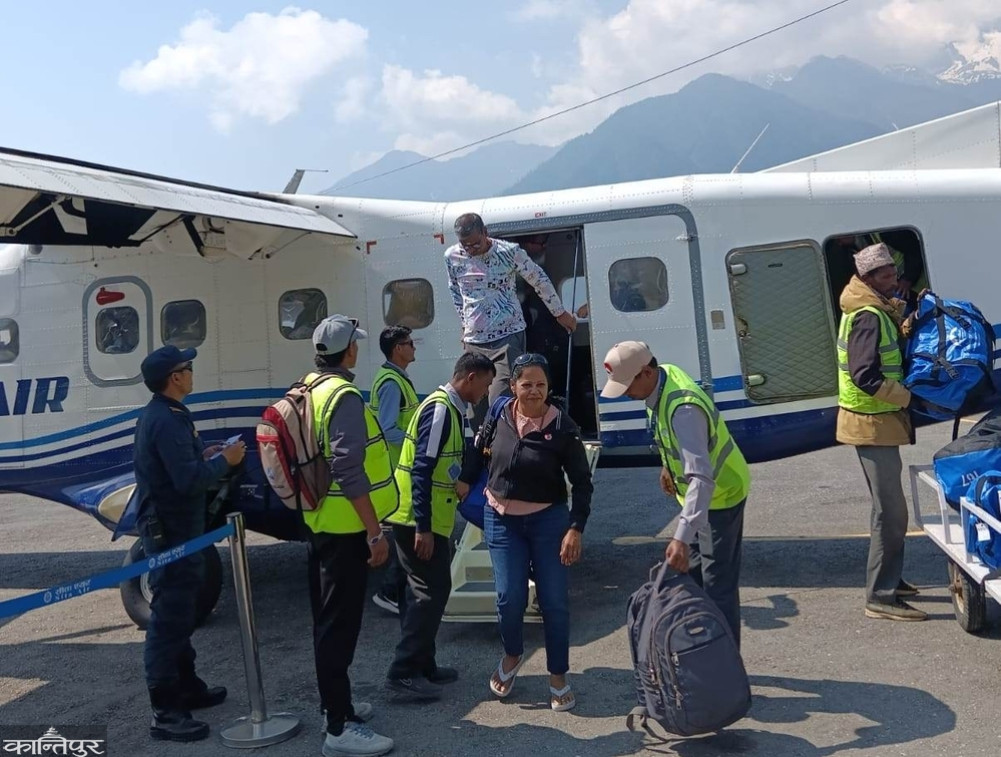
Mustang, the district beyond the Himalayas, where the mountains standing before our eyes sometimes wear silver and sometimes gold crowns. The Jomsom market, with the holy Kaligandaki flowing in the background, is bustling with activity these days.
This activity is not of any celebration, but of tourists. On 26 Jestha, a special day for Mustang. On that day, 3,808 tourists set foot on the soil of Mustang, says Rajesh Prasad Gupta, head of the Area Conservation Office of the National Trust for Nature Conservation (NCNC) in Jomsom. Of them, 250 were Europeans. The rest were religious tourists from neighboring India. This does not include the number of Nepali pilgrims.
It is especially hot in Bihar and Uttar Pradesh, India. As the summer vacations have begun in schools there, people are coming to Nepal in search of coolness, says Bimala Sherchan, the owner of Snowland in Jomsom and the president of the Hotel Association, Mustang. The roads are also good, making it easy for them to travel. ‘Now, the team that left Pokhara in the morning is reaching Jomsom in 4 and a half hours,’ said Chairman Sherchan, ‘Indian tourists are easily coming to Jomsom in EVs.’
Some are bringing their families, children and elderly parents. Gupta said that the number of female teachers in Indian schools is significant. On the other hand, the enthusiasm of Indian youth who have come to enjoy the adventure by riding bikes on the ‘rough’ roads along the banks of Kaligandaki, splashing stones and mud, is also worth seeing.
Nepal Police data shows that the attraction of foreign tourists to the Himalayan district of Mustang has increased dramatically. According to the tourist arrival records of the District Police Office, Mustang, a total of 755,754 domestic and foreign tourists have entered Mustang by the end of Jestha (in 11 months) of the current fiscal year 2082/83.
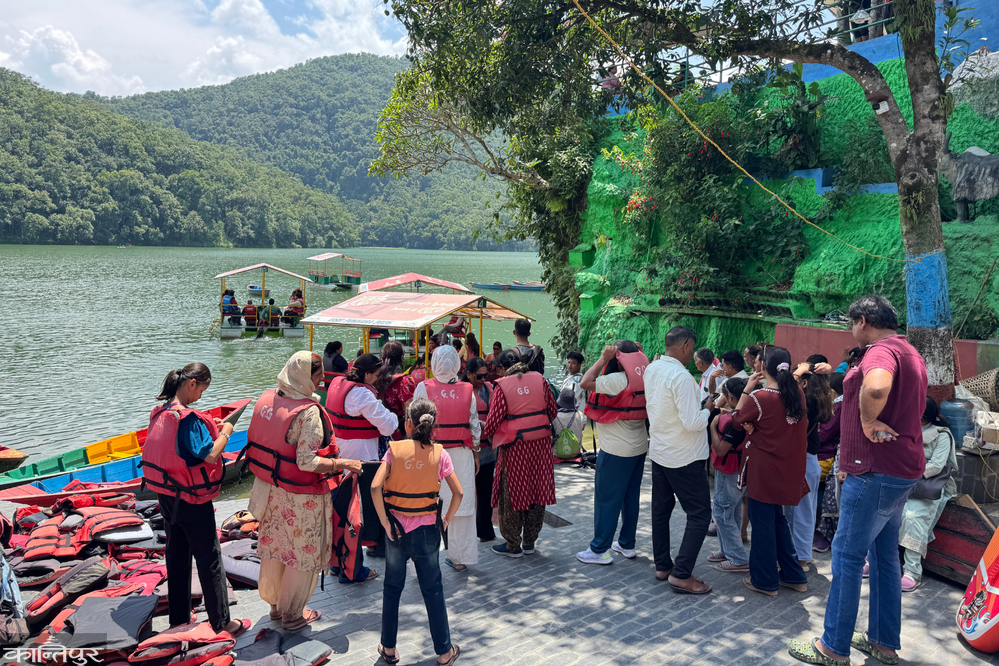 In the last fiscal year, 755,779 tourists visited Mustang. This year, even before the Ashar data is added, the number of tourists has already reached the same level as last year. Police Inspector Santosh Basyal said that there has been an increase of more than 62 percent in the number of foreign tourists entering Mustang in this fiscal year 2082/83 compared to the previous year. By the end of the current fiscal year, more than 244,000 foreign tourists and more than 460,000 domestic tourists, totaling 750,000, have entered Mustang.
During this period, 159,160 vehicles have entered Mustang. Police Inspector Basyal said that about 9,000 domestic/foreign tourists entered Mustang from the temporary border on the day the government granted a four-day holiday in Jestha, while about 15,000 pilgrims gathered in Muktinath.
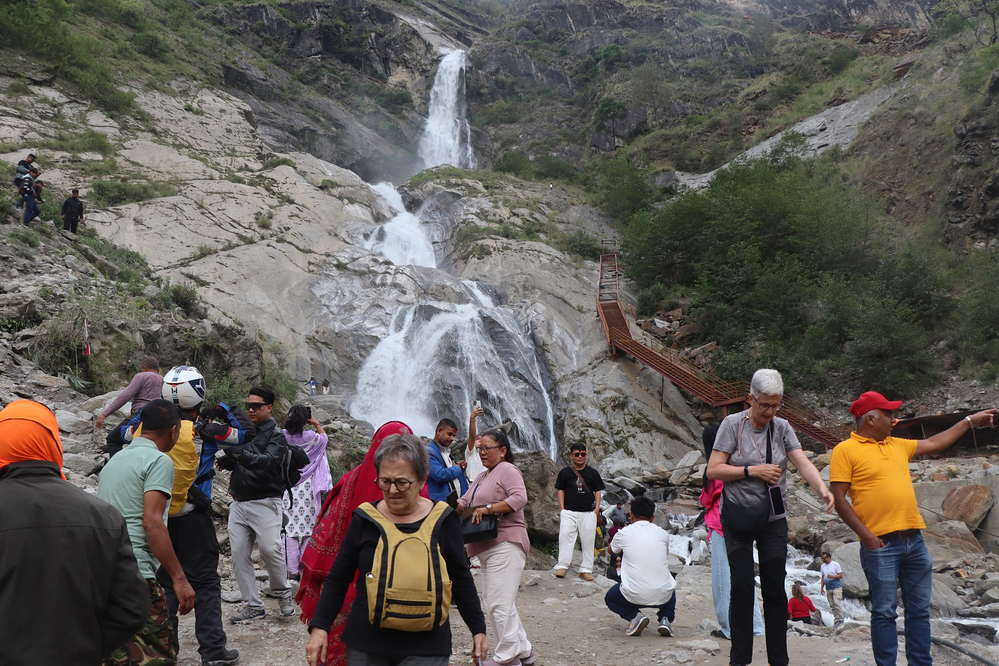
ACAP officer Gupta says that tourists flock to Muktinath due to the faith and unique nature of the pilgrims. ‘For Indian tourists, the first and biggest purpose of coming to Mustang is a religious journey,’ he said. ‘They consider seeing Muktinath, bathing in its 108 streams and experiencing salvation as the greatest blessing and glory of their lives. But the journey does not end with faith alone. When they see the form of Mustang from the courtyard of Muktinath, they become enchanted.’
Huge and sky-high mountains but there is no greenery on them. This ‘tree-less’ (treeless) barren landscape becomes very unique and attractive for them. ‘And the vast expanse of Kaligandaki, which looks exactly like a desert,’ says Conservation Officer Gupta, ‘the joy they see standing in that expanse, wearing traditional Mustang costumes and jewelry, and taking photos and videos is truly indescribable.’
During this ‘off-season’, not only Mustang, but in recent days tourist destinations such as Swargadwari in Dang in the west, Pokhara, Pashupati in Kathmandu, and Dharan in the east are bustling as warm destinations attracting Indian pilgrims and tourists. This off-season tourist rush has reached the peaks of the Himalayas this time.
The enthusiasm of Indian youth who came to enjoy the adventure by riding bikes on 'rough' roads, splattered with stones and mud along the banks of the Kaligandaki is also worth seeing. The history of mountaineering in Nepal, and especially spring mountaineering, has been completed for 76 years. Since French citizens Maurice Herzog and Louis Lachenal climbed Annapurna (8,091 meters) in 2007, it has been a tradition for foreigners to come to Nepal to climb mountains every spring. In mountaineering parlance, spring is called the 'prime season'. But this time, before the start of spring, the joint attack by the United States and Israel on Iran from mid-Falgun cut off 7 airline flights from the Gulf region to Nepal for months.
After the tension in Iran, businessmen expected a big blow to Nepal's 'prime season' prime business. But this time, there was no such negative impact on Nepal's mountain tourism. During the spring mountain climbing season, 1,195 climbers from 79 countries came to Nepal to climb 31 mountains here. The Department of Tourism collected more than 1.08 billion rupees in salami fees from Everest alone. In the spring mountain climbing season of 2026, climbers from all over the world were enthusiastically attracted to the mountains of Nepal.
According to the details released by the Department of Tourism in the last three months from 17 Falgun to 18 Jestha (1 March to 1 June 2026), a total of 149 teams carried out climbing activities in 31 mountains of Nepal this season, including 287 women and 908 men. The Nepal government collected a total of 1.2647 billion rupees (8.470 million US dollars) in salute fees from this mountain climbing. According to Director Himal Gautam, 495 climbers have obtained climbing permits for Mount Everest alone. Citizens from 56 countries of the world had reached the summit alone.
On the occasion of the 73rd International Everest Day organized by the Nepal government this time, Director General of the Department of Tourism, Ram Krishna Lamichhan, said that Nepal's mountains and Mount Everest have made an incomparable contribution to spreading Nepal's identity around the world. Nepal's direct and indirect mountain tourism has been making a significant contribution to the country's economy, diplomacy and social development.
He said that the government receives billions of rupees in royalties annually from this sector, while citizens are getting quality employment and the private sector is getting business opportunities. On average, a climber spends up to 5 million rupees, according to businessmen involved in climbing. In this way, apart from the government, the private sector did a turnover of about 6 billion rupees this spring season.
‘Since the 1950s, there have been huge positive changes in the mountain tourism business and system. The development in the food and accommodation conditions of tourists and modern climbing equipment has made climbing more comfortable, due to which the interest and fascination of foreigners towards mountain climbing is increasing day by day,’ said Director General Lamichhane. He said that a historical record has been set on Everest in the climbing permits and salute fees issued this year.
Director General Lamichhane said that currently, the Khumbu region, Annapurna region and Kanchenjunga region are the main destinations of mountain tourism. ‘Considering the fact that we should pay equal attention to the promotion and publicity of the mountains/hills in Karnali and the Far West of Nepal, the current government has included it in the 100 priorities of the 100 days,’ he said.
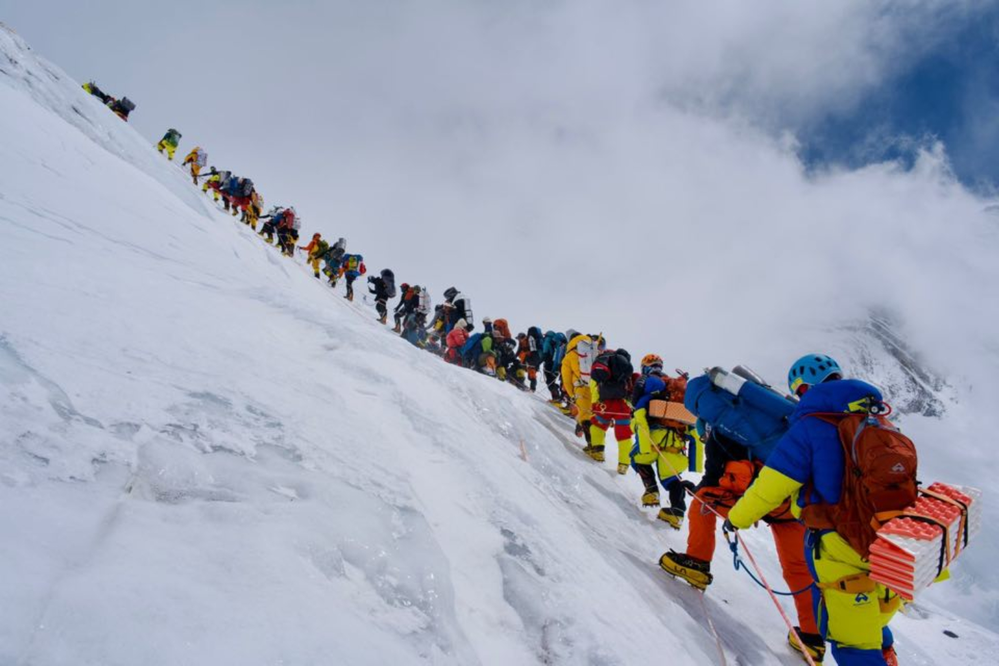
 Dambar Parajuli, President of the Mountaineering Operators Association of Nepal, said that the attraction of climbers from all over the world towards Nepal’s mountaineering is increasing. ‘The revenue of billions collected in the spring season this year and the market that has become dynamic have reaffirmed the special contribution of mountain tourism to Nepal’s economy,’ he had said at an association program a few days ago. Clarifying the fact that the opening of the road was delayed by a few weeks compared to the previous one due to the snowfall in the Khumbu Icefall in the initial stage of the Everest climb, President Parajuli said, ‘There was no ‘traffic jam’ on Everest as was being discussed outside.’
Despite some delays at the beginning of the season, Parajuli says that due to the tireless efforts of the skilled Nepali team, the highest number of climbers have successfully scaled the peak this season, which has once again raised the level of Nepal's climbing management efficiency among the world. According to the association, 1,080 domestic and foreign climbers have climbed Mount Everest this year. This number is claimed to be the highest ever.
After photos/videos of Indian tourists cooking and drying clothes on the roadside became public with the increase in the summer season, the Ministry of Culture, Tourism and Civil Aviation last week published rules, safety and conduct rules for foreign tourists visiting Nepal by road. The ministry had issued instructions through social media with the aim of making Nepal visits safe, organized and tourist-friendly.
There is a shortage of food and accommodation for vegetarian pilgrims in Nepal, and the necessary infrastructure (hotels, dharamshalas, toilets) for such a large number of tourists is not yet ready. In an interview with Kantipur, Minister Poudel had said that even if only 1 percent of India's total population of tourists could be brought to Nepal, at least 10 million religious tourists could come annually. However, he said that there is a shortage of food and accommodation for vegetarian pilgrims in Nepal, and the necessary infrastructure (hotels, dharamshalas, toilets) for such a large number of tourists are not yet ready. Minister Poudel said that Indian pilgrims are mostly vegetarian, but since vegetarian hotels are limited in Nepal, they have chosen the option of cooking their own food. He said that the construction of dharamshalas and the increase in vegetarian restaurants at various religious destinations have been prioritized from the coming fiscal year. In order to make Nepal visits safe, organized and dignified, all rules related to travel, health, culture and security were urged to be followed. Amidst the debate that started after the Indian tourist photo went viral on social media, Tourism Minister Khadak Raj Poudel had said that the changing nature of Nepal-India religious tourism should be turned into an opportunity.
After stating that a list of vegetarian hotels and restaurants from Bhairahawa to Pokhara to Muktinath would be made available to tourists at the border checkpoint, the department is currently collecting data. ‘Just as our parents look for pure food when they go to pilgrimage sites in India, Indian pilgrims also look for the same when they come to Nepal. If there were enough vegetarian restaurants and dharamshalas, they would not have to cook food on the road,’ the Tourism Minister said. ‘Therefore, instead of criticizing only on social media, the government is planning and working in this sector from the coming year, considering it necessary to focus on infrastructure management.’
It has been found that private sector investment in Nepal’s tourism and hospitality (hotels, resorts and restaurants) sector has expanded unprecedentedly. According to the Office of the Registrar of Companies, Tripureshwor, from 2063 to 2083 Jestha, 6,570 hotels, luxury resorts, restaurants and tourism infrastructure companies including cable cars have been registered in Nepal during this period. Analyzing the financial details of these companies, it is evident that the size of capital in Nepal's tourism business has become very large.
 The total authorized capital in this sector is more than 456.37 billion rupees, while entrepreneurs have committed to actual investment through issued capital worth 331 billion rupees. With the construction of international airports and the increase in the number of foreign and domestic tourists, there is competition to open star hotels and luxury resorts across the country.
According to the Office of the Registrar of Companies, billions of rupees are being invested in cable car and integrated resort projects in various parts of the country, not only in tourist areas such as Kathmandu Valley, Pokhara, Chitwan, Bhairahawa and Lumbini. This issued capital of more than 331 billion rupees is one of the largest investments in the service sector of Nepal, says Tek Mahat, Chief Executive Officer (CEO) of the Hotel Association of Nepal. He said that this has created millions of direct and indirect jobs in the country and has laid a strong foundation to establish Nepal as one of the best premium tourism destinations in the world.
According to an official of the Department of Tourism, 41 large hotels and resorts, prestigious chain hotels across the country have been in the environmental assessment process for the last 5 years. To ensure legal investment and environmental sustainability in the tourism and hospitality sector of Nepal, 41 large hotels, resorts and hospitality businesses across the country have joined the legal process of environmental assessment.
These hotels, which are operating or under construction in various districts, are undergoing the process of preliminary environmental testing, environmental impact assessment, brief environmental study and approval. According to the details registered with the concerned government bodies, meetings have been scheduled to review the environmental reports and work schedules of various hotels from 2082 Mangsir to 2083 Jestha mid-2083.
The number of partnerships and investments by world-famous chain hotels in Nepal has also increased. Currently, there are 350 hotels ranging from one to five stars in operation in Nepal, with 16,613 rooms and 26,285 beds. According to the latest data from the department, there are 44 one-star hotels, 49 two-star hotels, 37 three-star hotels, 40 four-star hotels, and 28 five-star hotels.
There are 3 five-star deluxe hotels, 3 luxury guesthouses/heritage hotels, 5 deluxe four-star hotels, 1 normal heritage hotel, 127 ordinary resorts, 10 deluxe resorts, and 3 luxury resorts in operation. All of these are monitored by the Department of Tourism.