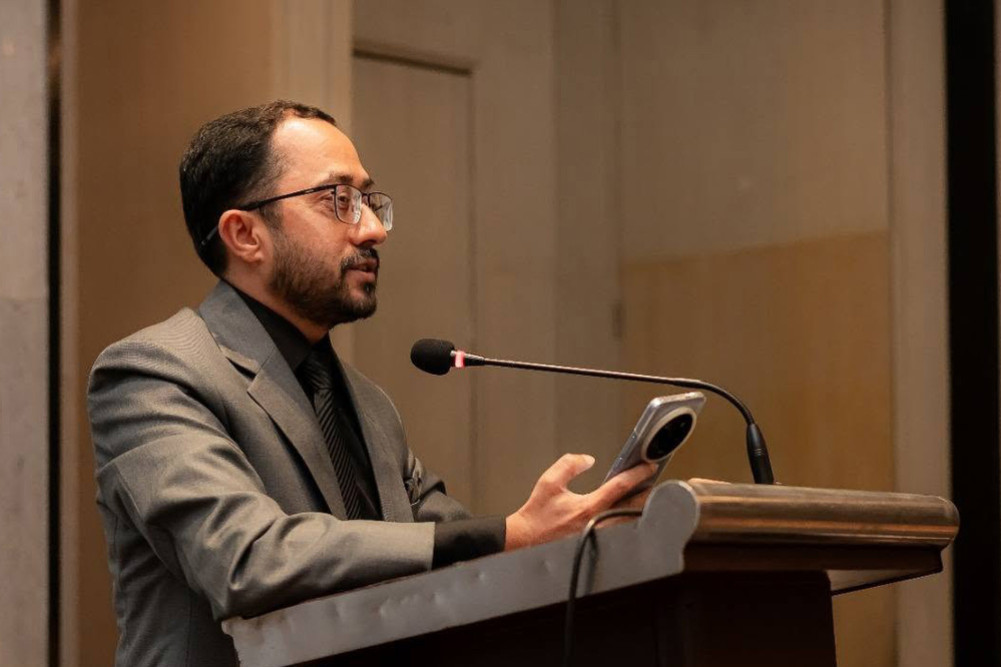
Acting Governor Pandit expressed the view that monetary policy should be coordinated with the budget and balance inflation, financial stability, and market expectations.
We use Google Cloud Translation Services. Google requires we provide the following disclaimer relating to use of this service:
This service may contain translations powered by Google. Google disclaims all warranties related to the translations, expressed or implied, including any warranties of accuracy, reliability, and any implied warranties of merchantability, fitness for a particular purpose, and noninfringement.
Nepal Rastra Bank Deputy Governor and Acting Governor Kiran Pandit has said that while the upcoming monetary policy will support the government's goal of high economic growth, it should equally address the challenge of maintaining economic stability.
At a program on 'Role of Monetary Policy in Accelerating Economic Growth' organized by the Society of Economic Journalists (SEJON) on Tuesday, Pandit mentioned that the process of formulating monetary policy is now underway even though the government has already made the fiscal policy (budget) public. He expressed confidence that the discussions taking place at such a time will provide policy suggestions to the Rastra Bank.
He said that although there is a natural interrelationship between fiscal policy and monetary policy and in some cases even conflict, both policies should proceed in a coordinated manner. He said that although monetary policy should support the government's goal of high economic growth, the responsibility of keeping inflation, financial stability and other economic indicators within the desired limits is equally important.
Pandit clarified that the NRB will formulate policies keeping in mind its goals, the basis and mechanism of monetary policy operation. Stating that there is a great expectation in the market towards monetary policy, he pointed out the need to manage those expectations carefully. He also emphasized the need to clearly understand the difference between regulatory reform and monetary policy.
He said that there is a need to formulate a clear commentary on policy decisions and regulatory arrangements related to the banking sector. He said that a serious review is needed on the impact of loan restructuring and concessional arrangements implemented during the COVID-19 pandemic on the banking system and capital formation.
Acting Governor Pandit also drew attention to the rapidly evolving digital challenges in the financial sector. He said that issues such as fintech, open banking, monitoring of digital transactions and technology-related risk management have now become important agendas of monetary policy and regulatory frameworks. He believed that there was a need for thematic reviews and continuous dialogue in view of such changes.
He also emphasized the need to bridge the gap between the policy-making level and the general public. Noting that the real needs and problems of the youth, farmers and lower-level citizens in particular have not reached the policy-making process, he said that the role of the media would be important in bridging this gap. According to him, such discussions expand the dialogue between policymakers and stakeholders and provide useful suggestions for practical policy reforms, so it is necessary to continue such programs.