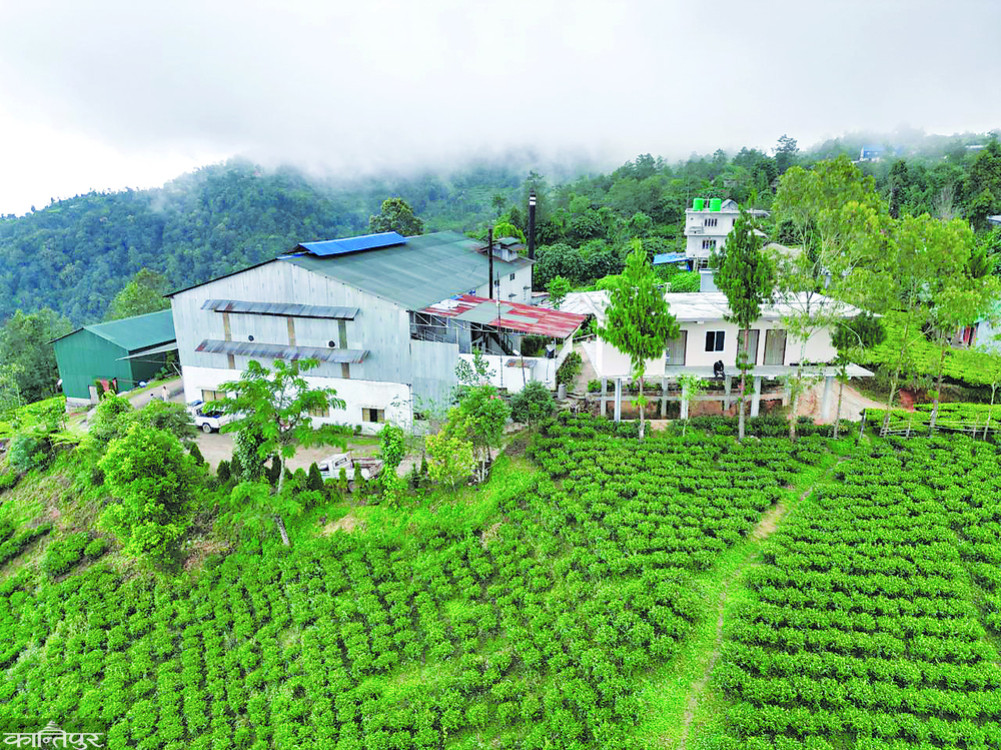
Dilli Shrestha, president of the Suryodaya Orthodox Tea Producers Association, said that after discussions between the Tea Problem Resolution Committee of Suryodaya Municipality, local people's representatives, and the Suryodaya Orthodox Tea Producers Association, a three-point agreement was reached on the issue of operating the industry.
We use Google Cloud Translation Services. Google requires we provide the following disclaimer relating to use of this service:
This service may contain translations powered by Google. Google disclaims all warranties related to the translations, expressed or implied, including any warranties of accuracy, reliability, and any implied warranties of merchantability, fitness for a particular purpose, and noninfringement.
53 tea industries in Suryodaya Municipality, Ilam, which were closed in protest after exports were hit by the new standard operating procedures (SOP) implemented by the Tea Board of India, are set to reopen.
A three-point agreement was reached after discussions between the Tea Problem Resolution Committee of Suryodaya Municipality, local people's representatives and the Suryodaya Orthodox Tea Producers Association on operating the industry, said Suryodaya Orthodox Tea Producers Association President Dilli Shrestha. According to him, the municipality will arrange a systematic storage room to store about one million kilograms of tea that is stuck in the industry until the tea export to the Indian market becomes easier. Similarly, an agreement has been reached between the industrialists and farmers to postpone payments to farmers for some time until the market situation improves.
Similarly, the agreement states that awareness programs will be conducted in all wards with the participation of the municipality, industrialists and farmers, completely banning the use of pesticides to improve the quality of tea.
Nepali tea exports were affected after India implemented a new rule from May 1 that required mandatory laboratory testing of every tea truck, taking about 15 days to receive the test report, and requiring a fee of INR 11,500 per truck. After exports were halted, Suryodaya industries were closed. With the closure of the industry, farmers were forced to sell 60 to 70 trucks of green tea daily to the CTC industry in Jhapa.
Nepal produces about 15,600 metric tons of tea annually, of which 86 percent is exported to India. Tea is cultivated on an area of 20,602 hectares across the country. More than 15,000 farmers and about 60,000 workers are directly dependent on this sector.