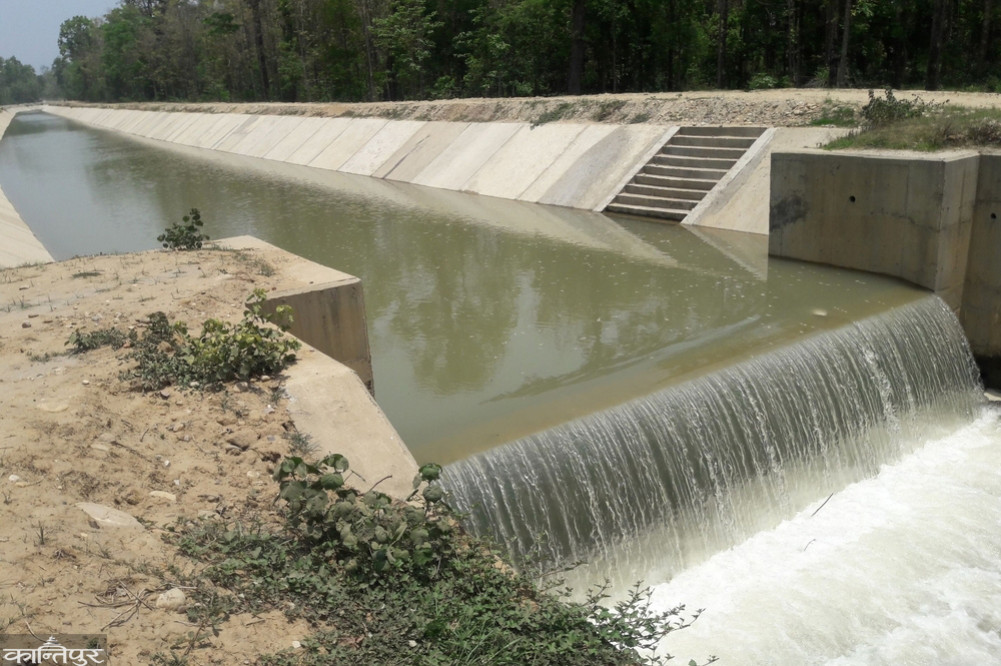
The Ministry of Energy, Water Resources and Irrigation has given high priority to irrigation expansion, river control, and the implementation of projects of national pride.
We use Google Cloud Translation Services. Google requires we provide the following disclaimer relating to use of this service:
This service may contain translations powered by Google. Google disclaims all warranties related to the translations, expressed or implied, including any warranties of accuracy, reliability, and any implied warranties of merchantability, fitness for a particular purpose, and noninfringement.
The government has set a target of expanding irrigation facilities to an additional 15,776 hectares of cultivable land in the coming fiscal year, bringing the total irrigated cultivable area of the country to 64 percent.
The Ministry of Energy, Water Resources and Irrigation has given high priority to irrigation expansion, river control and implementation of national pride projects. Currently, a total of 1.587 million hectares of land across the country have been irrigated.
Of the irrigable land, 532,090 hectares have been irrigated throughout the year. Lift and reservoir irrigation facilities have reached 5,671 hectares of arable land. Projects that are under construction and need maintenance have also been given equal priority, Minister for Energy, Water Resources and Irrigation Biraj Bhakta Shrestha informed.
According to the ministry, 1,524 kilometers of embankments have been completed so far on 84 rivers falling within the jurisdiction of the federal government. 13,821 hectares of land have been uplifted through this work. The ministry has stated that it aims to complete 70 kilometers of additional embankments and raise 210 hectares of land in the coming fiscal year.
Minister Shrestha said that the government has placed special emphasis on completing old and strategically important projects in the irrigation sector on time. The ministry is preparing to put all its efforts into accelerating the Bheri-Babai 'Diversion' Multipurpose Project and the Sunkoshi-Marine Diversion Project, which have not gained momentum due to construction entrepreneurs.
Sikta Irrigation Project and Rani-Jamara-Kulariya Irrigation Project have been given high priority. Sunsari-Morang Irrigation Project, Chandra Canal, Kamala Irrigation, Narayani Irrigation Project, Gandak Irrigation System and Koshi Pump Irrigation have also been given priority. The ministry has stated that a budget of Rs 10.2468 billion has been allocated for national pride irrigation projects alone.
The development of groundwater and lift irrigation systems in areas not served by surface irrigation has also been prioritized. A budget of Rs 1.84 billion has been allocated to develop a cluster-based groundwater irrigation system by utilizing the groundwater resources available in about 318,000 hectares of agricultural land in Terai-Madhes.
Similarly, Rs 800.28 million has been allocated to expand irrigation through lift technology in arable tar areas that do not have irrigation facilities. This program is believed to increase agricultural production and contribute to job creation and entrepreneurship promotion at the local level.
An integrated Karnali Irrigation Development and River Control Program will be launched in Karnali Province with the objective of improving the living standards of citizens, strengthening food security, and protecting and promoting local crops. In addition, a budget of Rs 922.3 million has been allocated for the River Basin and Tar-Bazaar Conservation Program and the Bheri Corridor Irrigation and River Management Project.
It is stated that a national policy has been adopted to protect rivers not only as a basis for water resources but also as a heritage linked to human civilization, culture, biodiversity and human existence. A program to conduct scientific studies of rivers with religious, cultural, environmental and social significance, and to preserve the traditions, lifestyles and spiritual values of indigenous communities connected to the rivers as national heritage has been included for the first time.