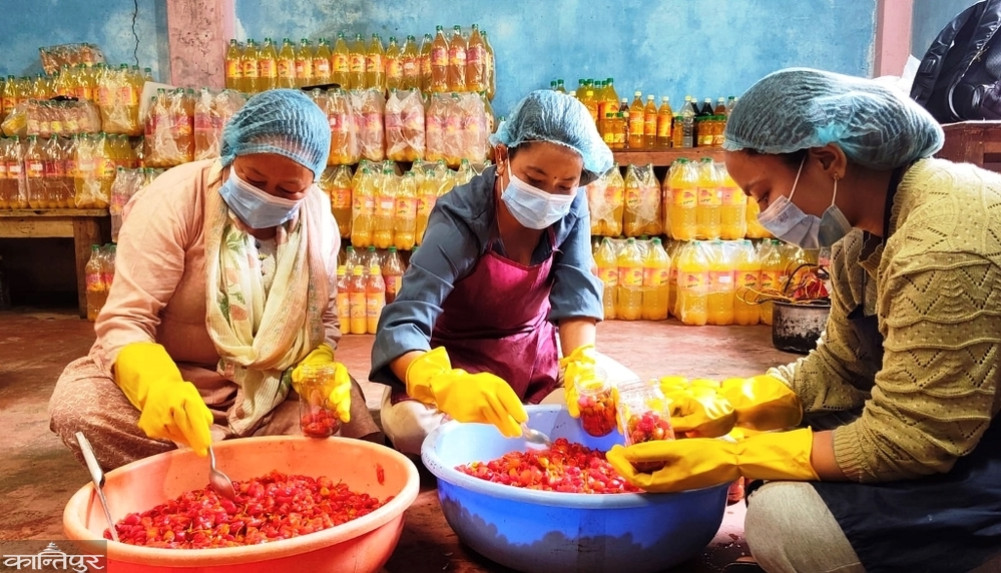
The industry, which Bishnumaya, who came to Dhankuta from Tehrathum, started with a small investment in 2052, now sells 20 products across the country and employs 8 people.
We use Google Cloud Translation Services. Google requires we provide the following disclaimer relating to use of this service:
This service may contain translations powered by Google. Google disclaims all warranties related to the translations, expressed or implied, including any warranties of accuracy, reliability, and any implied warranties of merchantability, fitness for a particular purpose, and noninfringement.
In Dhankuta, Bishnumaya Kandangba is known by many as 'Kavita' rather than her real name. Active in the fruit processing sector for more than three decades, she has become a successful example of rural women's entrepreneurship. The industry that started with an investment of three hundred thousand rupees has now expanded to a business with an investment of more than 150 million rupees.
Kavita, who came to Dhankuta from Tehrathum in 2048 BS after marriage, came up with the idea of earning money through fruit processing after seeing that the locally abundant junar and oranges were being wasted due to lack of market. That idea changed the direction of her life.
When she was 22 days pregnant, she struggled to get training on orange processing. Although the organizer initially refused, she participated in the training after the initiative of the then VDC President Narendra Niraula. 'I don't need stationery, I don't need allowance, I just let them sit in the training and then I'll participate,' she said. 'After that training, I started fruit processing in 2052 BS. In 2056 BS, I registered the Kavita Fruit Processing Industry.'
The industry, which started from a rented house, expanded by converting local farmers' produce into marketable goods. In 2066 BS, she was declared the best entrepreneur of Dhankuta. As the best entrepreneur, she got the opportunity to visit Thailand, Cambodia, Vietnam, Singapore and Malaysia. She says that international experience has given her a new perspective on operating the industry and expanding the market.
Initially, the industry started with the processing of junar and oranges, and now has brought more than 20 products to the market. Mango, orange and betel juice and squash, betel squash, mango, lemon, copper and chilli pickles, ready-to-serve beverages, tomato ketchup and soy sauce are the main products of the industry. The market, which started in Dhankuta, has now expanded to various parts of the country, including Kathmandu.
While operating the industry, she also faced challenges such as technical shortages, political instability, Maoist armed conflict and the Corona pandemic. She says that the loss during the Corona pandemic alone was around 5.8 million rupees. She says that the business network that was broken after Corona has not yet been fully restored.
She demands that the state create an environment that allows it to compete with products coming from outside. 'If only our products were guaranteed to be sold, then we can run it ourselves,' she says.
The industry currently employs about eight people, both regularly and part-time. She says that it has been providing employment and skills, especially to women from the families of men who are employed abroad. She is proud that many women who have learned work in the industry have later started their own businesses. 'If I had gone into employment, I would have been self-employed,' she says, 'there would have been no industry and I would not have been able to provide employment to others. Now, the livelihood of many families, including my family, is linked to this industry.'