In April alone, remittances worth 257.49 billion rupees have been received, the highest monthly figure ever.
We use Google Cloud Translation Services. Google requires we provide the following disclaimer relating to use of this service:
This service may contain translations powered by Google. Google disclaims all warranties related to the translations, expressed or implied, including any warranties of accuracy, reliability, and any implied warranties of merchantability, fitness for a particular purpose, and noninfringement.
Remittance inflows sent by Nepalis living abroad increased by 41.2 percent in April. According to the monthly report of the Nepal Rastra Bank, remittances of Rs. 1916 billion were received in the 10 months of the current fiscal year (from Shrawan to Baisakh).
Amid speculation that remittances entering Nepal will be affected due to the impact of the war in the Gulf countries, a high increase was also seen in Baisakh. The remittances that have come to Nepal till Baisakh are more than those that entered the entire last fiscal year. In the last fiscal year, Rs. 1723 billion had entered the country. Remittance inflows till Baisakh 2082 had increased by 13.3 percent.
Similarly, in Baisakh 2083 alone, remittances of Rs. 257.49 billion have been received. This is the highest amount ever in monthly terms. Earlier, Rs. 299 billion in remittances were received in Chaitra. In Baisakh last year, remittance inflows were Rs. 165.30 billion. In Baishakh, remittance inflows in US dollars increased by 33 percent to Rs 13.26 billion. Last year, such inflows increased by 10.6 percent.
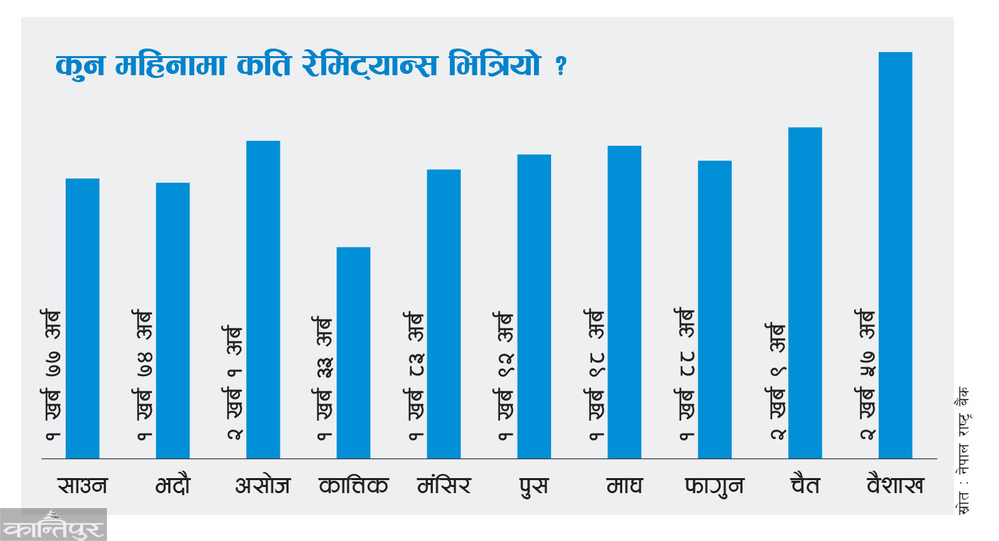
‘Fluctuations in the exchange rate of the US dollar and public holidays abroad on the last day of the month reduce remittances by 4/5 percent in the month. The last day of Baishakh was Thursday. That is why there have been some more remittances,’ said Chandra Tandon, former president of the Nepal Money Remitters Association, ‘The increase in the value of the dollar and the start of more remittances from the European region have led to a continuous increase in remittances in recent months.’
According to Tandon, about 35 percent of remittances are coming from the Gulf countries and the remaining 65 percent are coming from the European region and other countries. ‘The impact of the war is not in Saudi Arabia and Kuwait at the moment. There is a little bit in Bahrain. It is unclear whether the service sector including hotels in the UAE will be affected for some time. However, the remittances from these regions are decreasing,' he said, 'as more than that is coming from Europe, the overall remittances are continuously increasing.'
Currently, about 40 percent of the remittances coming to Nepal come from West Asia. This share has been decreasing in recent months. Currently, there are about 1.9 million Nepali workers in the Gulf region. Of the 700,000 Nepalis who go abroad for employment every year, about 65 percent, or 450,000, go to the Gulf countries alone.
In the fiscal year 2081/82, 1.7 trillion 2 billion remittances were received. Of that, the Gulf countries' share was about 39 percent (673 billion). Similarly, the Gulf region's share was 38.9 percent in the fiscal year 2080/81 and 45.1 percent in the fiscal year 2079/80. Apart from this, India's share in the total remittances coming to Nepal till last Chaitra, about 10 percent, and the UK, Australia and Malaysia's about 6/6 percent remittances entered Nepal, according to the National Bank.
The West Asian War has not yet had an impact on remittances entering Nepal, said Guru Prasad Poudel, spokesperson of the National Bank. According to him, remittances from the Gulf region have increased by 8.2 percent in April compared to last Chaitra and by 39 percent annually. From Ashar to Baisakh of the current fiscal year, the Nepali rupee has depreciated by about 10.4 percent against the US dollar. This change in the exchange rate has helped increase the monetary value of remittances as the income received in foreign currencies is converted into Nepali rupees at a higher rate, said spokesperson Poudel.
‘Recently, there has been an increase in the trend of sending remittances through formal channels. "With the expansion of the banking system, digital payment infrastructure and remittance companies, it can be assumed that the trend of moving from informal channels to formal channels has increased," he said. "However, it seems that information technology service income, personal transfers and other private income may also be included under the remittances from workers heading, which can only be confirmed through a comprehensive analysis." Although the number of Nepali workers going for foreign employment has decreased in recent months, it had increased continuously before. As a result, remittances have increased, said Spokesperson Poudel.
Thus, due to the effect of the exchange rate, continuous income flow from West Asia, expansion of formal channels and stability of foreign employment, remittance inflow has increased significantly in the current fiscal year, said Poudel. He said that this has made a positive contribution to Nepal's external sector stability, foreign exchange reserves and domestic consumption.
The positive impact of the high rate of increase in remittances has also had on foreign exchange reserves. Accordingly, foreign exchange reserves have reached Rs 3,744.55 billion as of Baisakh. This is an increase of 1026 billion rupees, or 38.3 percent, compared to last Ashar. In mid-Ashar, 2082, the total foreign exchange reserves were 2677.68 billion rupees. 'Such reserves in US dollars increased by 24.0 percent to 24.19 billion rupees in mid-Ashar, 2082, from 19.5 billion rupees in mid-Ashar, 2082, to 24.19 billion rupees in mid-Baisakh, 2083,' the monthly report of the Nepal Rastra Bank said.
Based on imports up to 10 months of the fiscal year 2082/83, the foreign exchange reserves held by the banking sector are sufficient to cover 22.6 months of goods imports and 19.2 months of goods and services imports. The National Bank's target was to maintain foreign exchange reserves sufficient to cover at least 7 months of imports this year. In mid-Baisakh, 2083, the ratio of foreign exchange reserves to gross domestic product (GDP) was 60.7 percent.
Similarly, the inflation rate has started increasing continuously in recent months. Accordingly, the average price increase in the last Baisakh was 5.04 percent. In 2082 Baisakh, the price increase in the food and beverage group was 4.63 percent, while that in the non-food and service group was 5.26 percent. In the same Baisakh last year, the price increase in these groups was 1.52 percent and 3.45 percent, respectively.
The average price increase in the 10 months of the current fiscal year is 2.66 percent. The average price increase in the same period of the previous year was 4.39 percent. Similarly, during the month, the annual point consumer price index of the fruits subgroup under the food and beverage group increased by 18.60 percent, ghee and oil by 13.99 percent, vegetables by 5.40 percent, and fish and meat by 4.16 percent. However, the annual point consumer price index of the pulses and legumes subgroup decreased by 1.67 percent and spices by 0.65 percent.
The annual point consumer price index of the miscellaneous goods and services subgroup under the non-food and services group has increased by 19.90 percent, transportation by 15.30 percent, education by 5.54 percent, alcoholic beverages by 4.77 percent, and clothing and footwear by 4.73 percent. In the last 10 months alone, 16.96 billion foreign direct investment (equity only) has been inflow. In the same period last year, such foreign direct investment (equity only) had inflow of 10.58 billion. With the increase in remittances, the balance of payments surplus has also reached 863.56 billion. In 2082 Baisakh, the balance of payments position was in surplus by 438.52 billion.

