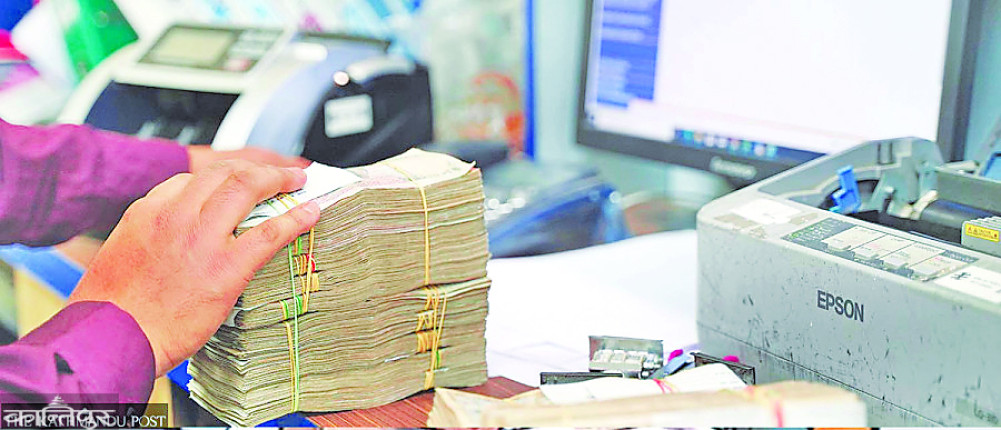
There has been excess liquidity in the financial system for the past three years, and it has been steadily increasing in recent months.
We use Google Cloud Translation Services. Google requires we provide the following disclaimer relating to use of this service:
This service may contain translations powered by Google. Google disclaims all warranties related to the translations, expressed or implied, including any warranties of accuracy, reliability, and any implied warranties of merchantability, fitness for a particular purpose, and noninfringement.
Despite the fact that the average loanable amount (excess liquidity) is more than 10 trillion rupees per year due to the failure to increase credit demand, the financial and insurance sector is projected to expand by 9.16 percent in the current fiscal year. This growth rate is 1.61 percentage points higher than the previous fiscal year.
The growth rate of the financial and insurance sector is expected to improve this year compared to last year due to the increase in deposits and loan flows in banks and the increase in the collection of renewal premiums for non-life insurance and life insurance, said Dhundiraj Lamichhane, Deputy Chief Statistical Officer and Spokesperson of the National Statistics Office.
‘The total value added of this sector is expected to increase due to the increase in the income of social security funds, provident funds, citizens' investment funds and securities trading commercial and merchant banks,’ said Spokesperson Lamichhane. The National Statistics Office has revised the growth rate of this sector to 7.55 percent in the fiscal year 2081/82. In the fiscal year 2080/81, the growth rate of this sector remained at 9.96 percent, according to the office.
Although the growth rate of this sector has improved in the current fiscal year, its contribution to the gross domestic product (GDP) has not increased. Rather, it has shrunk slightly. The statistics office estimates that the financial and insurance sector will contribute 6.72 percent to the GDP in the current fiscal year. In the previous fiscal year, the contribution of this sector to the GDP was 6.78 percent.
Although credit expansion from banks and financial institutions has not been as expected in the last 9 months, net profit has increased by about 19 percent due to increased loan recovery, decreased bad loans, and increased non-interest income, said Santosh Koirala, President of the Nepal Bankers Association. He said that this may have had a positive impact on the economic growth rate.
‘Income other than interest income including remittances, digital transactions, letter of credit guarantees, treasury bills, service fees, etc. has increased in recent months,’ said Chairman Koirala, ‘Mainly small loan recovery has increased. There has been a positive improvement in the tendency of customers to repay after taking a loan.' He said that the financial condition of the bank will further improve in Ashar. He said that since Ashar is the end of the financial year, there is a possibility of recovering a lot of loans, and since the profitability of banks is seen to improve, there are expectations that the growth rate will also improve.
As of the second week of Jestha, there is more than 1.3 trillion rupees in excess liquidity (amount that can be given loans). Although the government has said that appropriate policy and legal arrangements will be made for investment promotion, economic reform and smooth service delivery through the upcoming budget, there has been no clear policy for utilizing the excess liquidity in banks and financial institutions.
Excess liquidity has accumulated in the financial system for the last three years. It has been increasing continuously in recent months. Foreign exchange reserves are around 35 trillion. The government was expected to bring a policy through the budget that would utilize the investment in the financial system.
In this context, Finance Minister Swarnim Wagle admitted that it has not been possible to directly bring a policy that would utilize the excess liquidity in banks. In the first press conference after the budget was made public (17 Jestha), Finance Minister Wagle had said that the government could not think about liquidity utilization due to the constitutional limit of not being able to take domestic loans exceeding 5.5 percent of GDP. ‘But there are other tools in the budget for liquidity utilization,’ Finance Minister Wagle had said at that time, ‘We have made arrangements in the budget to allow projects to raise investment from outside the government’s balance sheet (budget system).’ He claims that this will help in the utilization of liquidity in the banks.
From last Shrawan to Chait, banks and financial institutions have collected deposits of Rs 615.67 billion. This is an increase of 8.5 percent compared to the 9 months of last year. Deposit collection had increased by 5.7 percent in the same period last year.
From last Shrawan to Chait, banks and financial institutions have disbursed loans of Rs 311.95 billion. This is an increase of 5.7 percent. This year, the National Bank has set a target of expanding credit by 12 percent. But looking at the situation as of Chaitra, experts say that it will be difficult to meet the 12 percent target.
According to the data of the Nepal Rastra Bank, out of the loans flowed from banks and financial institutions to the private sector as of Chaitra 2082, the share of loans flowed to the non-financial institutional sector was 63.3 percent and the share of loans flowed to the individual and household sector was 36.7 percent. In the same period last year, such shares were 63.4 percent and 36.6 percent, respectively.
As of Chaitra last, 14.9 percent of the loans invested by banks and financial institutions were secured by current assets (agricultural and non-agricultural goods) and 63.4 percent were secured by real estate collateral. In the first nine months of the fiscal year 2082/83, loans in the consumer sector increased by 11.7 percent, in the construction sector by 10.7 percent, in the transport, communication and public services sector by 10.1 percent, in the industrial production sector by 6.5 percent, in the finance, insurance and real estate sector by 5.7 percent, and in the service industry sector by 3.1 percent. But the NRB data shows that agricultural sector credit has decreased by 2.3 percent.
Among the loans provided by banks and financial institutions, trust receipt (import) loans increased by 32 percent, margin loans by 13.4 percent, hire purchase loans by 8.5 percent, real estate loans (including personal residential home loans) by 4.6 percent, demand and other working capital loans by 4.3 percent, term loans by 3.7 percent, cash credit loans by 2.8 percent, and overdraft loans by 0.3 percent, the NRB has stated.