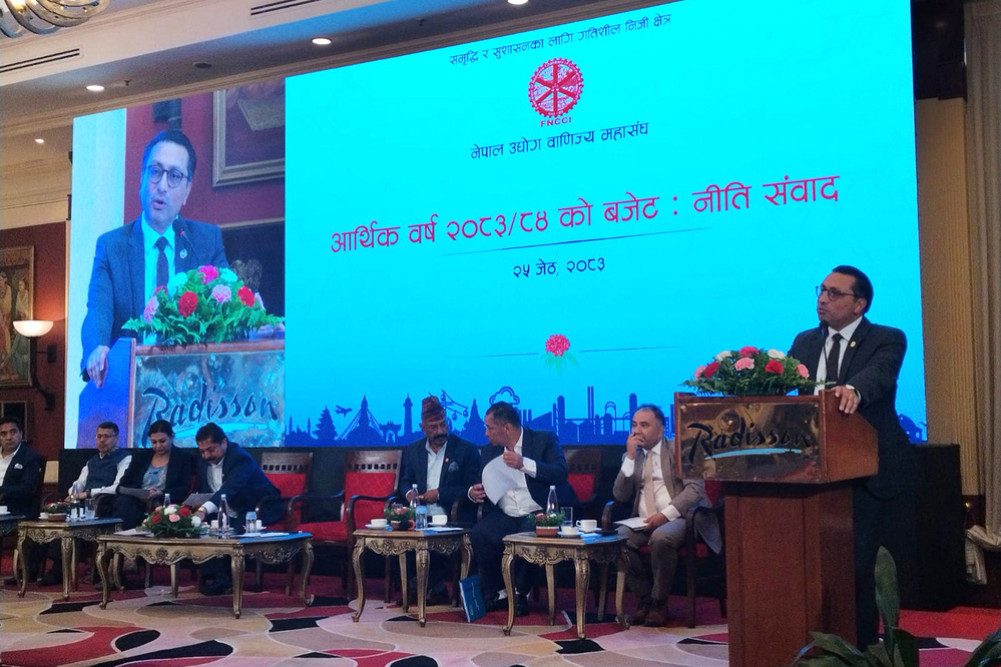
The Finance Minister claimed that efforts have been made to encourage the private sector and increase production, and that the government has adopted a policy to protect domestic industries and products.
We use Google Cloud Translation Services. Google requires we provide the following disclaimer relating to use of this service:
This service may contain translations powered by Google. Google disclaims all warranties related to the translations, expressed or implied, including any warranties of accuracy, reliability, and any implied warranties of merchantability, fitness for a particular purpose, and noninfringement.
The Federation of Nepalese Chambers of Commerce and Industry (FNCCI) has said that effective implementation is essential even though the budget for the upcoming fiscal year is expected to break the economic slump seen in recent years. At a policy dialogue organized by the federation in Kathmandu on Monday, President Anjan Shrestha clarified that the private sector will not weigh the budget in terms of support or opposition.
‘We see that the budget improves the investment environment, increases production and creates employment in the country,’ he said, ‘In this way, I want to give this budget the benefit of the doubt, this budget is on the right track.’
Chairman Shrestha clarified that the budget has dared to break that cycle when Nepal’s economy has been stuck in a cycle of protectionism, informality and administrative hassles for decades. ‘We have to see how the implementation will be.’ Evaluation of any budget is incomplete without the context of the circumstances in which it was made. Our economy has been going through an uncomfortable paradox for a few years,' he said, 'On the one hand, investable funds have been piling up in the banking system, interest rates have fallen to historic lows. On the other hand, demand for credit has not increased. Because demand in the market is shrinking. Private investment has slowed down, capacity utilization of industries has decreased, and youth power is constantly migrating abroad.'
The National Statistics Office has projected that the economic growth rate for the current fiscal year will be limited to about four and a half percent. Chairman Shrestha said that the budget, which came amidst such laxity and uncertainty, is expected to restore confidence and momentum in the economy. 'Overall, the budget has shown the ambition of structural and legal reforms by rising above traditional expenditure allocation,' he said, 'The federation takes this direction positively.'
Chairman Shrestha claims that if the reform plans mentioned in the budget are fully implemented, it will make the state's expenditure structure healthy in the long run. ‘Investment facilitation and new tools for capital mobilization are the strong points of this budget. The provision of an automatic approval system for bringing in foreign investment and the restriction of information to information only, without requiring prior approval from Nepal Rastra Bank, when withdrawing investment, will make a deep positive impression on the psychology of investors,’ he said. ‘Foreign capital flows more on trust than on law. And, trust is built through such ease.’
The budget has some practical facilitations for the industrial sector. Accordingly, the provision that only information is provided to the Department of Industries on the capacity and capital growth of the industry and the provision that structures built on leased land in special economic zones and industrial zones can be used as banking collateral has been decided to provide direct relief to these entrepreneurs in their daily lives, said Shrestha.
Chairman Shrestha said that the phased introduction of modern equipment in the capital market through the budget will increase both liquidity and depth in the market and help in bringing in capital from non-resident Nepalis. This is likely to lead to the decision to consider capital gains tax as the final tax in the stock market, the restructuring of NEPSE and the development of tools such as intraday, short-selling and derivatives. He said that there are also issues that the budget has missed and need to be reconsidered.
He said that the actual tax burden on industrialists and consumers will not decrease that much as the budget has made adjustments to the domestic production promotion and protection fee and clean infrastructure investment fee in many areas. ‘Such a trend of maintaining the burden by changing the name raises questions about policy transparency. The federation is aware of this. The relief given to raw materials is superficial,’ he said, ‘Reducing customs rates on 273 industrial raw materials is a good step.’ But there has been no concrete relief on most of these key raw materials.’ Therefore, he said that the expected impact of reducing production costs will be limited.
If domestic production is to be truly competitive, the relief should reach the main raw materials. The system that directly affects small farmers is at odds with the goal of self-reliance. The customs duty rate on agricultural tools used by small farmers has been increased from one percent to five percent. Chairman Shrestha says that this will directly harm farmers. In the
program, Finance Minister Swarnim Wagle said that the government aims to take a big leap forward in freeing the country's economy from the traditional structure and moving it towards good governance and structural reforms. He clarified that the government will not back down from ending the long-standing policy-level 'policy capture' and 'micro syndicates' that protect the interests of a limited group.
He says that there may have been some technical or preparatory shortcomings as he had to bring a new budget within about two months of his appointment as Finance Minister. He claims that the budget has drawn a clear roadmap for economic development for the next 5 years. ‘The government’s action plan and determination regarding the direction in which the country will be taken and what economic reforms will be implemented in the next 5 years are very clear,’ said Finance Minister Wagle. ‘We have presented this first year’s budget by drawing a comprehensive vision and long-term roadmap for five budgets.’
Finance Minister Wagle said that the budget was prepared amidst the country’s financial situation and the complex and compelling circumstances of budget preparation. ‘The budget has been prepared with utmost restraint, practicality and responsibility amidst the country’s limited resources and means,’ he said. ‘In this, we have tried to encourage the private sector and increase production.’
Aiming at the concerns raised by industrialists and businessmen regarding tax rates and revenue policies, Wagle clarified that the government has adopted a policy of protecting domestic industry and production.