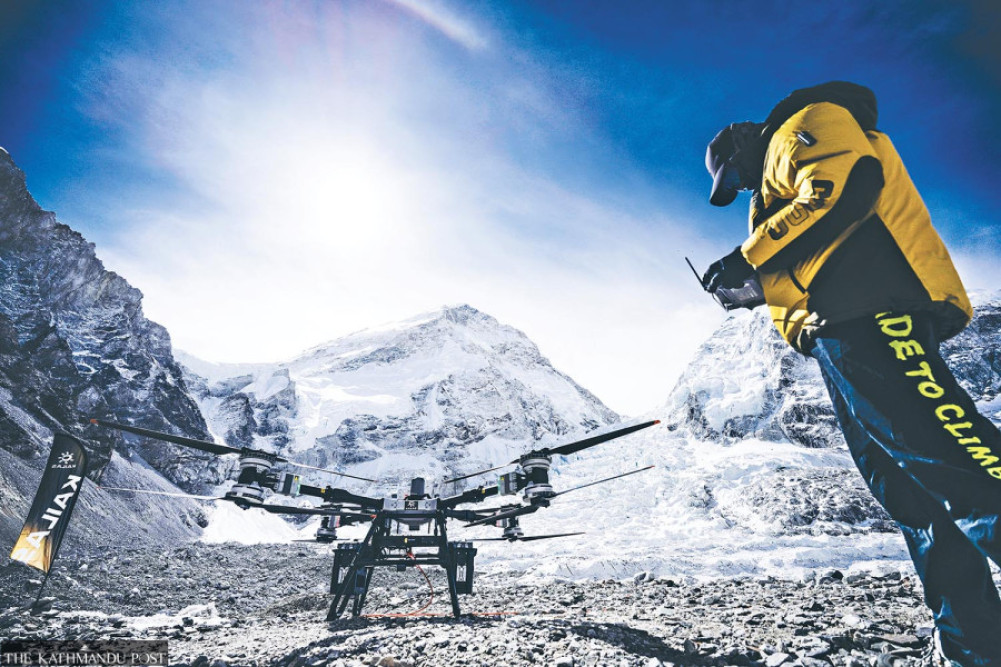
This year, most of the supplies were transported to Camp 1 via drone, and what once took hours of climbing and an entire team of high-altitude guides was now completed in minutes.
We use Google Cloud Translation Services. Google requires we provide the following disclaimer relating to use of this service:
This service may contain translations powered by Google. Google disclaims all warranties related to the translations, expressed or implied, including any warranties of accuracy, reliability, and any implied warranties of merchantability, fitness for a particular purpose, and noninfringement.
For 22-year-old guide Lakpa Rinji Sherpa, this season's Everest ascent was different from previous ones. Fear was constant. The Khumbu Icefall was as challenging as ever, with long, deep crevasses underfoot. Huge snowdrifts (seraks) looming overhead. But unlike last year, he didn't have to repeatedly make the perilous journey up the icefall carrying heavy loads.
Instead of the usual eight to ten trips between Everest Base Camp (5,364 meters) and Camp 2 (6,400 meters), Lakpa Rinji made only four trips this time. This was because there was no safe route or calm weather. The use of drones made all this possible.
‘Every year we are afraid to cross the icefall,’ said Lakpa, ‘there are cracks below, ice piles above. We have to walk along unstable paths.’ Traditionally, Sherpa guides leave base camp shortly after midnight, carrying up to 15 kg of provisions on their backs. The journey from Khumbu Icefall to Camp 1 and from there to Camp 2 takes six to seven hours. ‘We never stop,’ said Lakpa, ‘the icefall section is extremely dangerous.’
This year, most of the supplies were transported to Camp 1 by drone. What once took hours of climbing and an entire team of high-altitude guides now takes minutes. His experience gives a glimpse of the technological changes taking place on Everest. Drones are making one of the world's most dangerous professions, the Everest expedition, easier.
A test by Chinese drone manufacturer DJI in April 2024 is considered the world's first drone delivery test on Everest. Using its 'Flycart' platform, the company carried oxygen cylinders and essential supplies up. Similarly, it brought garbage down.
These tests indicated that drones could do the dangerous work traditionally done by Sherpa guides. After successful tests, DJI's Flycart drone began transporting supplies to Camp 1 in 2025. This season, supplies were transported commercially using drones.
Instead of having to travel eight to ten times to carry provisions between the base camp and Camp-2, the guides made an average of only four trips this time due to the drone. According to drone operators, the work that used to take 6 to 7 hours can now be completed in about 10 minutes. In some cases, the drone does the same amount of work as more than a dozen guides. Many in the Khumbu region have seen the drone as multi-useful.
‘This is a life-saving initiative,’ said Mingma Chhiri Sherpa, chairman of Khumbu Pasanglhamu Rural Municipality in the Everest region. ‘Even normal movement in the Khumbu Icefall is very risky.’ How dangerous it must be to carry heavy equipment and provisions! Technology can reduce that burden and save lives.’
The Khumbu Icefall is considered the most dangerous section of the southern slope of Everest. The path is broken in this area, which stretches for about 600 meters between the base camp and Camp 1. Snowfalls can fall at any time while walking.
For decades, Sherpa guides have faced the greatest risk there. In April 2014, a massive avalanche killed 16 Sherpa guides. The incident is considered one of the deadliest disasters in the history of Everest. In 2023, three Sherpa guides were buried in an avalanche on the icefall. Their bodies have not yet been found.
According to government figures and the Himalayan Database, about 50 people have died on the Khumbu Icefall alone between 1953 and 2023. This year was also dangerous. A huge and unstable ice floe blocked the construction of the route for about three weeks. This led to delays in the climb. According to the Everest Pollution Control Committee (SPCC), the ice floe was about 55 meters long, 37 meters wide and 28 meters high.
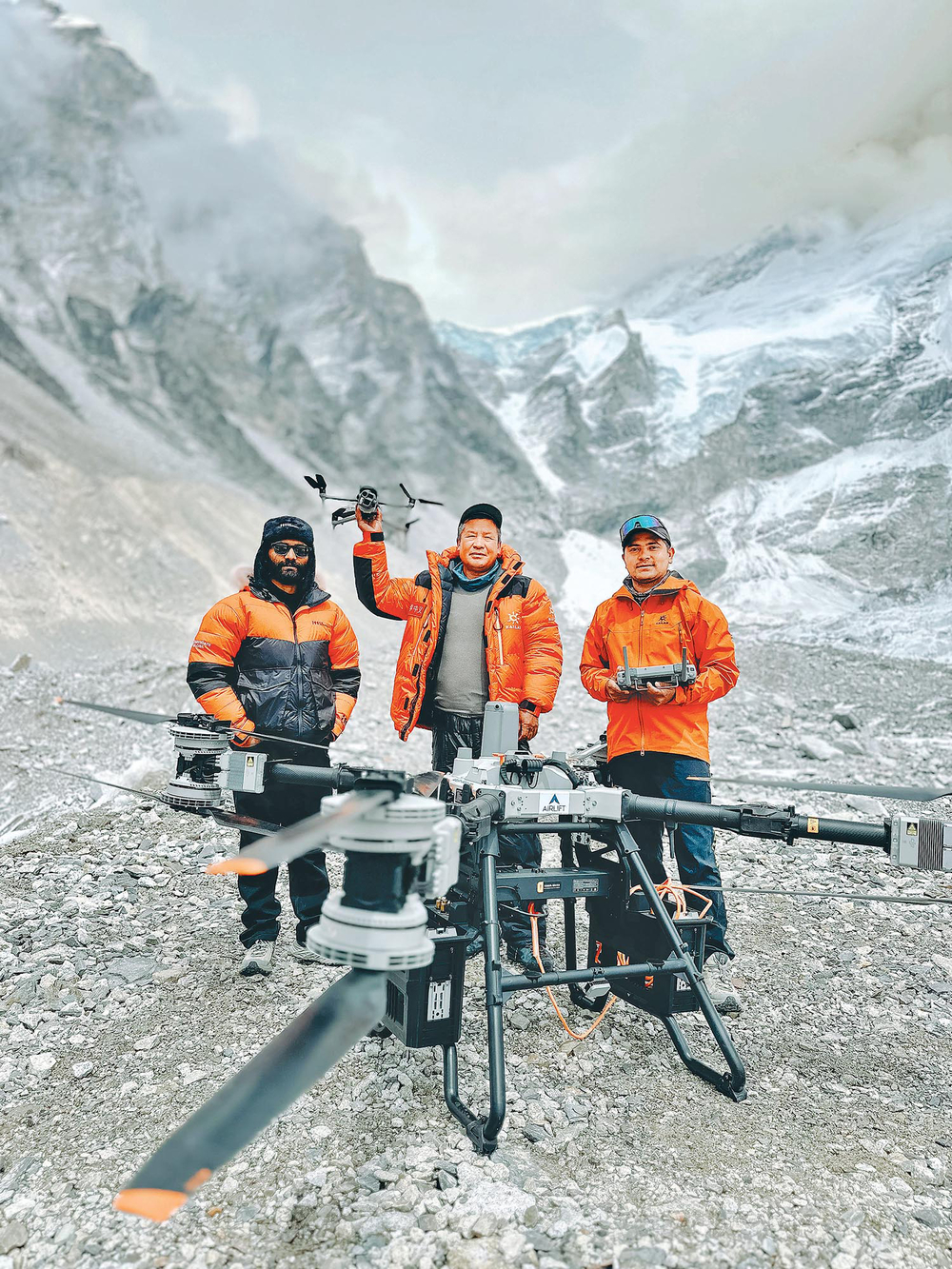
A special team of icefall doctors tasked with preparing the route began work on March 16. However, after they had completed some work, the huge ice floe again blocked the work. Drone imaging and aerial monitoring methods were used for 19 consecutive days to understand the condition of the ice floe. “The landslide was monitored through multiple on-site inspections and drone imaging throughout the period,” said Milan Pandey, co-founder of Airlift Technology Pvt. Ltd.
Eventually, part of the landslide collapsed, but the rest remained unstable. Finally, on May 13, the path was opened and conditions were created for the mountaineering to resume. The situation was continuously monitored by drones, which showed that the role of drones in inspections and risk assessment is also important.
The increasing use of drones on Everest is also helping to address environmental challenges. This season, Airlift Technology used drones to transport 3.5 tons of garbage from Camp 1 to Base Camp. “In total, we transported more than 10 tons of goods up and down,” said Pandey, “out of which 3.5 tons of garbage was brought down from the mountain.” Most of the garbage was bags of human excrement.
Since last year, climbers have been required to collect their excrement in special bags during their climbs. Local officials say the rule was introduced to reduce pollution and improve sanitation on Everest.
The initiative has further strengthened Nepal's efforts to keep the mountain clean. Since 2014, climbers have been required to forfeit a $4,000 deposit if they fail to bring back at least eight kilograms of garbage. Under the proposed new law, the deposit will be converted into an environmental fee that will be spent solely on Everest conservation and cleanup activities.
After the climbing season ended on May 29, drones have been flying about 20 flights a day to bring garbage to the base camp. Local officials say a clean mountain and a safe working environment complement each other. “There are many businesses operating in the Himalayan region on Everest, including hotels, lodges, airlines, helicopter operators, guides, porters,” said Mingma Chiri, “but there are still many risks. We want to reduce those risks through technology.” However, not everyone views this drone revolution with optimism and optimism.
Some are concerned that the expansion of drone operations could ultimately reduce employment opportunities for Sherpa guides and high-altitude workers. Lakpa says such concerns are unnecessary. Guides earn money by both showing climbers the way and carrying supplies between camps. While drones have reduced the burden of carrying heavy loads in the lower reaches of Everest, the work in the upper reaches still relies on human skill. These jobs generate a good income. For example, guides usually earn Rs 350 to Rs 500 per kg while carrying luggage from base camp to Camp-2. Above Camp-2, this rate increases sharply to Rs 1,000 to Rs 1,500 per kg.
Transporting oxygen cylinders is very profitable. A guide can earn Rs 4,000 for carrying a four-kg oxygen bottle, while bringing down an empty cylinder can earn up to Rs 10,000. A guide usually brings down up to eight empty cylinders.
‘Climbers often need many bottles,’ said Lakpa, ‘the real earnings are from Camp-2 to Camp-4. Even if drones reduce some work below Camp-1, it does not mean that we lose income.’ He said drones should be seen as a helper, not a competitor. “Without exception, we don’t want to carry loads through icefalls,” he said. “Our main job is to show climbers the way. Drones give us more confidence to cross dangerous sections.”
The evolving drone story also took an unexpected turn this year. After a Chinese-made DJI drone proved its effectiveness on Everest, an American competitor also entered the race. American drone manufacturer Friefli Systems has sought permission to test its Ultra X Gen 2 heavy-lift drone on Everest. Nepali authorities have temporarily suspended DJI’s Flycart 100 operations for 10 days while they review the permits for both systems.
The move has sparked a new debate within Nepal’s mountaineering community. Supporters have welcomed the increased competition and innovation in technology. Some expressed concern that Everest could become a platform for commercial and geopolitical competition between foreign technology companies. “We were banned for 10 days and there was no reason for it,” Pandey said.
But despite this obstacle, he said, drones have proven indispensable. Its need has been felt more especially after the logistical (transportation) complications created by the delay in opening the climbing route. “Drones can quickly deliver oxygen bottles to higher camps in an emergency,” he said.
According to initial estimates, the 2026 Everest season has ended with more than 100 climbers and guides reaching the summit. This season, the government issued permits to a record 495 climbers for a fee. Typically, a climber hires one Sherpa guide for his expedition.
This season will be remembered by many for the technological transformation that is quietly taking place beneath the world's highest peak, as well as the successful ascents. For generations, Sherpas have risked their lives to carry the burden of Everest climbers on their backs. Now, with drones buzzing over the shifting snow and crevasses of the Khumbu Icefall, the burden is beginning to ease.
For guides like Lhakpa Rinji Sherpa, this may be the most important and greatest achievement of all.