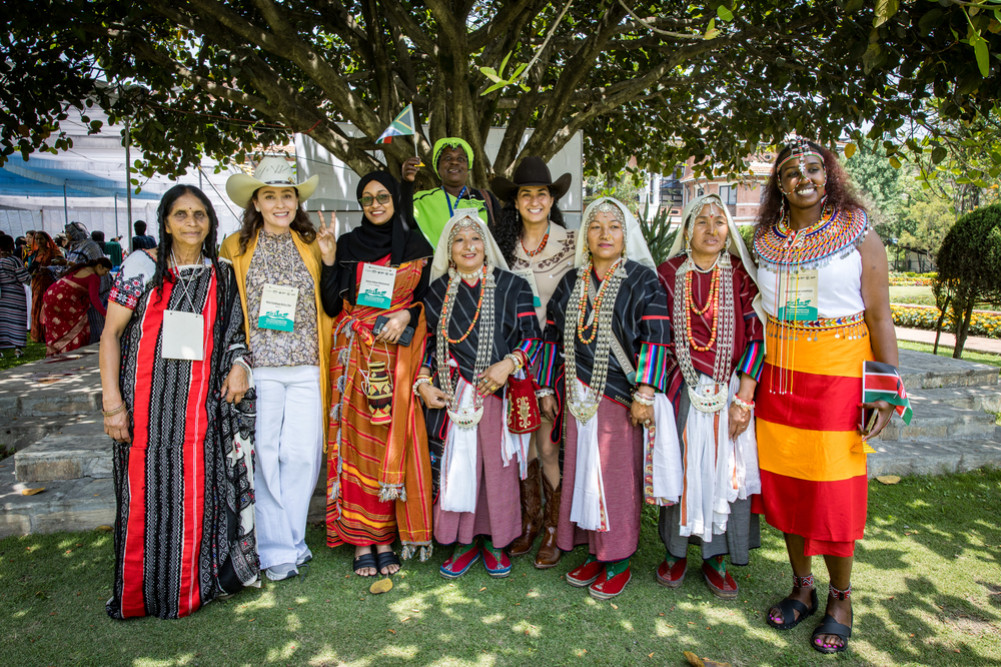
The conference held in Kathmandu from 12 to 15 May has also set an action plan on issues such as unitedly protecting rights and enhancing capacity to deal with climate change.
We use Google Cloud Translation Services. Google requires we provide the following disclaimer relating to use of this service:
This service may contain translations powered by Google. Google disclaims all warranties related to the translations, expressed or implied, including any warranties of accuracy, reliability, and any implied warranties of merchantability, fitness for a particular purpose, and noninfringement.
The International Conference of Women in Pastoralism and Livestock has set a new global agenda and action plan for sustainable pasture management.
The conference, held in Kathmandu from 12 to 15 June, also set an action plan on issues such as protecting rights and enhancing capacity to deal with climate change. This initiative has been taken as a significant achievement of the International Year of Pastoralism and Livestock 2026.
The conference on the theme of ‘Global Gathering of Pastoralist Women’ was attended by more than 100 pastoralists and open-range ranchers from 40 countries. The conference has formed a global network of pastoralist women, drafted the ‘Kathmandu Declaration’ (MERA+16) for a common agenda and action, and set a common strategy in global policy forums.
The conference, jointly organized by the International Centre for Integrated Mountain Development (ICIMOD) and the Pastoralism and Gender Group of the IYRP Working Group, aimed to honor their leadership, exchange experiences and knowledge, and strengthen global collaboration on pastoralism, rangelands, and climate justice.
The main theme of the conference was to review the ‘Mera Manifesto’. This manifesto is a key political document prepared by women pastoralists at a global gathering held in the ‘Mera’ region of India in 2010.
The draft manifesto includes rights to land and natural resources, political participation, access to basic services, recognition of traditional knowledge, and climate justice as common priorities.
At the closing ceremony, Yi Shaoliang, Rangelands Manager of ICIMOD, said that women pastoralists are important custodians of rangelands and biodiversity. She also noted that their leadership is essential for sustainable landscapes and climate adaptation, especially in sensitive mountainous and dry regions.
Similarly, Srijana Joshi Rijal, Ecosystem Specialist at ICIMOD, called this moment historic, stating that it is a historic moment for pastoral women. She said, “They are the guardians of our planet. Women from different sectors have come together to secure the common future of the present and future generations and to raise their voices on the global stage.”
Nitya Ghotge, Co-Chair of the IYRP Working Group on ‘Pastoralism and Gender’, said that this is a defining moment, noting that pastoral women from all over the world have come together to build the future of their children and communities.
The newly created global network will continue knowledge exchange, mutual support and joint advocacy between different sectors. It is said that this will help to bring the voice of the pastoralist community from the local level to global policy .
On the same occasion, Sikinkimuge, a participant from Inner Mongolia, China, said, “I feel honored to participate in this event and am now excited to hear that a global network of pastoralist women will be formed .”
While the global focus is on food systems, biodiversity and climate resilience, recognizing pastoralist women as leaders and rights holders is essential for building sustainable economies and landscapes .
Sarla Khaling, Head of ‘Resilient Economies and Landscapes’ at ICIMOD, said that the achievements of this process are deeply linked to inclusive development and environmental sustainability . “When pastoralist women lead, building sustainable economies and landscapes is possible,” she said .
The ‘agenda’ set by the conference will be presented at international forums including the United Nations . It is also expected that collaboration between women from different sectors will help to exchange new solutions, advocacy strategies and emotional support.
Rangelands cover almost half of the Earth's land area and pastoralism is the world's most widespread land use system. About half of the world's pastoralist population is women and girls.
They play a crucial role in pastoralism, land conservation, food security and the transmission of traditional knowledge. However, they still face insecure land rights, limited movement rights, low political representation and the disproportionate impact of climate change, the conference also discussed.