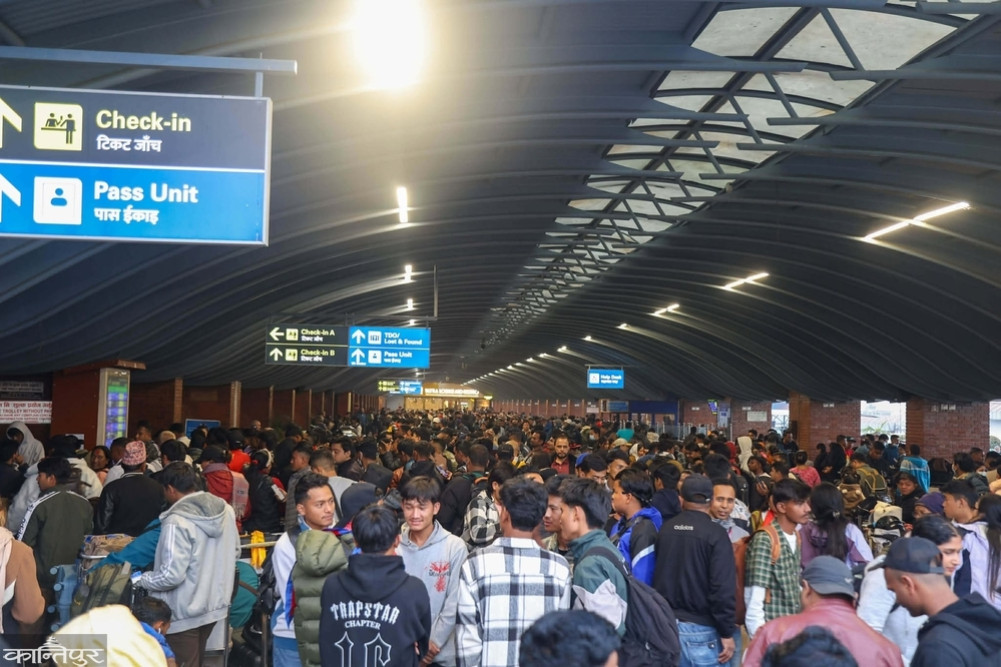
Finance Minister Swarnim Wagle addressed the situation seen in the foreign employment sector in the budget for the upcoming fiscal year on Friday.
We use Google Cloud Translation Services. Google requires we provide the following disclaimer relating to use of this service:
This service may contain translations powered by Google. Google disclaims all warranties related to the translations, expressed or implied, including any warranties of accuracy, reliability, and any implied warranties of merchantability, fitness for a particular purpose, and noninfringement.
The government has announced that it will make the cost of foreign employment, which has been unorganized for a decade due to the lack of proper service fee determination, 'worker-friendly'. Finance Minister Swarnim Wagle addressed the situation seen in the foreign employment sector in the budget for the upcoming fiscal year on Friday.
'We will make the service fee worker-friendly by encouraging zero cost for foreign employment,' he said. For this, the government has announced that it will make arrangements for unsecured loans and installment payments from employers. 'Foreign employment will be made dignified, transparent and automated,' Minister Wagle said.
From 26 Jestha 2072, the Ministry of Youth, Labor and Employment had adopted a policy of 'free visa and free ticket' for workers going to the Gulf and Malaysia. After the implementation of this policy, foreign employment entrepreneurs were allowed to charge only 10,000 rupees as service fee from workers going to foreign employment. Before that, the service fee was fixed at 70,000 for Gulf countries and 80,000 for Malaysia. But after the implementation of the free visa and free ticket policy, workers have been deprived of receiving receipts for the actual costs paid to the manpower company.
...............................
– Remittance investment and fund operation
– Returnee migrant program
– Labor registry affiliation
– Unsecured loans for those going for foreign employment
– Special campaign to include workers working in the unorganized sector in the social security system
– Labor exploitation to be considered an economic crime
...............................
After the Balendra Shah-led government started tightening the cost fee of 10 thousand, foreign employment entrepreneurs have started sending new workers for foreign employment less. After the monitoring team deployed by the Foreign Employment Department started arresting foreign employment entrepreneurs, they have put forward a demand for fixing the service fee.
‘On the day the state was announcing 10 thousand. On that day, we were in protest in Tahachal (department). We have been saying that we cannot send for 10 thousand rupees since 11 years ago. We have not sent them for 10,000,' said Hari Bahadur Pandey, chairman of the committee, at a press conference organized by the Foreign Employment Entrepreneurs' Unity Committee on Wednesday. 'We are forced to collect more than that. We have already collected it. There is no point in asking for bribes or hiding stones in this.'
The committee said that the service fee should be equal to two months' salary. 'When a worker comes to Kathmandu from Jajarkot, it costs him 10-15 thousand rupees. It is not possible to send him for 10,000,' he said, 'Fix the service fee. We will not allow him to collect more than that. If he has collected it, we will take responsibility for it.'
According to the Ministry of Labor, currently only 7 percent of workers go for foreign employment at zero cost. A large part of this is in the Malaysian labor market. Finance Minister Wagle has announced that the government will make foreign employment dignified, transparent and automated by arranging unsecured loans and payment from employers in installments. He said that priority will be given to reviewing labor agreements and entering into additional agreements with new destination countries to make foreign employment more secure and dignified. So far, Nepal has signed labor agreements/understandings with 13 countries.
The government has allocated a budget of Rs 3.63 billion for the entire labor sector. This budget has been allocated for the rehabilitation, rescue, skilled training, provision of nutritious food at subsidized rates, etc. of workers who have returned from foreign employment. By mid-Falgun of the current fiscal year, 273,530 people with new labor permits have gone for foreign employment.
The government has adopted a policy to encourage returnees from foreign employment. Minister Wagle said that remittance investment and funds will be operated to convert remittances into consumption and production by encouraging 'return migration'. 'We will implement a returnee migrant program to utilize the knowledge, skills, and abilities of those who have returned from foreign employment.' We will make the youth skilled by conducting various short-term workplace-based programs,' he said. 'I have allocated the necessary budget to rescue Nepali citizens stranded abroad and to make arrangements to easily bring back the bodies of deceased workers.'
He said that arrangements will be made for going for foreign employment only after learning skills. 'To further encourage remittances coming in through formal channels, a lottery program will be run based on every receipt of remittance inflow,' he said. This budget has announced that a law will be made to consider labor exploitation as an economic crime. Due to the lack of effective labor audit in the internal labor market, no action has been taken against those who have been exploiting workers. 'A law will be made to bring violation of labor agreements, wage fraud and labor exploitation into the legal system as economic crimes,' he said. 'Labor disputes will be resolved quickly through the labor tribunal by the end of the year.'
He said that arrangements will be made for workers and employers to be mandatorily affiliated with the labor registry. "This will make it mandatory to pay wages and insurance provided by organizations licensed to supply construction, agriculture, hospitality, transportation and industrial workers, in addition to security guards and domestic workers, through banks," he said. Minister Wagle said that the mandatory compensation and insurance claim system for workplace accidents will be made more effective.
The budget mentions the implementation of the National Qualification Framework and prior learning recognition to formally recognize the skills of migrant, informal and experienced workers. "Interns with remuneration will be institutionalized," Wagle said. The government has announced that it will run necessary programs to provide nutritious food at subsidized rates to support the health of informal workers.
Jeevan Baniya, Research Director of the Center for the Study of Labor and Mobility (CSLAM), said that the budget of the Ministry of Labor is decreasing further. "The importance given to the labor sector should have been increased, and the size of the effective programs and budget should have been increased. This time too, it has not been relaxed," Baniya said, "The budget for the labor sector had reached eight billion." It has been falling every year to three billion. This time too, there have been no new programs that will have a long-term impact in this area.’