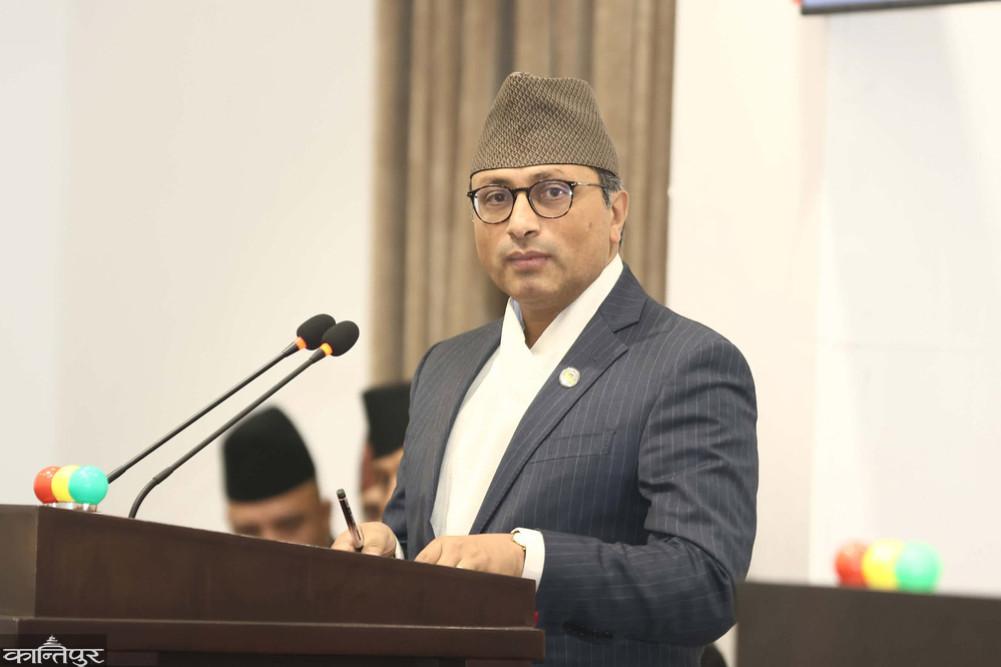
The Ministry of Finance is preparing to present the budget on the theoretical ground of good governance, economic restructuring and prosperity, integrated infrastructure, all-round social upliftment, expansion of the middle class, and strengthening of soft power.
We use Google Cloud Translation Services. Google requires we provide the following disclaimer relating to use of this service:
This service may contain translations powered by Google. Google disclaims all warranties related to the translations, expressed or implied, including any warranties of accuracy, reliability, and any implied warranties of merchantability, fitness for a particular purpose, and noninfringement.
Finance Minister Swarnim Wagle, who has been opposing the large-scale budget, is making public the budget for the coming fiscal year by exceeding the limit given by the resource committee. At a time when revenue has shrunk and foreign grants are not increasing as expected, Finance Minister Wagle is going to bring a large-scale deficit budget with an ambitious target for revenue collection.
The National Resource Estimates Committee led by the Vice Chairman of the National Planning Commission had set the budget ceiling (limit) for the fiscal year 2083/84 at Rs 1.89 trillion. However, after it was not possible to prepare the budget within that limit, the resource committee, which met on Wednesday at the request of the Finance Minister, increased the budget ceiling given earlier to around Rs 2.15 trillion.
‘Accordingly, a budget of up to Rs 2.15 trillion can be brought. However, the Finance Minister will only confirm the exact figure of the budget on Thursday night,’ said an official involved in budget preparation. ‘My estimate is that the budget will be between Rs 2.15 trillion and Rs 2.2 trillion.’
The budget of 21.5 trillion rupees will be 4.5 trillion rupees more than the revised estimate of the current fiscal year's budget. A budget of 19.64 trillion rupees was allocated for the current fiscal year. For this, after estimating that revenue collection would not be sufficient and expenditure would be low, it has been revised through the mid-term review and fixed at 16.88 trillion rupees. 'A large-sized budget has been prepared with the expectation that revenue collection will be high this year due to the emphasis on a powerful government and good governance,' said the official involved in the budget preparation. 'As the expectations from the new government are also high, a large-sized budget had to be brought with many new programs.'
A source said that the government has prioritized large infrastructure through the upcoming budget. 'The government will not allocate budget for new projects. The government is prepared to allocate a large budget for projects of national pride that are in the final stages of construction and complete the remaining projects next year after their completion,' said an official involved in the budget preparation.
The government, which had set a target of collecting Rs 52.32 billion in grants last year, has received only Rs 23.20 billion. This year, the government had set a target of Rs 53.44 billion in grants, but only Rs 20.77 billion has been collected till Jestha 12. The government is under pressure to increase the salaries of employees in the upcoming budget. According to the law, the government should increase the salaries of employees every two years. According to this, the salaries of employees should be increased from the current year's budget, but they have not been increased. The government had formed a salary increase study committee for employees under the coordination of Chief Secretary Suman Raj Aryal. The committee submitted its report last week.
The report has suggested setting the minimum salary of employees at Rs 35,000 and the maximum at Rs 121,000. Currently, the salary of an office assistant is around Rs 24,000 and that of the Chief Secretary is around Rs 77,000. The government is not in favor of increasing the salaries as suggested by the report. However, the government is preparing to reduce the number of employees on a large scale. ‘The government is preparing to reduce the number of employees and pay adequate salaries to the employees who are working,’ the source said, ‘but since the resource situation does not allow for a large salary increase at once, the government is discussing whether to increase salaries by only 10 to 15 percent.’ The source said that the agriculture, energy, and tourism sectors are also priorities in the budget. Homework is being done to increase the production of agricultural produce, reduce costs, and connect the produced materials to the market. ‘There is a preparation to increase the budget of the Nepal Electricity Authority next year for the development of the energy sector,’ the source said, ‘There has been a discussion about whether to provide infrastructure construction projects worth up to Rs 150 million for each MP through the Ministry of Finance. While selecting the projects, the federal government’s budget must be included in the bank, and the cost, construction period, and environmental impact assessment must be excellent in all aspects.’ The government is preparing to implement a new method (model) of infrastructure financing by mobilizing alternative development finance, diaspora capital, and private investment to raise investment.
‘The budget will be focused on projects that will provide high returns on foreign aid, loans and private sector investment. Transformative projects will be taken forward with clear goals, a fixed budget and a strict time frame,’ the source said. ‘The budget will include performance agreements with the project manager, digital progress tracking, land acquisition and resolving forest-related obstacles and not changing the responsibilities of key human resources until the project is completed.’
The government is preparing to bring a budget in the upcoming budget by prioritizing 5 areas, including good governance, reducing the tax burden on the middle class, and making economic diplomacy effective. The government plans to maintain good governance through digitization and make the economy dynamic and achieve the goal of rapid economic growth.
The government has set a target of increasing revenue by about 20 percent next year, raising resources through grants, other income and public debt, which is very ambitious. Due to the slowdown in economic activity, government income has also slowed down along with revenue mobilization in recent years. Government income has increased by only about 7 percent till 12th Jestha of the current fiscal year.
The government has targeted to collect Rs 1.48 trillion from revenue alone this year, but has so far received only Rs 1.26 trillion (69 percent of the target). The government's revenue growth so far is only 7 percent compared to the same period last year. Revenue seems to be more affected especially in the post-Covid years.
While the average annual growth rate of revenue in the 5 fiscal years before the fiscal year 2076/77 was 14.9 percent, in the subsequent 5 fiscal years this growth rate has fallen to 8.7 percent. In such a situation, Finance Minister Wagle is about to bring a large budget without a strong base of resources. 'Foreign grants have also been made the main basis in terms of resources. After the formation of the new government, the commitment to grants is increasing due to the increased trust of foreign donors, and preparations are underway to increase it further,' said the source.
The government, which had a target of collecting Rs 52.32 billion in grants last year, has received only Rs 23.20 billion. This year, the government has set a target of Rs 53.44 billion in grants, but only Rs 20.77 billion has been collected till 12 Jestha. Based on this, achieving the government's revenue and grant collection targets is very challenging.
The government has made the government's 100-point agenda on good governance and the Rashtriya Swayamsevak Sangh (RSS) pledge the main basis of the budget. The budget also includes programs such as land distribution and housing for squatters. The government is preparing to maintain good governance in the budget. For this, the government has planned to lay the foundation for good economic governance through digitization.
The source said that through the budget, the government is discussing reducing the maximum rate of personal income tax (39 percent) and increasing the tax-free threshold from 500,000 to 800,000. Although there have been discussions on making the Value Added Tax (VAT) multi-rate or reducing the current 13 percent limit, no decision has been made, the source said.
'It is very difficult to implement multi-rate in Nepal, as our tax administration does not have the capacity and many other countries that have gone to multi-rate have also returned to single-rate, so despite discussions, no decision has been made on this issue,' the source said.
The new budget is set to allocate more budget than the current one, mainly in the large infrastructure and information technology sectors. The government has set a target of an average economic growth of 7 percent for the next decade. Based on this, the government is expected to set a target of 7 percent economic growth for the next year as well. In an economy that has been experiencing an average economic growth of 4 percent for the last three decades, the government, which has received close to two-thirds of support, has made good governance, digitization, and investment expansion the basis of economic transformation, and therefore the government is forced to increase the size of the upcoming budget to achieve that.
‘Capital expenditure of Rs 407 billion has been allocated in this year’s budget. However, approximately 90 percent of the amount that will increase the size of the budget next year will be added to capital expenditure,’ the source said. ‘Although there is talk of increasing the budget in the infrastructure sector, there are not many new projects. We are preparing to allocate sufficient budget for projects that will be completed quickly, contribute significantly to national importance and the economy.'
The Ministry of Finance has stated that the upcoming budget will be presented on five theoretical grounds: good governance, economic restructuring and prosperity, integrated infrastructure, all-round social upliftment and expansion of the middle class, and strengthening of soft power. The government, which has put forward an agenda of comprehensive legal reforms to improve the service system, will come up with a policy framework to clean up the political and economic aspects through good governance, sources have stated.
Currently, while the government's mandatory public liabilities are 1.3 trillion 30 billion, only less than 1.2 trillion has been collected in revenue. Therefore, the government is forced to borrow to fulfill its mandatory liabilities. Moreover, as the size of the budget increases by many, the government is forced to borrow internally and externally to raise resources.