The cost of the project is 64 billion rupees including interest.
We use Google Cloud Translation Services. Google requires we provide the following disclaimer relating to use of this service:
This service may contain translations powered by Google. Google disclaims all warranties related to the translations, expressed or implied, including any warranties of accuracy, reliability, and any implied warranties of merchantability, fitness for a particular purpose, and noninfringement.
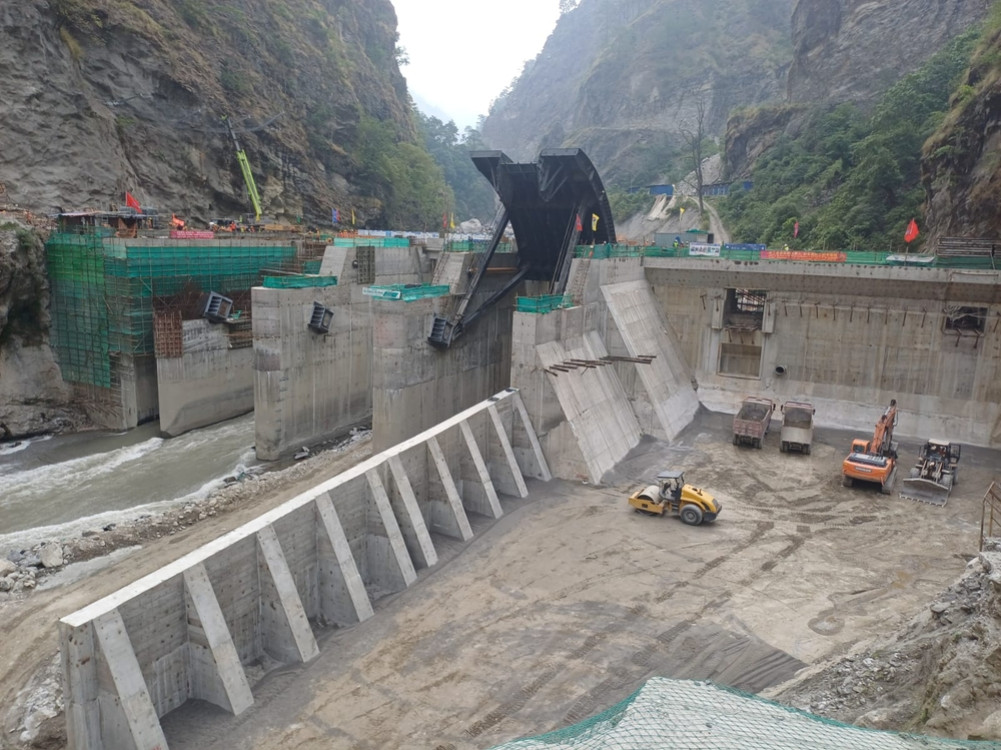
The installation and testing of the beer gate at the dam of the 216 MW Upper Trishuli-1 Hydropower Project under construction has been completed. One of the three beer gates under the important hydro-mechanical structure has been installed and tested.
The beer gate controls the flow of river water and diverts it towards the tunnel for power generation, maintains the water level in the dam, and safely discharges excess water into the river. With the completion of the gate installation and operation as per the prescribed technical standards, it is expected that the construction work of the project will gain further momentum and help complete the project on time.
The beer gate installation and operation work has been completed through coordination and continuous efforts between the project management team, technical experts, construction professionals, and relevant stakeholders. Quality, safety, and environmental standards have been given high priority during the construction process.
The dam and related structures of this project, which is being built under the leadership of Korean companies, are being constructed in the Haku area of Amachodingmo Rural Municipality-1 in Rasuwa, and the underground power house is being constructed in Uttargaya Rural Municipality-1. The Upper Trishuli-1 project, which will use the generated electricity for domestic consumption, is the largest hydropower project under construction with direct foreign investment.
The main construction work of the project began in December 2078. Currently, the digging of the 9.5-kilometer-long main tunnel has been completed and concrete lining is underway, while the digging of the complex 292-meter-long vertical tunnel has been successfully completed. The construction of the civil structure of the power house is underway and the installation of electro-mechanical equipment including turbines, generators is ongoing.
The overall physical progress of the project, which is targeted to be completed by December 2026, has reached 82 percent. Although the construction work was affected by the floods in the Trishuli River in 2024 and 2025, the target is to complete it by mid-2027. The project cost is Rs 64 billion including interest. The construction is being carried out by Dusan Energy in the Engineering, Procurement and Construction (EPC) model. The
project is expected to generate 1.53 billion 31 million units of electricity annually. Of the electricity produced, 38.75 percent will be generated in the winter and 61.25 percent in the rainy season. The electricity generated by the project will be fed into the national transmission system through the Trishuli-3B Hub Substation of the Nepal Electricity Authority. A Power Purchase Agreement (PPA) has been signed between the company and the Nepal Electricity Authority.
The Upper Trishuli-1 project is considered a very important project for Nepal's power system as it is located close to the Kathmandu load center and will generate 104 MW of stable (farm) energy even in winter.
Nepal Water and Energy Development Company Pvt. Ltd. (KOEN), Korea Overseas Infrastructure and Urban Development, the International Finance Corporation (IFC) under the World Bank Group, and Nepali partners have been established to develop the project with institutional investment.
At the program, Joint Secretary at the Ministry of Energy, Sagar Raj Gautam, stated that the successful completion of the beer gate installation is an important technical achievement for the project and said that the ministry will provide necessary facilitation to complete the project on time.
Executive Vice President of KOEN, Yong Ki Lee, mentioned that the company has paid special attention to completing the project within the estimated cost and time. Noting that Korea has been expanding its investment in renewable energy in recent times, he said that the company is ready to invest more in Nepal's hydropower projects, which have immense green energy potential.
Korean Ambassador to Nepal Park Tae-yong believed that Nepal-Korea energy cooperation would enter a new phase after the completion of the project being built under the leadership of a company owned by the Korean government.
Sonung Kim, CEO of the project promoter Nepal Water and Energy Development Company Pvt. Ltd., said that the completion of the beer gate installation and operation was a significant achievement of the project and that the company was committed to completing the project within the stipulated time.