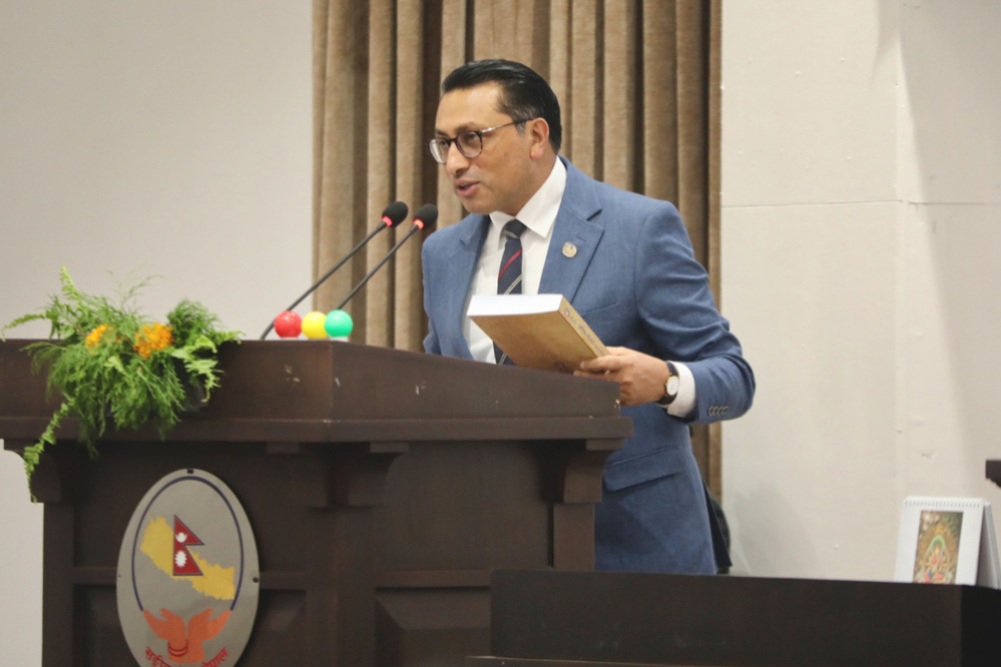
With low economic growth and weak revenue mobilization, the government is forced to borrow more to pay off debt principal and interest and fulfill mandatory obligations including social security.
We use Google Cloud Translation Services. Google requires we provide the following disclaimer relating to use of this service:
This service may contain translations powered by Google. Google disclaims all warranties related to the translations, expressed or implied, including any warranties of accuracy, reliability, and any implied warranties of merchantability, fitness for a particular purpose, and noninfringement.
In recent years, the economy has been in a state of stagnation due to increasing budgets, declining revenue collection, and low capital expenditure. This has had a direct impact on economic growth. The government has been bringing in a larger budget every year than the previous one, but has not been able to raise and spend resources, so it is increasingly difficult to make sweeping cuts through the mid-term review. In this way, as the government's revenue and capital expenditure targets remain unmet every year, development spending has shrunk and debt burden has increased. Due to the weak state of revenue mobilization along with low economic growth, the government is forced to borrow more to repay the principal and interest on loans and fulfill mandatory obligations including social security.
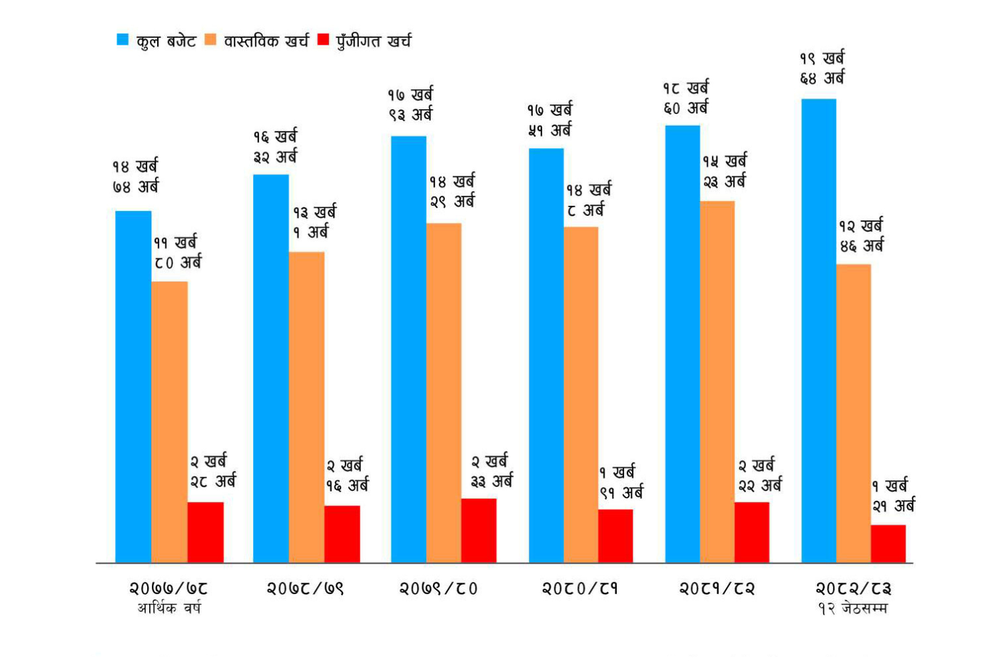
In a decade, the federal budget allocated to the gross domestic product (GDP) has averaged only 33.7 percent annually and the actual expenditure has averaged only 26.8 percent. The allocation ratio to the gross domestic product reached its highest level of 39.4 percent in the fiscal year 2076/77, but it is 30.5 percent in the fiscal year 2081/82. The average annual growth rate of the budget during this period was 12.3 percent, and the growth rate was 4.1 percent in the 5 fiscal years after the Covid pandemic, according to the Ministry of Finance.
Economists say that economic growth has been affected by the poor allocation, spending, and quality of the capital budget. Not only is it difficult to add new investment, but existing investment (fixed capital) is also declining, economist Dilliraj Khanal comments, which is why the country has not achieved satisfactory economic growth.
‘The report released by the World Bank shows that the government’s capital stock in Nepal last year is decreasing. This means that the productive capacity of the economy has declined,’ Khanal said. ‘Although the government’s share in total investment is around 20 percent, this is a guide for the private sector. When the government’s investment is decreasing, the private sector is not in a position to expand investment, which is what is happening now.’ Khanal said that the government should encourage the private sector to expand investment by increasing investment. ‘Although the size of capital expenditure has increased moderately in recent years, the effective (actual) expenditure has decreased in form,’ he said, ‘There is a large share of unproductive and wasteful expenditure in current expenditure. To improve this, concrete criteria should also be made for current expenditure allocation,’ he said, ‘Until now, without setting concrete criteria, increasing current expenditure without justification is wasting a large amount of resources.’ Khanal said that Nepal has the highest tax payment rate and the weakest condition of Nepalis in terms of education, health and other facilities in South Asia. ‘Unless there is a comprehensive reform in the public expenditure system, starting from budget allocation, the expenditure made on the current basis will be very counterproductive in the future,’ he said, ‘because the current system does not make anyone feel responsible. The problem is in the structure.’ He suggested that the current distortions of revenue should be corrected by creating a medium-term revenue structure, just as the medium-term expenditure structure was created. In the past decade, capital expenditure has averaged only 19 percent of the annual total federal expenditure and an annual average of only 64.1 percent of the total capital allocation. This, on the one hand, is due to low capital allocation and on the other hand, a significant portion of the allocation is not being spent, which seems to be affecting the goal of long-term economic transformation. Experts say that this situation has been created due to the inability to efficiently allocate the available financial resources to projects that provide the highest return. They suggest that capital expenditure should be increased based on need and justification by removing the complexity of project implementation.
The total expenditure in the fiscal year 2077/78 was Rs 1474 billion, but it has reached Rs 1964 billion in the current fiscal year. The government's expenditure situation has not improved much during this period. Accordingly, out of the total expenditure of Rs 1180 billion in the fiscal year 2077/78, only Rs 1246 billion has been spent in about 10 and a half months of this year. On average, the expected improvement in capital expenditure and revenue collection has not been achieved during this period. The economic situation paper issued by Finance Minister Swarnim Wagle states that economic growth has been affected due to poor allocation, spending and quality of capital expenditure.
The average economic growth in the last five years has been less than 4 percent. Accordingly, the economic growth rate in the fiscal year 2077/78 was 4.49 percent (at constant prices) and reached 5.28 percent in 2078/79. However, the economic growth rate in the three subsequent fiscal years has been less than four percent. The National Statistics Office has projected that the economic growth rate in the current fiscal year will be 3.65 percent at constant prices and 3.85 percent at consumer prices. This is less than the government's economic growth target. The government has set a target of 6 percent economic growth in the current fiscal year.
Government reports have pointed out that due to the slowdown in economic activity, revenue mobilization has been lax in recent years. Revenue seems to be more affected especially in the post-Covid years. The average annual growth rate of revenue in the five fiscal years before the fiscal year 2076/77 was 14.9 percent, but the position paper states that this growth rate has fallen to 8.7 percent in the subsequent five fiscal years.
In this way, capital expenditure is less in proportion to the total allocated budget and the expenditure is not effective, which has not contributed to the expected economic growth, says Prakash Kumar Shrestha, former vice-chairman of the National Planning Commission. ‘Before Covid, capital expenditure had increased, economic growth was also good. But it could not be sustained,’ he said, ‘This confirms that there is no identification between investment and expenditure in Nepal.’ The size of the budget and tax rates are also increasing, and capital expenditure has also increased to some extent. ‘But the reasons for the failure to achieve the expected economic growth are political, policy and administrative instability, good governance, difficult geography, etc.,’ said Shrestha. Shrestha says that if we move forward without reforming the current system, we will not be able to achieve the economic target.
‘Every year the size of the budget increases, revenue does not increase accordingly, and as a direct result, public debt increases. "As long as the country is forced to borrow more to pay the principal and interest on the loan and meet current expenses, the risk of the country falling into a debt trap remains high," Shrestha said. "To prevent this situation from happening, the current structure of the country's public finance management must be comprehensively improved." The share of current expenditure in total expenditure is high. In the last decade, the average current expenditure in total expenditure has been 66 percent, capital expenditure 19 percent, and financial management 14 percent. It is seen that the current expenditure should be managed in a way that does not allow it to increase by restructuring the government structure, clear division of labor between the three levels of government, and cutting unnecessary institutions and employees in the federal environment. The government, which is busy preparing the 2083/84 budget, which is seen as the base year for building a $100 billion economy, has the challenge of boosting the morale of the private sector and creating an environment for investment expansion. The National Accounts data of the National Statistics Office has shown that the private sector, which used to invest up to 25 percent of the economy, was limited to 19 percent last year.
The government is forced to borrow public money for its daily operations due to a sharp decline in revenue collection. The private sector, which was hit by the Covid pandemic and the subsequent demand control policy adopted by the government, had suffered losses of more than Rs 30 billion during the Gen-G movement. According to the report, while total fixed capital formation increased by 19 percent at current prices this year, government investment decreased by 33 percent, while institutional investment increased modestly. The office stated that private sector investment in net fixed capital formation increased as government investment decreased. Experts say that the private sector's investment decreased due to the decline in morale of the private sector, entry from the manufacturing sector into the service and trade sectors, and decline in real estate investment.
Nepal has the highest tax rate in South Asia. The general public has to pay more than a dozen types of taxes under the federal government alone. Despite such high tax rates, the government's treasury has been in deficit recently. In mid-Asard 2082, the federal government's consolidated fund was negative by Rs 204 million. As of Jestha 12, the treasury is negative by Rs 198.74 billion. Thus, the federal government has to raise internal debt to cover its deficit, but the state and local governments remain in surplus. The government's outstanding liabilities are high.