Multinational companies operating in Nepal say: 'We should be made promotional ambassadors'
We use Google Cloud Translation Services. Google requires we provide the following disclaimer relating to use of this service:
This service may contain translations powered by Google. Google disclaims all warranties related to the translations, expressed or implied, including any warranties of accuracy, reliability, and any implied warranties of merchantability, fitness for a particular purpose, and noninfringement.
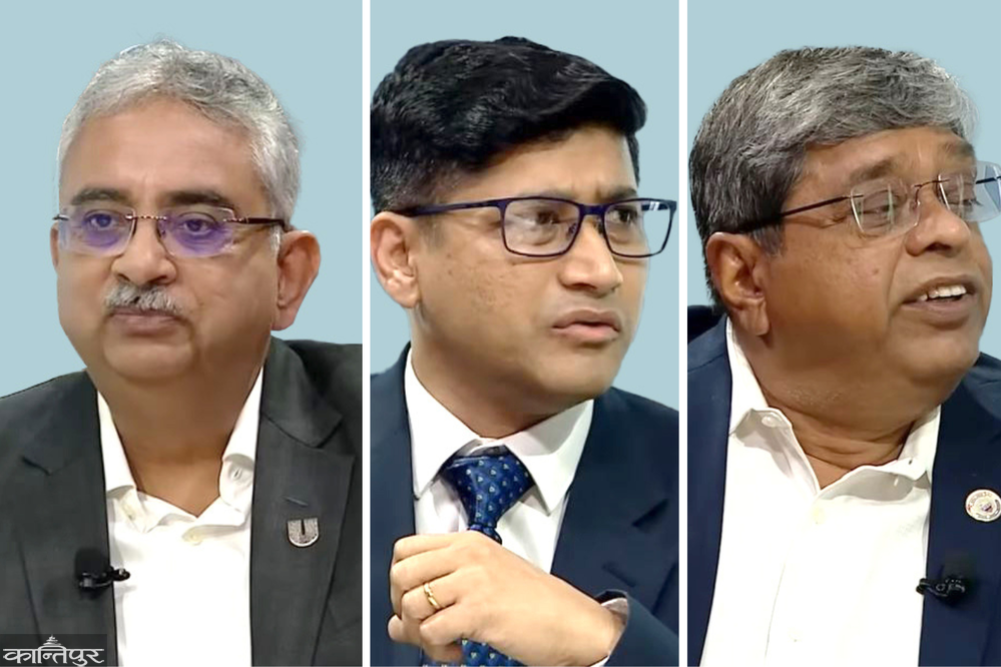
In the three decades since Nepal officially opened up to foreign investment, it has not been able to attract more than one percent of its gross domestic product in any year. In the last three years, this figure has been around 0.2 percent. Even though least developed countries like Nepal, such as Cambodia, Bangladesh, and Rwanda, have been attracting significant investment, Nepal has not been able to attract foreigners. Although most companies operating in Nepal are operating satisfactorily, some have already exited. As companies operating here are facing various problems, they have also not been able to vent their frustration and recommend others to invest in Nepal. In such a situation, they suggest that local companies should be used as promotional ambassadors for Nepal to attract foreign investment. In this context, Kantipur has spoken to Unilever Nepal CEO Amlan Mukherjee , Berger Paints Country Manager Rajiv Roy , and Nepal-India Chamber of Commerce Multinational Company Coordinator Saibal Ghosh .
Give the message that business is easy in Nepal
A stable government that is clear about its priorities is bringing a budget. The government has been saying that it has started working through 100 agendas related to governance reforms by setting its priorities in various places. But the government should not focus only on reforms within Nepal, it should also look at the instability happening around the world, which is not limited to West Asia.
 Instability is also being seen elsewhere in the world. In such a situation, the government needs to bring a balanced budget. The good thing about the government is stability and clear principles. The expectation of the industry sector is that a progressive budget should come. We are not expecting any magic wand to solve all the problems and difficulties of Nepal from a single budget. But I am expecting at least one clear direction from the budget.
It should support local industries, help start the cycle of consumption in the market, help bring the money accumulated in various financial institutions and banks into the cycle of consumption and most importantly, the government should increase investment in infrastructure development. Investing in infrastructure has a positive impact on many other cycles, which is very beneficial for the economy.
We are not saying that all the problems and difficulties of Nepal will be solved with a single budget, but at least we expect a clear direction: Amlan Mukherjee, CEO, Unilever Nepal Progressive policies or approaches help not only multinational companies but also local industries to flourish. The contribution of the manufacturing sector to Nepal's Gross Domestic Product (GDP) is around 5 percent. This is very low compared to similar countries like Nepal around the world. The government is challenging or accepting various laws, regulations and policies as a problem in the name of 'Make in Nepal'. At a time when Nepal starts manufacturing in Nepal, revenue will increase, along with a good investment environment, local and international companies as well as neighbors will look at Nepal positively.
Amidst such policy ups and downs, many companies have been operating in Nepal for more than 30 years. We have built a successful business model. We are a business organization. We are paying high taxes. We want to do good for Nepal. What is good for Nepal is also good for my organization. If the situation is good, we want to invest more and grow the business.
Nepal needs to pay attention to the tax structure. We have an inverted tax structure. The government needs to address this. The tax on raw materials cannot be equal to or higher than that on finished goods. Neighboring country India has implemented the Goods and Services Tax (GST). What is Nepal's equivalent in return for GST? Ultimately, the government should stick to the policy it has adopted so that investors can evaluate and invest. We expect the government to decentralize the decision-making process. If all the decision-making process is centralized only in Kathmandu or the ministry, the results will be delayed.
When the government takes policy decisions, then the faceless (not physically present) government and local bodies take decentralized policies. I think the momentum will be better and more stable after that. First, we need to create employment opportunities in Nepal. We need to create employment in Nepal that meets the aspirations of the youth. There is a huge amount of money accumulated in various banks and financial institutions in Nepal. But there is not enough demand for loans.
The airport should be convenient. We also need an international airport. We are a landlocked country. We do not have sea ports. We cannot easily have a railway due to our topography. Its cost is high. The continuous brain drain from Nepal is seen as a big problem. They must be stopped. The people working daily around us are not skilled. We have unskilled or semi-skilled people. Those people have not received any formal training. They will be very happy if they receive training. But the existing Corporate Social Responsibility (CSR) policy does not allow investment in unskilled or semi-skilled people. The government needs to revise the policy in this regard. If we could train them, we could improve their living standards.
All changes cannot be made from one budget. But we expect policy stability and reforms from the upcoming budget. Tax certainty is a very important issue. Forget big companies like us, a small businessman pays advance tax deduction 'TDS' when he receives money from any transaction he does. TDS is deposited in the tax offices. Now, if he does not get it back after submitting the tax assessment details at the end of the year, his capital is frozen. How will he run his business after that? This is a big problem for investors too.
The government's approach is right. That is why I am optimistic. A huge amount of remittance money is lying idle in the banks. It is time for us to discuss financial instruments to disburse loans. Today's bank interest rates are negligible. In such a situation, the government should bring an investment-friendly policy to increase investment. We should be aware of how and what financial instruments we can add to utilize the investable money in the bank.
Ghost tax or similar cumbersome provisions should be removed
In the past, we have seen many short-term policies. Those of us involved in industry and entrepreneurship want long-term policies and stable policies. We have been seeing new policies coming with the change of government in Nepal. Sometimes those policies are good for business, some policies are also adverse.
 The government should focus on improving some issues. Let us focus on the single-door system. Since the formation of the new government, we have heard talk about creating a single-door system for investment approvals and other things. Sometimes we are going to the Department of Industry. Sometimes we are going to the Nepal Rastra Bank. But it is positive that the government is working towards reducing the obligation to visit many such bodies. Our expectation is that it will be converted to digital medium. The more faceless the administrative process is (tech-friendly and does not require physical presence), the more transparent it will become. And, the more beneficial it will be for the industry sector.
The tax system should be predictable. Ghost taxes or other such hassles should be completely eliminated. Industry is the medium that drives the economy forward. In all the policies that come now, the government should review its working style and existing laws. The government should pay attention to what old policies can be removed and what new arrangements can be introduced or emphasized to accelerate the industrial sector.
Even though we keep talking about becoming export-oriented, we are more import-oriented. Therefore, our exports must now be increased. There is a great need for Special Economic Zones (SEZs) in various parts of the country. Some special incentives and facilities should be brought to make them operational successfully. Such issues help to strengthen the economy in a short time.
Not all changes can happen from one budget, but we expect policy stability and reform from the upcoming budget. : Rajiv Roy Country Manager, Berger Paints Nepal Infrastructure construction is necessary for any investment. We have hydropower as a source. We can go for renewable energy. Because we have enough barren land to put solar panels. We have beautiful destinations. We can work in tourism immediately. Tourism can also develop the hospitality industry. Information Technology (IT) and Back Process Outsourcing (BPO) also help equally.
The government can do all these things. But for that, digital travel is a must. The government should think about introducing 5G and building high-speed internet highways. All these issues need to be worked on. Production is not just about picking up a product. Starting its production. And it will be accepted in the market. You have to start somewhere. For example, I can easily build a hydropower project of more than 750 MW. Energy is a sector where everything from project design to transmission lines has to be built. If there is electricity, it can be sold to neighboring countries like India and Bangladesh. Because there is a lack of clean energy there.
We are focusing on low-cost tourism. But now we should also move towards luxury tourism. We have beautiful places. We have Manang, Mustang. People are surprised when they reach there. The recent move by the Indian Embassy in Nepal is a very good step. Influencers should be allowed to come to Nepal. That will further highlight Nepal's tourism potential. Good roads should be built here.
Don't banks know how to mobilize the money they have invested? When consumption starts, that money will be directed towards industries. If the existing industries start doing better, new industries will enter. Only then will employment opportunities be created.
The government needs to decide which imports of basic items like daily electronics products that we use can be easily replaced by local products. Bank loans are being used in two main big sectors. One is small, cottage and medium industries (SMEs). Let's look at the retail shops of the industry. Now, thousands of retail shops have closed. Because those shops have closed due to reduced demand.
We need to think about how luxury tourism can be brought forward within the tourism industry. Religious and luxury tourism should be promoted together. We should ensure that tourists from all over the world come to these areas. The biggest success of the upcoming budget is that it will create a large number of Nepal promotion ambassadors for Nepal. The direction of the budget should help companies like us to stand up and become more optimistic.
We are fully confident that policy and political stability will continue for the next 3 to 5 years.
If we do not increase consumption, it will be difficult for established companies to survive
Policy stability is the most important issue, it gives certainty to investors about how much return will be received : Saibal Ghosh Multinational Company Coordinator, Federation of Nepal-India Chambers of Commerce and Industry We have been talking about policy stability for a long time. Any investor, whether he is a foreign direct investment (FDI) investor or a local entrepreneur, invests in a particular industry only by looking at other financial parameters. If he is importing raw materials from India or a third country, how much customs duty will be charged, how much value addition will be required and what will be the estimated income? He looks at everything. Therefore, changes in policy can affect his entire financial calculations.
The most important issue is having the right policy and policy stability. This gives any investor certainty about the return on their investment within a certain period of time before investing. Therefore, a minimum requirement for investors to invest is policy stability.
We will have to work mainly in the field of education. Education means primary school education, then up to the graduation level and should be good institutions. Indian Prime Minister Narendra Modi himself had suggested setting up IITs and IIMs in collaboration with the Nepal government during his visit. He meant that it could be started as a joint initiative at first and later handed over to the Nepal government. We need to find a way to keep our youth in the country. Only quality education can make that possible.
 We are very happy that today the remittances entering Nepal are about 33 percent of the GDP. But perhaps we are losing those skilled human resources of the future. Practically speaking, the chances of them returning to Nepal are very low. The country's brain drain is continuing, which is also hampering our population and consumption. Unless we effectively increase our consumption, it will be very difficult for established companies to survive. There will also be obstacles for new investors.
We also have hydropower. Now the period of hydropower is not very long. Ultimately, it should be renewable energy. Now renewable energy is becoming cheaper in the international market. Today it is around Rs 3 per unit. Experts say that this facility will not be available for the next 10 years. India is investing heavily in renewable energy. We should also pay attention to this.
Youth are leaving the country at school age. Therefore, in the first phase, it is necessary to build infrastructure to provide quality education in Nepal. Starting today, we should provide quality education here.
What I have mentioned here is not a matter of one year or one budget. But let us take the right steps in the right direction for the right work. The government is taking the right decisions in terms of identifying and understanding priority areas. It is difficult to predict that it will soon be converted into real data. But with the right direction, not only this budget but the entire economy should move in the right direction. There are also various external challenges now, which may continue for at least the first 6 months of the upcoming budget period. Keeping all these issues in mind, let us identify the key areas and take the right steps in the right direction.
The current government's focus on taking timely decisions is very good. I am confident that we will do better in the future. The government will probably form a high-level dispute resolution commission to address the disputes that have been brewing for the past 10-12 years.