Despite paying a large portion of income to the state, the general public receives little social services and security.
We use Google Cloud Translation Services. Google requires we provide the following disclaimer relating to use of this service:
This service may contain translations powered by Google. Google disclaims all warranties related to the translations, expressed or implied, including any warranties of accuracy, reliability, and any implied warranties of merchantability, fitness for a particular purpose, and noninfringement.
Not only are the services provided to Nepalis, who pay up to 39 percent of their income in income tax, very poor, but revenue collection is also shrinking. Despite paying a large portion of their income to the state, the general public is increasingly frustrated due to lack of infrastructure and poor social services and security.
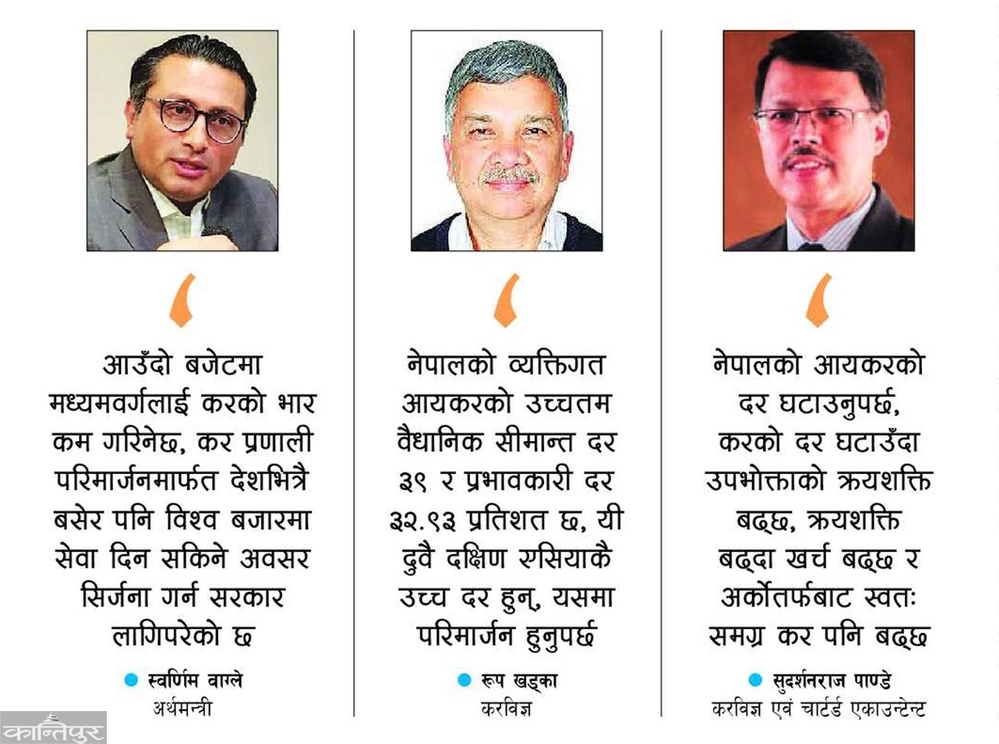
Nepal's income tax rate is the most expensive in South Asia, so it should be reduced, suggests tax expert and chartered accountant Sudarshan Raj Pandey. 'The international community has spread a negative message that Nepal charges up to 39 percent income tax. While only about 4/5 billion rupees in tax have been collected from the high rate,' he said, 'Reducing the tax rate increases the purchasing power of consumers. When purchasing power increases, spending increases, and on the other hand, the overall tax automatically increases.'
Pandey said that there are many countries where reducing tax rates has not reduced overall revenue. 'Looking at the example of neighboring India, the government there reduced the Goods and Services Tax (GST) last year. But the revenue did not decrease,' Pandey said, 'Before the implementation of GST, indirect taxes in India were 55/56 percent. Under GST, the maximum tax rate is only 24 percent. Therefore, Pandey estimates that even if the tax rate is reduced and the scope is expanded, the overall revenue will not decrease.
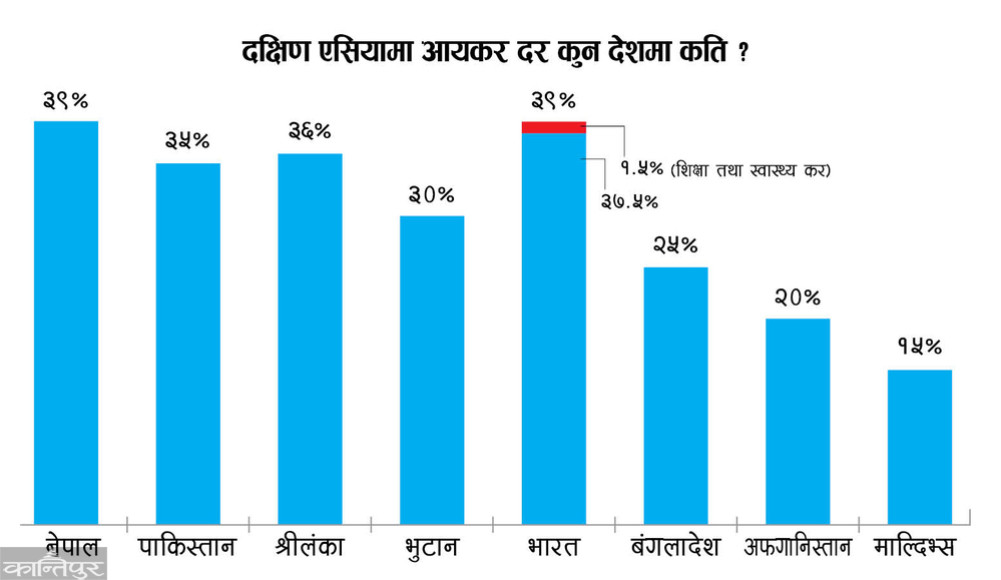
Pandey argues that although European countries have high taxes, their tax rates are not comparable to Nepal. The social security situation in those countries is very good. But in Nepal, the current tax rate is high because there is an obligation to earn not only for oneself but also for one's descendants. In India, the maximum income tax is 30 percent (up to 37.5 percent with surcharge), 35 in Pakistan, 36 in Sri Lanka, 30 in Bhutan, 25 in Bangladesh, 15 in Maldives and 20 in Afghanistan. An additional 1.5 percent is levied in India as education and health tax.
Despite the high tax rate, the social security situation here is not better than in many other South Asian countries. There is a lack of quality services in government hospitals, the quality of public schools, transportation, drinking water, but also administrative services and security are weak. The health insurance program is very weak. Therefore, the middle class has to pay more taxes and also spend heavily on health, education, etc.
Even though the scope of the social security fund has increased in Nepal, it has not fully covered the private sector and the informal sector. The tax-paying population base in Nepal is small. There is a greater burden on the limited formal sector. Experts say that this has increased the feeling that 'honest taxpayers are being punished'. According to the Internal Revenue Office, in the fiscal year 2081/82, about 11,000 people paid taxes at a rate of 30 percent or more. From this, the state collected about 10 billion in revenue.
Experts say that even if the benefits from the state do not increase even if taxes are paid at a high rate, citizens will be discouraged from paying taxes and there is a possibility of tax evasion. Since the size of the informal sector in the economy increases when the tax rate is high, it should be reduced as much as possible, said Laxman Aryal, an expert on tax administration and former secretary. 'As people's income increases, when it reaches the level of paying high tax rates, people either do not work or start looking for ways to evade taxes,' he said. According to the latest economic census, 49 percent of businesses in Nepal are informal.
Therefore, Aryal suggests that tax rates should be reduced as much as possible. ‘The first thing that needs to be done now is to increase the tax threshold. Because some people are earning. But taxes have not been raised accordingly,’ Aryal said, ‘Is the tax on share transactions the final tax or not? The state should have a clear opinion on that. Instead, the current 7.5 percent capital gains tax can be increased to 15/20 percent. The tax rate can also be set differently based on the transaction amount.’
In Nepal, the personal income tax rate is divided into 6 categories. Under personal income tax, the first limit on professional income (5 lakhs for a single individual and 6 lakhs for a couple) is not subject to income tax. But the starting slab of employment income of natural persons, i.e. up to 5 lakhs for a single individual and 6 lakhs for a couple, is also taxed at 1 percent.
Not even 1 percent tax is levied on income from pensions, pension funds and contributions to the social security fund based on contributions. In case of income exceeding that, tax is levied from 10 to 39 percent. Accordingly, income from 5 to 7 lakhs is 10 percent, income from 7 to 10 lakhs is 20 percent, income from 10 to 20 lakhs is 30 percent, income from 20 to 50 lakhs is 36 percent and income above 50 lakhs is 39 percent.
In Nepal, only 1 percent income tax is levied on personal income received from employment up to 500,000 rupees. But the government has been saying that no tax will be levied up to that amount. The minimum tax-free limit in India, Sri Lanka, Maldives and others is higher than in Nepal. Since the tax collected by the government is used through the budget, there is no exact data on where the tax money was spent.
However, former Secretary Aryal said that about 75 percent of the total government expenditure is met through revenue, 10 percent through internal debt and the remaining expenditure is met through external debt, foreign aid and grants. Tax expert Roop Khadka says that the first slab of income that is exempt from income tax in Nepal is the same in all South Asian countries except Afghanistan and the Maldives. “The statutory rate and average effective rate of personal income tax on income up to US$ 60,000 are the highest in Nepal,” Khadka said. “The highest statutory marginal rate of personal income tax in Nepal is 39 percent and the effective rate is 32.93 percent. Both of these are the highest rates in South Asia.”
Khadka believes that since the tax rate is high in Nepal, it should be revised. In Nepal, those with high incomes will be taxed at higher rates and those with low incomes at lower rates (progressive tax), and this type of system will reduce the unequal distribution of income in society, he claims. However, the practice of imposing higher rates on high-income individuals has narrowed the tax base in various countries and has led to a tendency for taxpayers to evade taxes due to high rates, weakening tax implementation, Khadka said. According to him, the government should reduce the 39 percent tax rate and abolish the 1 percent social security tax.
Saying that the country will not rise until the middle class is secure, Finance Minister Swarnim Wagle has been saying that the government will also adopt a policy of reducing the tax burden on such a class. As the keynote speaker at the Kantipur Economic Summit 2026 held in Kathmandu last Wednesday, Finance Minister Wagle stated that the tax burden on the middle class should be reduced by reforming the tax system as part of the restructuring of the economy.
“Our tax system is mainly based on trade taxes. Production is shrinking. The potential for service exports will be expanded through the development of digitization and IT-based industries,” he said. “A policy environment should be created for this.” Finance Minister Wagle said that the government is working to create opportunities to provide services in the global market even within the country through tax system reforms. Overall, he said, the goal is to reduce the tax burden, simplify the system, and make the service-based economy formal and competitive.
In Nepal, personal income tax was imposed from the beginning with the aim of reducing the unequal distribution of income in society in addition to revenue collection, tax expert Khadka said. He said that as a result of the first generation of tax reforms implemented in the 1990s, only two rates of personal income tax of 15 and 25 percent were maintained. Looking at the structure of tax revenue, the largest share of 32.9 percent is derived from value added tax (VAT). Income tax accounts for 30 percent, excise duty 15.5 percent, special service tax 0.3 percent, vehicle and infrastructure use tax 3.6 percent, and customs duty 17.7 percent.
The share of income tax in gross domestic product (GDP) was 5.39 percent in 2077/78. It is 5.23 percent in the fiscal year 2078/79, 4.71 percent in 2079/80, 4.93 percent in 2080/81, and 4.79 percent in 2081/82.