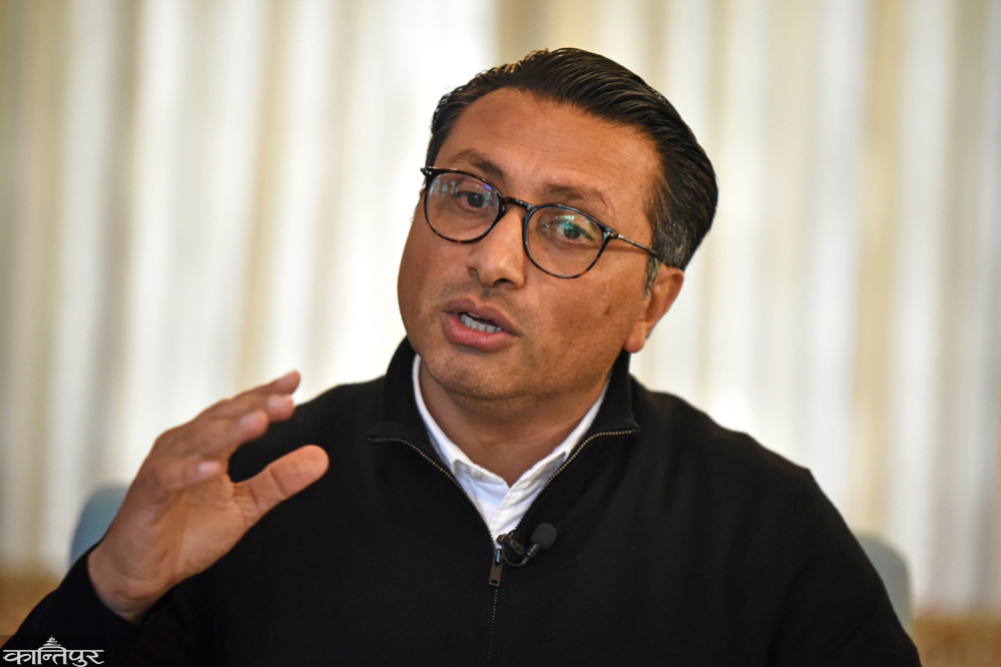
Stating that the budget preparation for the upcoming fiscal year is in the final stages, Finance Minister Wagle has sought suggestions from former finance ministers and economists.
We use Google Cloud Translation Services. Google requires we provide the following disclaimer relating to use of this service:
This service may contain translations powered by Google. Google disclaims all warranties related to the translations, expressed or implied, including any warranties of accuracy, reliability, and any implied warranties of merchantability, fitness for a particular purpose, and noninfringement.
Finance Minister Swarnim Wagle has met with eight former finance ministers and sought suggestions on the topics to be included in the upcoming budget. Stating that the budget preparation for the upcoming fiscal year is in the final stage, Finance Minister Wagle has sought suggestions from former finance ministers and economists. During the meeting, Minister Wagle informed that preparations are underway to bring a budget that will improve the living standards of the common Nepali people based on the foundation of good governance. While taking suggestions from former finance ministers on the budget preparation for the upcoming fiscal year, he said that the budget will be prepared in the new situation by following past experiences and positive practices.
Finance Minister Wagle said that everyone has led the Ministry of Finance in their own time for the benefit of the country and the people, and the objective is the same whether the situation is favorable or unfavorable. He said that the positive practices will be continued by reviewing the achievements and weaknesses of the past.
He said, 'We will move forward by following the good work done by you. We will walk on the path shown by our elders.' This system and this political achievement will bring prosperity.'
The former finance ministers participating in the discussion have suggested economic reforms, realistic revenue targets, expenditure cuts, boosting private sector morale and increasing investment in production-oriented sectors for the upcoming budget. Former Finance Secretary Rameshwor Khanal urged the implementation of the report of the High-Level Economic Reform Task Force and suggested not to spend the budget on unprepared and fragmented projects. He urged not to impose value-added tax on the electricity sector.
Former Finance Minister Shankar Koirala, expressing the view that policies should be formulated after studying old economic reports, suggested opening up the private sector in the electricity trade, expanding the industrial sector and moving forward with hedging policies. Former Finance Minister Yubaraj Khatiwada suggested not setting overly ambitious revenue targets and said that the revenue growth rate should be kept within the range of 10 to 12 percent. He expressed the view that a budget of about 2 trillion rupees should be brought, financial sector reforms should be carried out and the morale of the private sector should be increased. He said that the disorderly trend seen in national pride projects should be ended, subsidies in agriculture should be made effective, and coordination with Nepal Rastra Bank is necessary in financial sector reforms.
Former Finance Minister Prakash Chandra Lohani emphasized the need to increase cooperation between the government and the private sector and said that a policy to encourage small, medium and large industries equally is necessary. He opined that economic dialogue is necessary to find an Indian market for agricultural produce.
Former Finance Minister Surendra Pandey suggested reducing the number of large projects and focusing on limited national pride projects. He mentioned the need for reform of land use laws and said that a special plan should be brought for the development of the tourism sector.
Former Finance Minister Prakash Sharan Mahat expressed the view that social security allowance should be limited to the target group and that government industries and properties can be operated on the 'lease' model. He suggested reducing foreign debt and stopping possible collusion in large contracts.
Former Finance Minister Barshaman Pun said that the return on past infrastructure construction was weak and that investment in tourism infrastructure should be increased. He suggested that 'hill stations' and wedding destinations should be developed to attract the Indian middle class.
Former Finance Minister Bishnu Prasad Poudel said that the budget should be prepared based on the actual cost estimate and expressed the need for bold decisions on the use of mines and natural resources. He suggested that large projects like Budhi Gandaki should be implemented.
Former Finance Minister Janardan Sharma explained the budget as a document to implement political commitments and said that government spending should be cut. He suggested that investment should be increased in mining, pharmaceutical industry, chemical fertilizer industry and skilled manpower production.
Most of the former finance ministers participating in the discussion shared the view that it is necessary to accelerate economic reforms, increase confidence in the private sector, control spending and increase investment in production-oriented sectors.