Updated overdue amount is 755 billion, amount to be settled after taking action is 787 billion
We use Google Cloud Translation Services. Google requires we provide the following disclaimer relating to use of this service:
This service may contain translations powered by Google. Google disclaims all warranties related to the translations, expressed or implied, including any warranties of accuracy, reliability, and any implied warranties of merchantability, fitness for a particular purpose, and noninfringement.
Due to the lack of transparency, economic frugality and financial discipline in government/public expenditure, the amount of embezzlement has been increasing year by year. According to the annual audit report for the fiscal year 2081/82, the country's total embezzlement (including those that need to be resolved after action) has reached 1.543 trillion rupees.
The Accountant General has recently divided embezzlement into two headings: periodic embezzlement and amounts that need to be resolved after action. According to which, while periodic embezzlement is 755 billion 170 million rupees, the amount that needs to be resolved after action is 787 billion 860 million. According to the annual audit report released by the Office of the Auditor General on Friday, the embezzlement for the fiscal year 2081/82 alone is 88 billion 91 million rupees. This is slightly less than the previous year. The embezzlement for the fiscal year 2080/81 was 91 billion 59 million 79 million rupees. Auditor General Toyam Raya submitted the report to President Ramchandra Poudel on Friday.
In the fiscal year 2081/82, 5,526 offices/bodies, including federal, provincial and local levels, and organizations formed under federal law, were audited for a total of Rs. 9,484.5 billion. The total amount that needs to be recovered, regularized and paid has been included in the total amount of unpaid balances. The amount that needs to be settled after audit is included in the heading of audit arrears, revenue arrears, foreign grants and loans pending reimbursement, and principal and interest on loans given with collateral.
The Auditor General has stated that due to physical damage caused during the Gen-G movement on 23 and 24 Bhadra, the audit of 179 offices worth Rs. 1,47.9 billion could not be done. Auditor General Raya said that the amount of unpaid balances is increasing due to the lack of good governance in government bodies. He said that the increase in unpaid balances is due to the lack of implementation of the reform measures pointed out by the Auditor General's Office.
The largest share of the publicized irregularities is from the offices and bodies under the union. This year, irregularities of Rs 53.49 billion have been seen under the federal office, Rs 5.23 billion under the provincial office, Rs 19.5 billion at the local level, and Rs 10.32 billion at the committees and institutions. The Accountant General has also stated that after last year's audit and the instructions pointed out and given this year, Rs 14.63 billion have been recovered. Similarly, in the preliminary report prepared during the 63rd audit, Rs 95.27 billion 8 million were seen in the fiscal year 2081/82, while about Rs 7 billion has been recovered from the instructions and circulars issued by the time the report was made public.
In the fiscal year 2081/82, the highest irregularities were seen in the Ministry of Finance. The total irregularities of the Ministry of Finance and its subordinate bodies are Rs 37.63 billion 31 million. This is 70.36 percent of the total irregularities. Similarly, the Ministry of Physical Infrastructure is in second place. Its irregularities are Rs 7.10 billion 33 million.
The Ministry of Land Management, Cooperatives and Poverty Alleviation is in third place, with an unaccounted expenditure of Rs 1.5336 billion. The Ministry of Forests has an unaccounted expenditure of Rs 1.3457 billion, the Ministry of Communications has an unaccounted expenditure of Rs 1.1678 billion, the Ministry of Urban Development has an unaccounted expenditure of Rs 800 million, the Ministry of Foreign Affairs has an unaccounted expenditure of Rs 743.4 billion, the Ministry of Energy has an unaccounted expenditure of Rs 652.6 billion, the Ministry of Home Affairs has an unaccounted expenditure of Rs 577.2 billion, the Ministry of Health has an unaccounted expenditure of Rs 524.3 billion, and other ministries have an unaccounted expenditure of Rs 1.3986 billion.
In the fiscal year 2081/82, there were 661 local levels with an unaccounted expenditure of less than 5 percent. There are 39 local levels with an unaccounted expenditure of 5 to 15 percent, while others have an unaccounted expenditure of more than that. Out of 753 local levels, only 721 were audited.
The Accountant General stated that while auditing the accounts of 3,500 federal offices, 894 offices had zero unaccounted expenditure. The report mentions that 328 offices in the 1,124 offices in the province had zero irregularities in the audit.
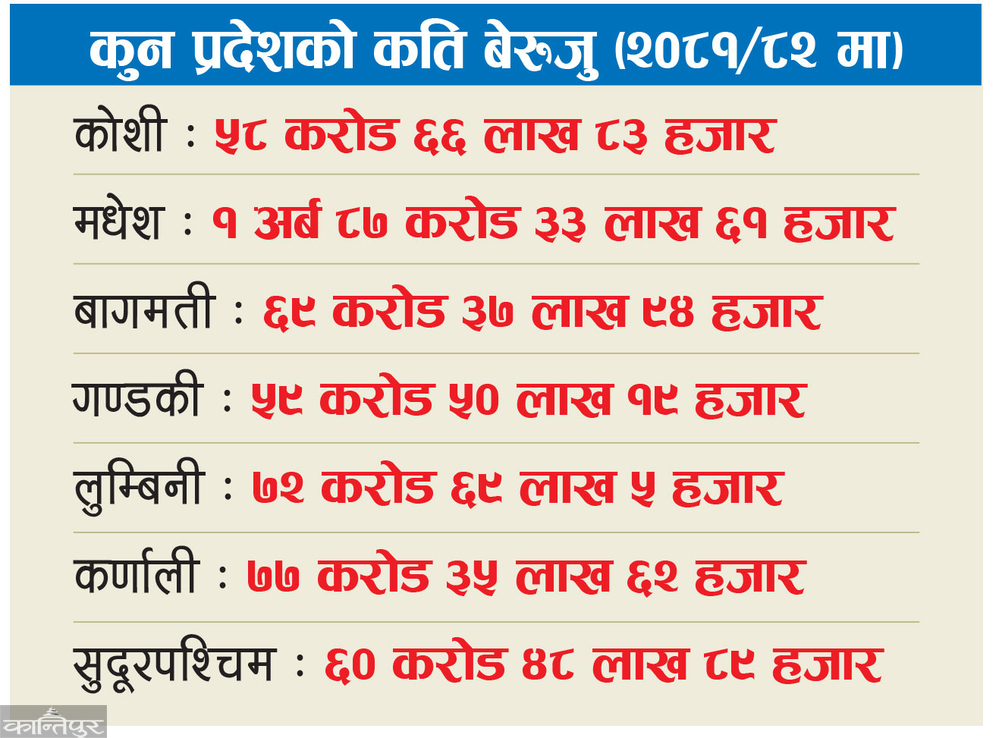
In the fiscal year 2081/82, the total irregularities in the bodies under the Koshi province were Rs 586.683 million, in Madhesh Rs 1.873361 billion and in Bagmati Rs 693.794 million. The irregularities in the bodies of the Gandaki province were Rs 595.19 million, in Lumbini Rs 726.95 million, in Karnali Rs 773.562 million and in the Far West Rs 604.889 million.
The Accountant General has also pointed out 24 separate areas for thematic reforms, saying that the federal, provincial and local levels need to do a lot of work for reforms.
Madan Kumar Sharma, president of Transparency International Nepal, which advocates for good governance, says that the Auditor General keeps pointing out irregularities, but there has been no improvement due to the government's tendency to ignore them. 'Every year, the Auditor General lists irregularities, the Authority prosecutes cases, and gives instructions, and the National Vigilance Center seems to be giving instructions, but what about improvement?' He says, 'Instead, we hear stories of those in power obstructing audits and threatening the audit officials so that irregularities do not become public. This shows that those in power are not prepared to make reforms.' Sharma also says that the country risks heading towards financial chaos if the issues pointed out by the Auditor General are not taken seriously.
 Roadmap suggested by the Auditor General
The Auditor General has suggested a roadmap for reform, from amending laws for financial discipline to restructuring unproductive and ineffective institutions. The suggestions for improvement have been presented under 24 headings under governance management, economy, public finance management, foreign aid, development management, public asset management, information technology, public administration and good governance.
The Accountant General has also suggested to the government in a point-by-point manner to end duplication in expenditure, development aid, a single-door system for expenditure by non-governmental organizations, predictable budgets and projects, their regular monitoring, and discourage projects without resources. Auditor General Raya says that if the suggestions are followed to the letter, the financial crisis will be controlled to a large extent.
The Accountant General has emphasized the formulation of laws and implementation of federalism under governance reform. The Accountant General has mentioned in the report that basic laws should be formulated and made timely to make the delivery of services including federal civil service and education services, which are directly related to the implementation of the constitution, effective. The Accountant General has also suggested amending conflicting and unclear provisions in the existing laws.
The report has pointed out that irregularities seen in the procurement of goods or services should be ended. The report also mentions the need to control the misuse of funds under the cover of compensation in development projects.
The report suggests institutionalizing the development of action plans, coordination, and interrelationships for assistance in accordance with the division of powers under the implementation of federalism. It says that the intergovernmental financial transfer system should be made predictable, transparent, and result-oriented, and necessary reform measures should be adopted to ensure stability in resource distribution.
The report mentions the need to emphasize a sustainable and self-reliant economy towards economic reform. ‘Necessary policy and structural reforms should be adopted to achieve sustainable economic growth through domestic production, job creation, and skilled human resource development,’ the report says. ‘Preparation and risk management systems should be strengthened to minimize the pressure on the economic and financial sectors, taking into account the potential impacts of global economic instability, natural disasters, and external risks.’
The report also suggests expanding the scope of the formal economy by reducing cash-based economic activities and expanding the digital payment system.
The Office of the Auditor General has suggested that the appointment of administrative heads and directors in public institutions should be based on subject matter expertise and be competitive, and that their service facilities be linked to work performance. Similarly, it has been suggested that the services, facilities and remuneration of the human resources working in government-owned public institutions should be reviewed and determined on an objective basis, and that legal provisions be made to require the prior consent of the Ministry of Finance when making decisions that will affect long-term financial obligations by organized organizations.
The report has emphasized the need to control unproductive and distribution-oriented spending. The report also suggests making arrangements to periodically publish the details of all types of services and facilities provided to high-level officials.
It has been said that foreign aid should be accepted only after ensuring that it is in line with national needs, long-term development priorities and sectoral strategies, that technical, material and all other types of foreign aid should be included in the national budget system to enhance transparency, and that it should fall within the scope of the Auditor General's audit. Similarly, the report also suggests ensuring that aid is received on time as per the commitment to reduce the gap between development aid commitments, actual receipt and utilization. It has been suggested to define the grant distribution issues, sectors and target groups on a legal basis for clarity so that grants are available only in productive and employment-generating sectors.
It has been said to remove duplication between the policy arrangements, procedures and criteria for grants provided by the three levels of government, to include the financial transactions of all non-budgetary entities in the integrated financial statement to ensure the real benefit of capital grants provided to commercial organizations, and to gradually move the evidence, documents and decision-making processes related to financial transactions to electronic records. The Accountant General has also suggested keeping up-to-date records of financial liabilities and commitments created from multi-year procurement agreements, foreign aid and other sources and developing a regular monitoring and liability management system for them.
The Accountant General suggests that while selecting projects, the budget should be allocated only after including them in the plan bank after a realistic assessment of cost-benefit analysis, internal rate of return and resource availability. The report states that to eliminate duplication in development projects operated by the tiers of government, they should be carried out in an integrated manner based on cost, geographical location and sensitivity.
It has also been said that the issues of determining the procurement requirements, determining the specifications of goods, construction work or consulting services or other services, determining the scope of work, preparing cost estimates and determining the implementation points and time taken to complete the work should be made clear and evidence-based. The Accountant General has suggested controlling the tendency of making payments without ensuring that the specified public participation components are actually included while conducting work through the consumer committee. For that, it has been said that the concerned employees should be made accountable and responsible. The report states that the provision of conducting or getting laboratory tests of construction materials and completed work should be mandatory to ensure the quality of construction work carried out by the consumer committee.
The Accountant General has also suggested ensuring the archiving and security of records, maps, treaties and agreements of national importance, making public and Guthi lands free from encroachment and ensuring proper protection and utilization, bringing land that has been compensated into government ownership and making arrangements for recording, protection and utilization, and making arrangements for timely repair and utilization or auction/transfer of vehicles seized at customs and unused in public bodies.
It has also been suggested to make legal arrangements covering all areas of information technology such as electronic transactions, information security, artificial intelligence, machine learning and electronic platforms, and to prepare clear criteria for identifying the need for electronic systems, developing them and purchasing equipment. Similarly, the Accountant General has suggested that the duplication of resources and uniformity in service delivery should be reduced by reviewing separate information systems in government bodies and developing integrated data centers and interconnected digital service platforms.
अनुत्पादक खर्च नियन्त्रणका लागि उच्च पदस्थ पदाधिकारी स्वयंले मितव्ययिताको उदाहरण प्रस्तुत गर्नुपर्ने भन्दै महालेखाले बैठक, सभा र उत्सवजस्ता शीर्षकमा हुने खर्चमा नियन्त्रण गर्न पनि निर्देशन दिएको छ । कानुनबमोजिम बाहेक पटके निर्णयबाट कुनै पनि किसिमका सुविधा तथा सहुलियत उपलब्ध नगराउन पनि सरकारलाई सुझाव दिइएको छ ।
निकायको कार्य प्रकृतिअनुरूप वित्तीय अनुशासन कायम गर्न छुट्टै आचारसंहिता तर्जुमा गर्न, वित्तीय कारोबारको परीक्षणबाट देखिने बेरुजुलाई जिम्मेवार व्यक्तिको कार्यसम्पादन र वृत्तिविकाससँग आबद्ध गर्ने व्यवस्था मिलाउन, कार्यसम्पादन करार गर्दा बेरुजु फर्स्योट तथा फरफारख गर्ने विषयसमेत समेट्न पनि महालेखाको सुझाव छ ।

