The government's goal is to boost economic growth by maintaining good governance through digitization.
We use Google Cloud Translation Services. Google requires we provide the following disclaimer relating to use of this service:
This service may contain translations powered by Google. Google disclaims all warranties related to the translations, expressed or implied, including any warranties of accuracy, reliability, and any implied warranties of merchantability, fitness for a particular purpose, and noninfringement.
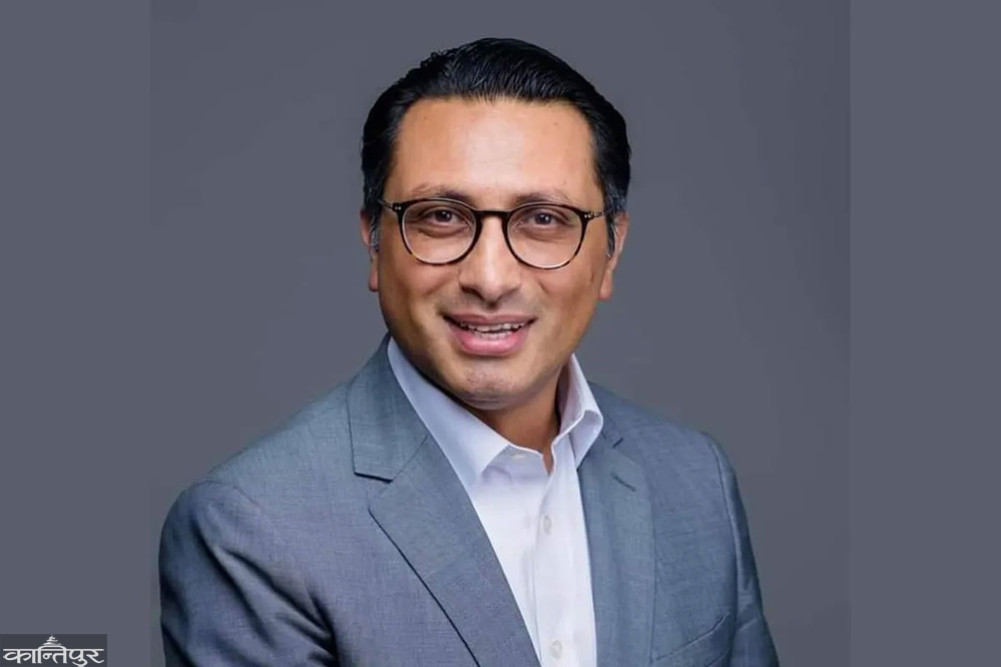
Finance Minister Swarnim Wagle has said that the upcoming budget will prioritize five areas, including good governance, reducing the tax burden on the middle class, and making economic diplomacy effective. He said that the goal of making the economy dynamic and achieving rapid economic growth will be achieved by maintaining good governance through digitization.
Addressing the Kantipur Economic Summit 2026 organized by Kantipur Media Group on Wednesday, Wagle said that the priorities and programs of the upcoming budget will be decided on five theoretical grounds, namely good governance, economic restructuring and prosperity, integrated infrastructure, all-round social upliftment, expansion of the middle class, and strengthening of soft power.
Finance Minister Wagle said that the government is moving forward with the belief that with excellent working systems, right policies and intentions, capacity management will also be easy. He said that the government has put forward an agenda of comprehensive legal reforms to improve the service system. Finance Minister Wagle said that the government wants to clean up the political and economic aspects through good governance. 'We have said that we will clean up the economic and political aspects. The Rashtriya Swayamsevak Sangh (RSS) had taken such a decision before the elections. This issue is also in our manifesto,' he said, 'The first 19 points written in the manifesto are related to good governance and the following 21 issues are related to the economy. Good governance and economy are our first priority.'
Pradeep Jung Pandey, former president of the Federation of Nepalese Chambers of Commerce and Industry, says that the steps the government wants to take to improve good governance and the economy are very good and necessary. He said that the Finance Minister's statement to reduce the tax burden for the middle class and industry is very good. He said that the reform of the industrial sector has begun with the government abolishing the Revenue Investigation Commission to solve the problems of the industrial sector.
'It is also good for the private sector that the government wants to effectively implement the one-stop policy for the development and expansion of the industrial and business sector,' Pandey said. He said that although the government's policies and programs are good, their effective implementation is necessary.
Finance Minister Wagle said that the priorities and principles of the appropriation bill will also revolve around the promises and policies and programs of the Rashtriya Swayamsevak Sangh (RSS). ‘The budget will be presented on 15 Jestha to institutionalize the issues we have talked about with figures. We have been paying the price for a long time of misrule,’ he said, ‘Now it is time to reap the dividends of good governance. The process of freeing Nepal from the institutional and policy-based occupation at the ‘micro’ level has begun. We will continue this in a concentrated manner.’
Thus, Finance Minister Wagle said that the government has prioritized firstly e-governance, secondly digital service flow and thirdly the creation of a digital economy.
Industrialist Shashikant Agrawal said that the work that the government wants to maintain good governance should be implemented very effectively immediately. He said that the results of the good governance that the government wants to do have started to be seen in a short time. ‘The private sector is in favor of good governance in the country. For this, the government has talked about digitization, which is very effective,' he said. He said that although the economic growth maintained by the government is challenging, it cannot be called impossible. He said that the step to stop smuggling is also commendable.
Finance Minister Wagle is committed to working using various data received from state bodies. 'Work will be done through cooperation and coordination between state bodies. This practice has not been done so far. Even if it was, it was less,' he said, 'We will work in a way that is agile, economical and reduces arbitrary powers by using data and digital. That will institutionalize e-governance.'
For digital services, every established technology will be arranged to provide services directly to citizens, and the Land Revenue, Passport, and License offices will start providing services in a convenient manner, said Finance Minister Wagle. 'We will also connect everyone to the Citizen App. Currently, citizens are only getting 5-7 services from this,” Wagle said. “We have moved forward to provide 100 services through the Citizen App in a short time. The service will be made more efficient by using data centers, G Cloud, and AI. For this, legal structures will also be improved.”
Rajendra Malla, former president of the Nepal Chamber of Commerce, said that although there are some challenges in achieving seven percent economic growth and a 100 billion US dollar economy, the efforts for economic reform are very good. However, he said that even if the economic growth does not reach seven percent all at once, the growth rate can be increased gradually. Even if the targeted growth is not achieved all at once, it will happen gradually, he said. “There should be good governance. The big ones should not be left alone and the small ones should not be imprisoned, and businessmen should not be treated like criminals and imprisoned,” Malla said.
Finance Minister Wagle said that Nepal will reap the benefits of good governance in the immediate, medium, and long term. He said that Prime Minister Balendra Shah has also given this a top priority. “The issue of having an IT authority in the Prime Minister’s Office has been envisioned. For that reason, a decision was made on Wednesday to have only 18 ministries, including the Prime Minister's Office,' he said. 'Now all IT-related work will remain under the Prime Minister.'
Wagle said that the economy is still dependent on remittances and the tax system is mainly based on trade taxes. 'Production is shrinking. The potential for service exports will be expanded through digitization and the development of IT-based industries,' he said. 'A policy environment should be created for this.'