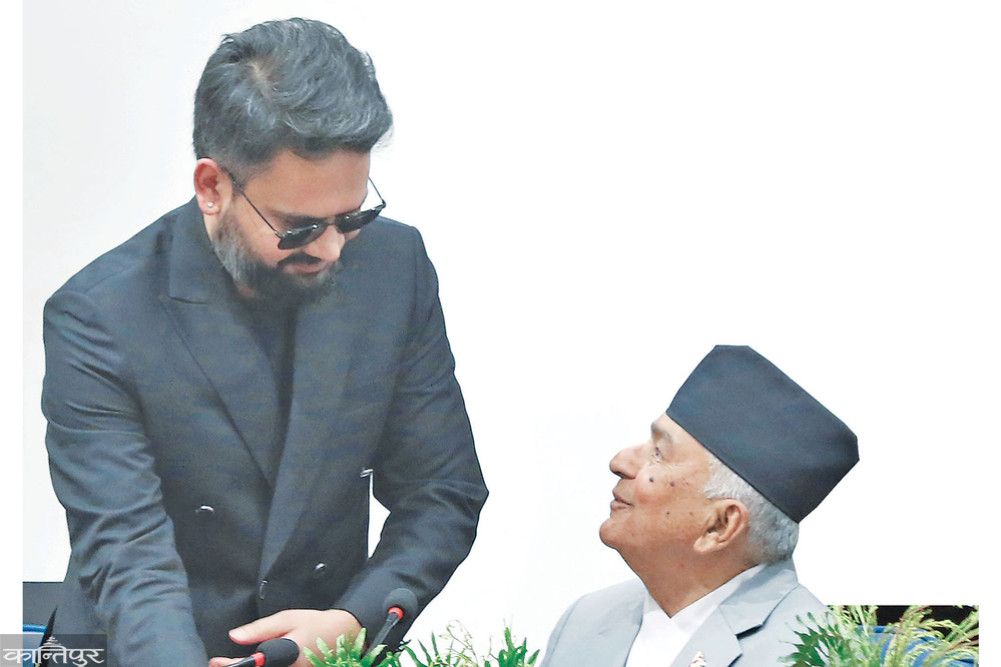
The government has made good governance, digitization, and investment expansion the basis of economic transformation.
We use Google Cloud Translation Services. Google requires we provide the following disclaimer relating to use of this service:
This service may contain translations powered by Google. Google disclaims all warranties related to the translations, expressed or implied, including any warranties of accuracy, reliability, and any implied warranties of merchantability, fitness for a particular purpose, and noninfringement.
The government has set an ambitious target of an average economic growth of 7 percent over the next decade through its policy and program for the fiscal year 2083/84. In an economy that has been experiencing an average economic growth of 4 percent for three decades, the government, which enjoys close to two-thirds support, has made good governance, digitization, and investment expansion the basis of economic transformation.
However, achieving the target appears challenging amid sluggish private investment, a weak industrial base, and declining revenue growth. However, the government claims that the target can be achieved through comprehensive legal and institutional reforms by launching a 'new phase of economic reform series'.
Stakeholders say that the concrete programs and plans to be included in the budget for the coming year, which will be brought on the basis of the policy and program, will determine whether the target will be achieved or not. For this, they say, the budget should present a clear roadmap to expand private sector investment, increase capital expenditure, and minimize the impact of ongoing tensions in West Asia.
The policy and program presented by President Ram Chandra Poudel in the joint meeting of Parliament on Monday prominently includes the issue of increasing the use of information technology to expand investment and promote good governance. However, as the economy has expanded from agriculture to the service sector without industrialization, employment opportunities are being lost.
The ongoing conflict in West Asia has not only increased costs but also has the potential to affect remittance inflows. The contribution of manufacturing industries to the gross domestic product (GDP) is less than 5 percent.
Only the programs in the budget can determine whether the target will be achieved or not, said Anjan Shrestha, President of the Federation of Nepalese Chambers of Commerce and Industry. ‘There has been talk of a decade of average 7 percent economic growth and upgrading to a middle-income country. Based on what programs are included in the budget, the target will be achieved or not,’ he said. ‘The expansion of private investment, construction of projects in the public-private partnership model and other issues are good. Their effectiveness remains to be seen.’
The ongoing conflict in West Asia has not only increased costs but also has the potential to affect remittance inflows. The contribution of manufacturing industries to the gross domestic product (GDP) is less than 5 percent. Although the government has addressed issues ranging from automated systems to investment visas to expand investment, past experience suggests that achieving the target is challenging. Foreign investment in Nepal is only 0.4 percent of GDP. When domestic investment is not growing, the government should reassure investors to increase foreign investment. According to the latest data from the Nepal Rastra Bank, 14.55 billion rupees of direct foreign investment (equity only) have been inflowed in the first nine months of the current fiscal year. Such equity was only 8.94 billion rupees in the same period last year.
In its policies and programs, the government has said that it will implement a new model of infrastructure financing by mobilizing alternative development finance, diaspora capital and private investment to raise investment. ‘Foreign aid, loans and private sector investment will be focused on projects that provide high returns. The transformational project will be carried out with clear goals, a fixed budget and a strict time frame,' the government has said. 'A performance agreement with the project manager, digital progress tracking, land acquisition and forest-related obstacles will be resolved, and arrangements will be made not to change the responsibilities of key human resources until the project is completed.'
Private sector investment has declined continuously in recent years. Due to the failure to increase demand, more than 1.1 trillion rupees of loanable capital have accumulated in banks and financial institutions. The decline in private investment has had a direct impact on revenue collection and public debt. Social security, grants and other mandatory obligations are more than 1.5 trillion rupees more than revenue collection. In such a situation, the government faces the challenge of how to raise the necessary investment to achieve the goals of 7 percent economic growth, a per capita income of 3,000 US dollars and building an economy worth 100 trillion. Capital expenditure towards government investment has been averaging only 64.1 percent for the past decade.

Economist Kalpana Khanal says that although seven percent economic growth is challenging, it is not impossible. She said that even though an average growth of seven percent is possible, the government needs to work hard in the current situation, as economic growth of up to eight/nine percent has been achieved in the past.
Targeted economic growth is possible if the government can increase capital expenditure and encourage the private sector to expand investment. She said that the economic growth target, although ambitious, is appropriate considering the pace at which the government wants to work.
The government has a policy to formalize a cashless, transparent and revenue leakage-free economy by linking all economic transactions to a digital platform. The government has a policy to formalize a cashless, transparent and revenue leakage-free economy by linking all economic transactions to a digital platform. About 49 percent of businesses in Nepal are informal. The government has set a goal to make payments for economic transactions through the digital system and reduce revenue leakage. The government has a policy to reduce the burden on entrepreneurs and middle-class families by reviewing the tax structure. ‘The burden on entrepreneurs and middle-class families will be reduced by reviewing the tax structure,’ the policy and program states, ‘The revenue system will be made enterprise-friendly through voluntary tax compliance, technology-friendly revenue administration, and a speedy tax dispute resolution system.’
The government has a policy to expand double taxation agreements with various countries, gradually integrate pollution, infrastructure and other scattered fees and transform it into a 'green tax' system. It has been said that 'under-invoicing will be controlled at customs points and the refund system of all taxes, including value added tax, will be made automatic and timely.' However, the situation of revenue growth in Nepal is not that good. The average annual growth rate of revenue in the 5 fiscal years before the fiscal year 2076/77 was 14.9 percent. In the subsequent 5 fiscal years, such growth rate has decreased to 8.7 percent. In the last 10 fiscal years, revenue mobilization has increased by an average of 12.3 percent annually. Till the second week of Chaitra of the current fiscal year, revenue mobilization has increased by only 4.4 percent compared to the same period of the last fiscal year. This confirms that revenue mobilization is low compared to the target.
In the last 10 years, revenue mobilization has been only 87.6 percent compared to the target set in the budget. In a situation where revenue mobilisation needs to be increased by controlling revenue leakage, expanding the tax base, simplifying and digitising tax administration, experts say that the policy adopted by the government to expand the tax base and control leakage will determine whether or not the revenue collection target is met.
Even if the policy and programme are good, the achievement of the target depends on implementation, says Birendra Raj Pandey, President of the Confederation of Nepalese Chambers of Commerce and Industry. ‘It is too early to analyse whether the targeted growth will be achieved or not,’ he said. ‘The Confederation has viewed it positively as many suggestions from the private sector have been included in tax, industry, investment facilitation, etc. However, it is not possible to say anything right now as the results will depend on how they are implemented.’
The government has formulated a new national employment policy and has stated that it will integrate skills, education, labor market information, social security, and employment service systems. The government has stated that it will formulate a new national employment policy and integrate skills, education, labour market information, social security and employment service systems. For this, the government is preparing to make legal arrangements for a remote work policy that allows people to work for foreign employers while staying in Nepal.
‘The skills of youth returning from foreign employment will be documented through a digital skill passport and international professional certification will be provided,’ the policy and program states, ‘legal aid and access to justice will be ensured for workers, a digital labor inspection system will be implemented to ensure minimum wages, and occupational safety and health will be ensured at the workplace.’
The government is preparing to utilize the investment received through remittances in the productive sector. For this, the government is preparing to diversify the destination countries that provide high wages through labor diplomacy and operate a ‘Remittance Investment Fund’ to transform remittances into productive ones through consumption. 1659 billion rupees have been received through remittances in the nine months of the current fiscal year (Shrawan to Chaitra).
Compared to the same period of the last fiscal year, remittance inflow has increased by 39.1 percent up to Chaitra of the current fiscal year. Last year, remittances increased by 10.2 percent in Chaitra Samm. But the government projects that the economy and remittance ratio will reach 33.2 percent this year. There is also a risk that the entire economic system will be affected due to the ongoing tensions in West Asia.
The government has put forward information technology, hydropower, tourism and high-value agriculture as the main pillars of economic growth in its policies and programs for the coming fiscal year to achieve high economic growth rates, claims Krishnahari Budhathoki, Chairman of the Parliament's Finance Committee.
'The government has mainly placed special emphasis on the development of the capital market, investment and the private sector. It seems that a strategy has been adopted to accelerate the mobilization of private and foreign capital through policies such as restructuring the NEPSE and clearing system, participation of institutional investors, attracting investment from non-resident Nepalis and the Investment Express,' Budhathoki said. 'This can be expected to contribute to the growth of production, investment and employment by expanding economic activities.'
Opposition parties have responded that the policies and programs are a continuation of the old programs. Congress leader and former Finance Minister Prakash Sharan Mahat said that the government has no plan to strengthen democratic institutions and increase their capacity. Opposition parties, on the other hand, have responded that the policies and programs are a continuation of the old programs. Congress leader and former Finance Minister Prakash Sharan Mahat said that the government has no plan to strengthen democratic institutions and increase their capacity. He said that although the government's prioritization of the digital sector is positive, it was initiated by the previous government.
'It is right to say that it is new since it is a new government. But there is not much newness in the policies and programs,' Mahat said, 'The government has not been able to bring a concrete program for the landless and squatters. There has been confusion about this even when it comes to implementation. Providing scholarships based on merit is one aspect. But the poor and those who are not connected to the state's access should not be separated.'
UML senior leader and MP Guru Baral said that the policies and programs have come up based on the economic infrastructure started by the old parties. 'The physical, social, and economic infrastructure that the old political parties including the UML had built. The government has come up with programs using new terminology on those infrastructures,' he said, 'There is nothing new in this. There are no new guidelines either. The progress that the people expected that the RSVP would make for the country did not seem to be fulfilled.'
Former Finance Minister and NCP leader Barshaman Pun also claimed that the policies and programs continued the same old issues. 'There is nothing new in the programs. It was said that after getting such a large mandate, they would disrupt the process,' he said, 'What are the government's priorities? What are good governance and employment, it is not clear.'
Labor Culture Party MP Aren Rai said that although the RSVP promised to transform the country in the elections, this has not been seen in the policies and programs. 'The RSVP promised to transform the country in the elections. Nothing much new was seen in bringing the policies and programs,' he said.
Rastriya Prajatantra Party Chief Whip Khushbu Oli reacted that although many issues were included in the program, time was not allocated in Parliament for discussion. "Everything has been included in the policy and program. But how does the government prioritize? This time, the time for discussion in the program is short. The time has been compressed," she said, adding, "Even the ruling party's MPs must have had many suggestions."