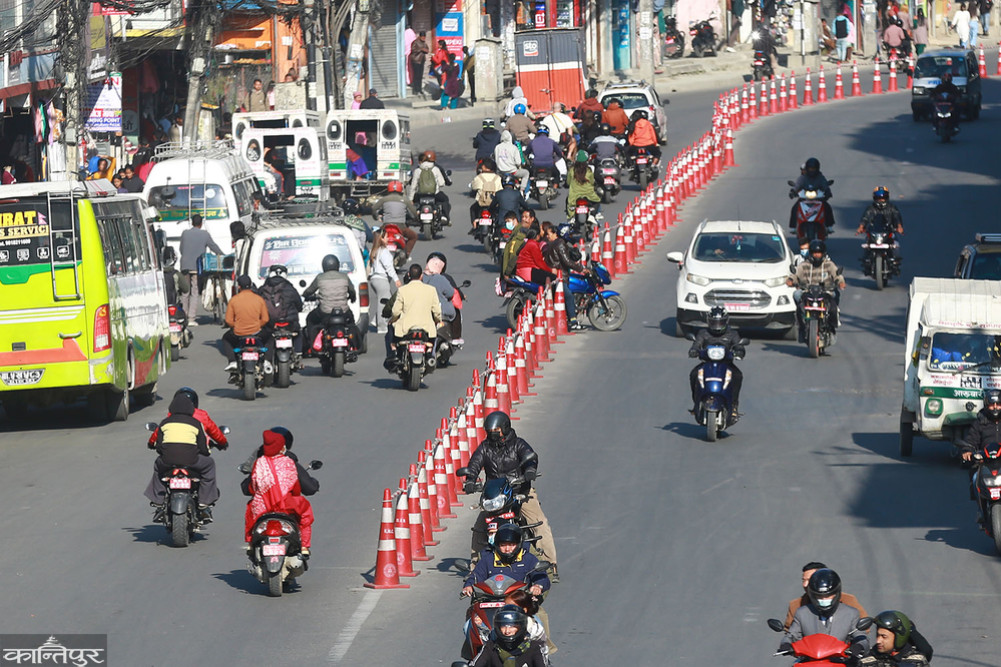
The government's policy and program mentions the strict implementation of a digital speed control system along with GPS tracking to reduce road accidents.
We use Google Cloud Translation Services. Google requires we provide the following disclaimer relating to use of this service:
This service may contain translations powered by Google. Google disclaims all warranties related to the translations, expressed or implied, including any warranties of accuracy, reliability, and any implied warranties of merchantability, fitness for a particular purpose, and noninfringement.
The government has put forward a policy to reduce the presence of police on the roads by linking traffic checks with technology. For that, the provision of AI-based traffic cameras and a digital fine system has been put forward.
The government's policy and program made public by President Ram Chandra Poudel states that the digital speed control system will be strictly implemented along with 'GPS tracking to reduce road accidents'. 'Safe infrastructure will be built for pedestrians and cyclists,' said President Poudel.
It has been said that risk mapping, early warning systems and disaster safety practices will be institutionalized by adopting a policy of making disaster management not reaction-oriented but preparation-oriented. 'A unified command system including the Nepal Army, Nepal Police and Armed Police Force, Nepal will be developed for search and rescue, and partnerships will be made with the private sector in the use of modern technology including drones and helicopters,' the policy program states.
It has also been said that the forensic and information analysis system will be improved by improving the physical infrastructure, equipment and investigation capacity of the Nepal Police. 'The national investigation system will be made technology-friendly,' the policy program says, 'The use of modern technology will be expanded for drug control, transnational crime and reduction of complex crimes.'
It has also been said that a special investigation unit will be established for cyber security, financial crime and digital fraud control. The Cyber Bureau under the Nepal Police is currently working for cyber security. A separate body is also active under the Central Investigation Bureau to look into financial crimes. Digital fraud is being investigated by various police agencies, including the Valley Crime Investigation Office.
It has been said that the Armed Police Force will be strengthened as a specialized security force. The Armed Police Force has been proposing to develop itself as a specialized body for border security.
When the then court did not cooperate in the mobilization of the army, the Armed Police Force was formed in 2057 BS by bringing in some manpower from the army and Nepal Police. At that time, the purpose of the force was to quell the Maoist conflict. In peacetime, the Armed Police Force has been given responsibilities such as border security, separatist activities and riot control, disaster relief, protection of important structures, VIP security, customs, revenue and industrial security. The government has also said in the policy program that illegal activities will be controlled by using drones and night vision cameras at the border.
It has been said that the security-related policies and laws will be revised in a timely manner to protect national interests. It has been said that the external dependence in the security sector will be reduced by arranging for the provision of the army and other security agencies and the production of necessary equipment domestically. ‘Professionalism will be enhanced through training of security personnel and development of strategic skills,’ the policy program states.