The government's policy of initiating the second phase of reforms as the economy has entered a phase of restructuring and upgrading
We use Google Cloud Translation Services. Google requires we provide the following disclaimer relating to use of this service:
This service may contain translations powered by Google. Google disclaims all warranties related to the translations, expressed or implied, including any warranties of accuracy, reliability, and any implied warranties of merchantability, fitness for a particular purpose, and noninfringement.
The government is bringing out the policy and program for the upcoming fiscal year on Monday, giving high priority to policy reforms, quality changes in public service delivery, economic transparency, and good governance. President Ram Chandra Poudel has a schedule to present the policy and program in a joint meeting of parliament.
The government has said that it will bring out policies and plans to move forward firmly to build a cultured and prosperous society by correcting the country's structural weaknesses. As the economy has entered a phase of restructuring and upgrading, the government's policy is to start the second phase of reforms from next year.
The government has been accusing previous governments of transforming politics into a profession and a means of investment, not a service, through expensive elections, opaque fundraising, and cumbersome party structures. The government claims that the country has reached a serious situation mainly due to policy corruption, transactions, and crony capitalism. The government is preparing to put forward plans to reform it, saying that this has created obstacles to economic growth through entrepreneurship, competition, and innovation.
The government will present a plan that will help determine the future course of action by realistically depicting the current economic, social and governance situation of the nation through the upcoming policies and programs and budget, the source claims. For this, the government is prepared to provide a strong basis for drawing the necessary roadmap for policy reforms, strengthening good governance and sustainable economic transformation by clearly identifying the current opportunities and challenges.
The government alleges that in the past, social security and distribution-oriented programs were expanded without a realistic assessment of long-term financial obligations, which added to the challenge to intergenerational equity. Therefore, it seems that the government will make efforts to ensure some equity in this through the policies and programs and budgets of the coming year. 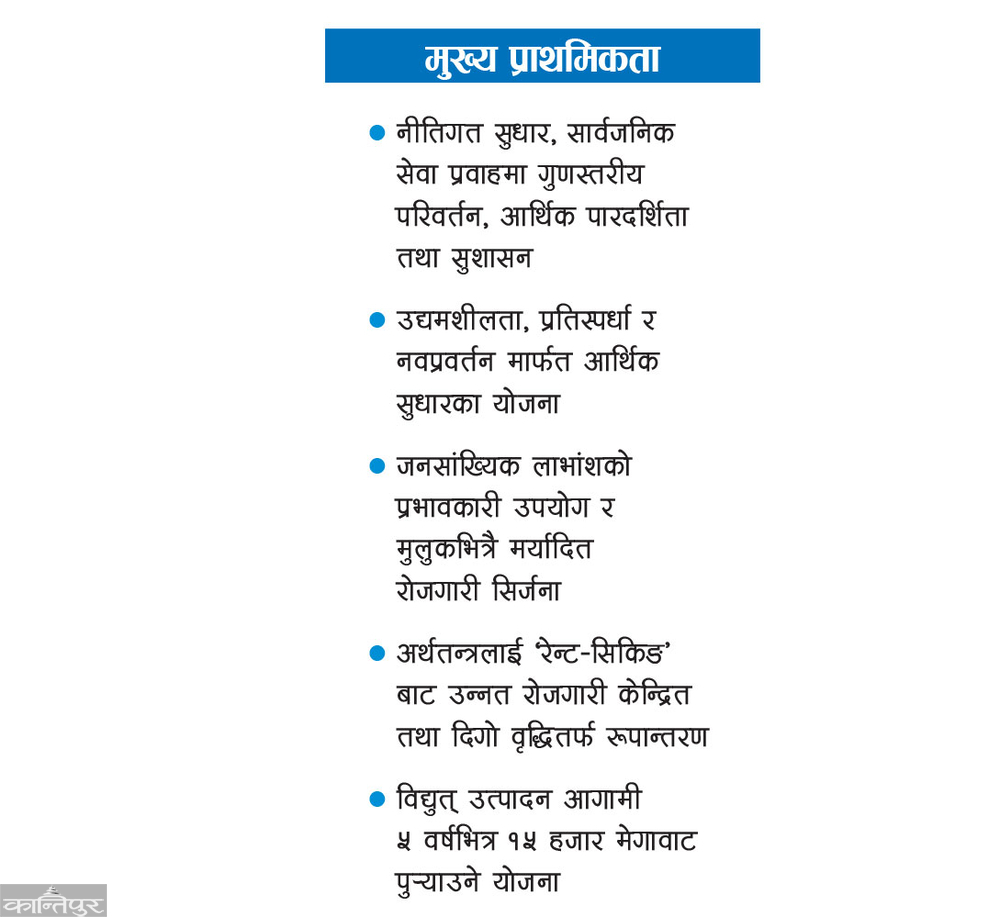
Due to the inability to effectively utilize the demographic dividend, foreign employment, remittance dependence and limited domestic job creation have become the character of the economy. The government says that Nepal's main challenge is not only lack of resources but also conceptual ambiguity, institutional weaknesses and weak implementation. Since nominal liberalization is not enough to get out of this situation, the agenda of comprehensive structural reforms will be included in the policies and programs. The government claims that these programs will promote competition, assimilate innovation and technology, and provide opportunities for new entrepreneurs to enter, transforming the economy from rent-seeking to advanced employment-focused and sustainable growth.
The government claims that the foundation is ready to achieve an average economic growth of 7 percent from the next fiscal year, bringing the per capita income to at least $3,000 and the size of the economy to close to $100 billion (100 billion) within five to seven years. The NCP's pledge and the government's 100-point agenda are focused on achieving the stated commitments and goals, as well as making Nepal a respectable middle-income country within five to seven years. For this, Finance Minister Wagle had selected the main drivers of economic transformation. Sources say that the government has included these issues in its policies and programs.
Finance Minister Wagle has already claimed that the government will increase the total installed capacity of electricity generation in the main driver of economic transformation to 15,000 MW within the next 5 years, complete the construction of important projects of national pride within the next two years, develop new projects of strategic importance, and attract private investment through infrastructure development.
The government is preparing to modernize and commercialize agriculture, increase productive employment through strong linkages with industry and tourism, develop quality infrastructure in the tourism sector, and increase employment and income through tourism services and ease of movement. The government will advance a policy to increase production, productivity, employment, and exports through the use of information and technology including artificial intelligence and the creation of a digital economy, according to sources.
Economists say that the country's economy has expanded from agriculture to the service sector without industrialization. While the contribution of industry and agriculture to the economy is shrinking, the contribution of the service sector is expanding. The government has a policy to improve the condition of productive industries in policies and programs and increase the contribution of this sector to the gross domestic product (GDP).
The contribution of the manufacturing sector to GDP in a decade has averaged only 5.4 percent. During this period, while the overall economy expanded by an average of 4.2 percent, the growth of the manufacturing industry has averaged only 2.9 percent. In such a situation of the economy, it is said that the policies and programs and budget will provide a strong foundation for policy reforms, strengthening good governance, and sustainable economic transformation by clearly identifying the current opportunities and challenges.
The government will introduce a special program to improve the country's industrialization situation due to insufficient investment, high dependence on imported raw materials, low adoption of innovation and advanced technology, and high production costs, sources said.
The government is also preparing to create decent employment opportunities within the country to reduce the growing dependence on foreign employment. As the number of foreigners seeking employment is high,
remittances sent by them have provided short-term relief in the external sector balance, poverty alleviation, domestic demand, and the social sector. However, experts have commented that there is a risk of a decline in human capital in the long term due to the shortage of skilled and semi-skilled manpower in the country and a decrease in aggregate demand. To solve such a problem, the government is ready to introduce a special program to create decent employment within the country.
In recent years, political instability has persisted in the country. However, after the last election, the Rashtriya Swayamsevak Sangh (RSS) has formed a government with a close to two-thirds majority. The government's policy is to increase the confidence of the private sector through an investment-friendly policy environment while maintaining good governance on the foundation of a stable government. The government plans to expand the productive sector and create employment by introducing domestic and foreign capital and technology into the economy.
The government believes that the vast potential of hydropower can be used as cheap and reliable energy to create stable foreign income through industrialization, expansion of the service sector, and energy exports. The government is preparing to strengthen Nepal's position in the green energy market by expanding regional electricity trade through the electricity produced.
The government has a policy to help enhance international competitiveness by improving tourism infrastructure, service quality, and destination management. The government says that with the use of artificial intelligence and robotics and the expansion of digital technology, opportunities for service exports and knowledge-based economy development are increasing. Therefore, it is understood that the upcoming policies and programs will include programs to connect youth and small enterprises to the global market by expanding high-value-added economic activities with low capital through information technology services, business process outsourcing, and digital entrepreneurship.
There is potential for expansion of production, income, and exports through modernization of the agricultural sector. Productivity can be increased and import substitution can be achieved through investment in high-value crops, animal husbandry, horticulture, and agro-processing industries. The government claims that the use of geographical diversity can support the development of region-specific production and rural industries.
Since good governance and institutional strengthening are the basis of economic transformation, it is said that the government's roadmap for improving development outcomes through public financial management reform, enhancing service delivery, and effective implementation of the federal structure has been included in the policies and programs.

