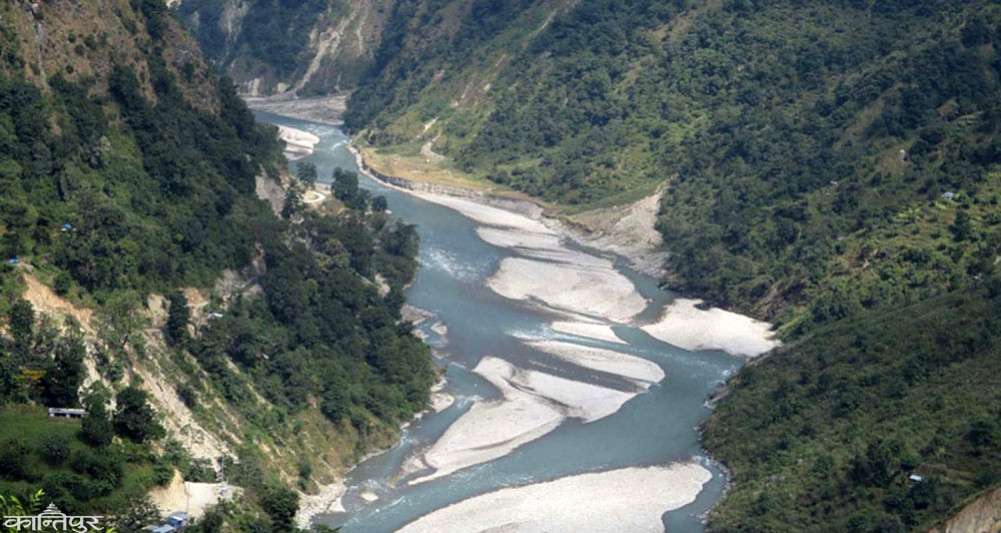
The contracting process for the construction of a bridge and camp connecting Dhading and Gorkha before construction begins has accelerated the construction of the 1,200-megawatt Budhi Gandaki Hydropower Project.
We use Google Cloud Translation Services. Google requires we provide the following disclaimer relating to use of this service:
This service may contain translations powered by Google. Google disclaims all warranties related to the translations, expressed or implied, including any warranties of accuracy, reliability, and any implied warranties of merchantability, fitness for a particular purpose, and noninfringement.
Bids have been invited for the construction of camps and bridges for the pre-development of the 1200 MW Budhigandaki Reservoir Hydropower Project. Bids have been invited for the construction of camps and bridges for the pre-development of the 1200 MW Budhigandaki Reservoir Hydropower Project.
The project promoter, Budhigandaki Company Limited, on Monday invited bids for the construction of permanent accommodation and office buildings (camps) and a bridge (bridge connecting Dhading and Gorkha) on the Budhigandaki River. The bridge will connect Benighat in Dhading, Siureni Bazaar in Gorkha and Selang Road.
The 1200 MW project, which is currently in the process of being finalized, has now moved forward with the construction phase. The investment modality of the project, which was approved twice by the interim government's Council of Ministers, has been implemented. While the interim government was in power, the cabinet meeting held on 2 Magh 2082 had decided to approve the financial investment framework of the project . However, the decision was not validated at that time.
The cabinet meeting held on 12 Falgun 2082 had again decided to approve the investment framework . However, there was a suspicion that it would not be validated either . However, on 9 Chaitra 2082, the Ministry of Energy, Water Resources and Irrigation sent a letter approving the financial investment framework of the project to the project promoter Budhi Gandaki Company . Point 224 of the budget statement for the current fiscal year states that the Budhi Gandaki project will be built in public-private partnership.
Last December, the Ministry of Finance had agreed to the investment framework of the 1,200 MW Budhi Gandaki Reservoir Hydropower Project. After the Ministry of Finance agreed to the investment modality, further processes were taken forward.
With the release of the budget from the Ministry of Finance, a contract has been called for the construction of a concrete bridge and camp, said Arun Rajouria, CEO of the project promoter Budhi Gandaki Company Limited.
‘We plan to start construction by placing a contract for the construction of the main project from January 2028,’ he said. ‘Within two years, we will conclude a power purchase agreement (PPA), financial management of the project, and build a bridge and camp leading to the project site.’ He said that preliminary discussions are underway with various banks and financial institutions to raise investment for the project.
The basic cost of the Budhi Gandaki reservoir hydropower project to be built in Dhading and Gorkha is $2.77 billion (about Rs. 374 billion). The construction period of the project is 8 years. The company says that the project will cost Rs. 406 billion, including Rs. 32 billion in interest during the construction period. The modality has been prepared with a loan and equity (equity) ratio of 70 and 30 percent based on the total cost including interest during the construction period.
The Government of Nepal will own 80 percent of the shares in the Budhi Gandaki Company Limited, the promoter of the project, and 20 percent of the shares of Nepal Electricity Authority. After the project is completed or in the final stage of construction, taking into account the actual financial indicators, a certain percentage of shares will be issued to the general public based on suitability and feasibility to reduce the debt burden or the government's share will be restructured.
The government will invest 248 billion rupees in the project, including 97.47 billion rupees for equity and 150 billion rupees for concessional loans. The 45 billion rupees invested by the government in the project so far has been converted into equity investment in the company.
By reducing the investment so far, the government will have to ensure the source of 228 billion rupees for investment in the project. Nepal Electricity Authority will invest 2437 billion rupees for equity in the project. It is said that the Nepal Electricity Authority will issue shares, issue energy bonds, take loans from banks and financial institutions, provide concessional loans to the government, raise funds from the infrastructure tax levied on petroleum products, issue shares to foreign employed and non-resident Nepalis and the general public to raise investment in the project.
An energy bond of Rs 30 billion will have to be issued with the government's facilitation to reduce the financial cost and make the project feasible. The bond will be purchased by banks and financial institutions, insurance and reinsurance companies and public funds. A loan of Rs 104 billion will be disbursed from banks and financial institutions.
The modality also mentions raising funds through co-financing with Employees Provident Fund, Citizens Investment Fund, Social Security Fund, Insurance and Reinsurance Companies, HIDCL, Nepal Telecom and commercial banks. The project will generate 3.38 billion units of electricity, including 1.41 billion units in the winter season and 1.97 billion units in the rainy season. The electricity purchase and sale rate was proposed to be 12.40 and 7.10 rupees per unit for the winter season and rainy season, respectively.
Thus, once electricity generation starts from the project, it will generate an annual income of 31.48 billion rupees. The project's power generation license will be valid for 50 years. If the project is completed within 8 years, electricity will be generated for 42 years. The detailed project report and tender documents of the project are under preparation.
The progress of land acquisition, which is considered the most complex part of the project, is about 96 percent. 45 billion rupees has been distributed to the landowners for compensation for land, structures, plants and fruits. 8,117 households in Gorkha and Dhading will be physically and economically affected by the project. Out of these, 3,560 households will be completely displaced. The company has stated that those who are completely displaced will have to be rehabilitated and relocated according to a procedure.
The government had started the project as a national pride project in 2069/70 with the aim of completing it in the fiscal year 2083/84. At that time, the total cost estimate was Rs 260 billion, as mentioned in the 60th report of the Office of the Auditor General. The Cabinet meeting held on 24 Chaitra 2079 had decided to build the project through domestic investment in the company model. As per the same decision, the company was established on 21 Ashar 2079 with the government holding the majority of the shares.
The Cabinet meeting held on 23 Kartik 2080 had decided to issue instructions to determine the investment model of the project. Immediately after, Budhigandaki Hydropower Company Limited had previously put forward an investment modality with two options in Chaitra 2080. However, confusion had arisen when the Ministry of Finance did not agree to the investment model.
At that time, the company had estimated the project cost at Rs 310.47 billion when it provided Viability Gap Funding (VGF), and the total construction cost of the project without VGF was Rs 398.2 billion.