According to the data of the Nepal Rastra Bank, the foreign currency leaving Nepal with students for foreign studies has been continuously increasing in recent years. Experts say that the trend of going abroad for higher education has increased in recent years as studying abroad offers job opportunities and good income.
We use Google Cloud Translation Services. Google requires we provide the following disclaimer relating to use of this service:
This service may contain translations powered by Google. Google disclaims all warranties related to the translations, expressed or implied, including any warranties of accuracy, reliability, and any implied warranties of merchantability, fitness for a particular purpose, and noninfringement.
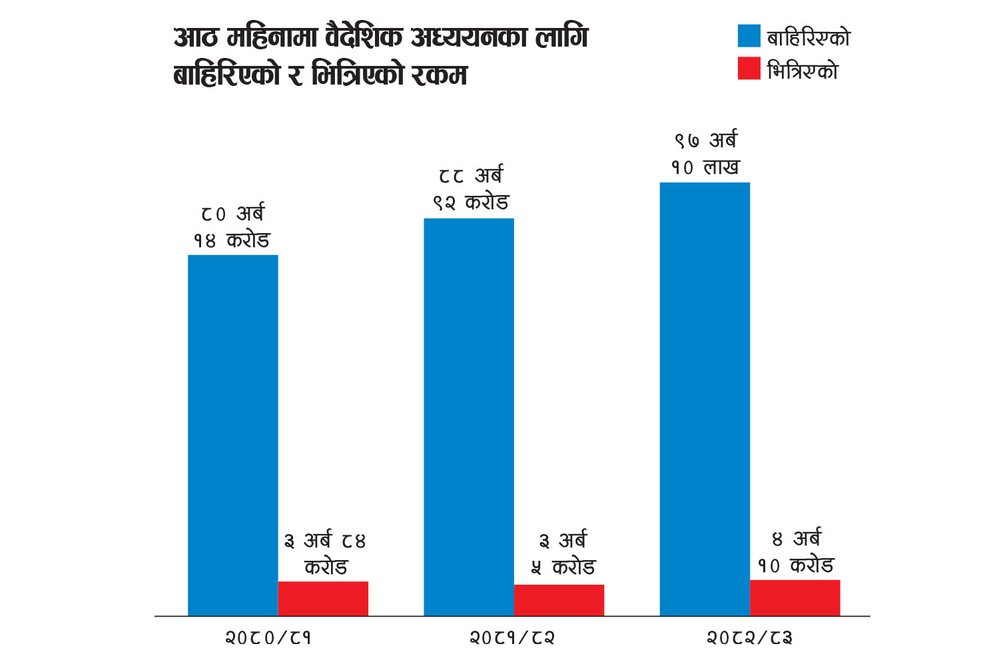
In the last eight months (Shrawan-Falgun), foreign exchange equivalent to 93.89 billion rupees has been spent on foreign studies. The amount spent on foreign studies has increased by about 8 percent compared to the same period of the last fiscal year. Experts say that the number of students going abroad for studies has increased during that period, so the foreign exchange outflow has also increased. In the eight months of the last fiscal year, 85.86 billion rupees were spent under this heading.
According to the data of the Nepal Rastra Bank, foreign exchange outflow from Nepal for foreign studies has been continuously increasing in recent years. Experts say that since studying abroad provides work and good income, there has been an increase in the number of people going abroad for higher education in recent years. They say that this has also had a positive impact on remittance inflow.
Although many students from Nepal go abroad for foreign studies, students from abroad also come to Nepal to study. Accordingly, in the eight months of this year, foreign students have brought in foreign exchange equivalent to 4.10 billion rupees for studies in Nepal. Nepal had brought in foreign exchange equivalent to 3.5 billion rupees under this heading in the same period of the last fiscal year.
Government reports have shown that the number of youth leaving Nepal in the name of study is increasing due to the increasing political instability in Nepal for a long time, the failure of effective work at the state level for economic development, and the lack of creation of new employment opportunities. This is confirmed by government data showing that the amount of money leaving Nepal for study abroad has been increasing continuously since the COVID infection.
 Although the state is committed to educational reform in the country, there is no policy to stop students going to study abroad in Nepal, former Vice Chairman of the National Planning Commission Prakash Kumar Shrestha said. ‘You cannot tell students not to go to study abroad, the country benefits when Nepali students go to study abroad. Because the foreign investment made now will build human capital and gain brain power in the future,’ he said, ‘Now the government should make a special policy to bring Nepalese who have already acquired education, skills, and capital abroad to Nepal, which has not been done.’
Currently, Nepal’s schools, colleges, and universities have not made a policy to give priority to students who have studied abroad, which makes them even more unable to compete in Nepal, Shrestha said. ‘Even if it is not possible to do it in all places at once, wherever possible, a comfortable environment should be created for foreign students to come and work in Nepal and a policy should be made accordingly,’ he added.
As the number of foreign students coming to Nepal has increased in recent years, Shrestha suggests that the government should take the initiative to increase that number further. ‘There is ample potential for Nepal to be developed as an ‘educational hub’ and ‘educational tourism’ for foreign students,’ he said. ‘The private sector has also demanded from the government to increase the quota for foreign students. Now the government should make a policy accordingly.’
Currently, many students of Nepali origin from countries including Myanmar and Bhutan come to Thailand. Shrestha says that Nepal should create an environment to attract these students by facilitating various procedures including visas.
Thus, in the eight months of the current year, when the amount that has left Nepal for studying abroad is subtracted from the amount that has entered Nepal through foreign students, it is seen that a net amount of 92.89 billion 93 million rupees has left Nepal. Last fiscal year, such amount was Rs 85.86 billion 450 million.
In the fiscal year 2081/82, Rs 138.48 billion was transferred out of the country for study. This amount has been increasing in every subsequent year. Accordingly, in the fiscal year 2080/81 alone, Rs 125.13 billion was transferred out of the country for study. According to the data of the Nepal Rastra Bank, Rs 142 billion was transferred out for study abroad in the fiscal year 2079/80, Rs 67.7 billion in 2078/79, Rs 46.32 billion in 2075/76 and Rs 25.81 billion in 2076/77.
Students from abroad also come to Nepal to study. Foreign students come to Nepal to study in subjects such as medicine, engineering, literature, culture and others. However, the money they spend here is income for Nepal.
There are two types of opinions regarding whether it is right or wrong for a large amount of foreign currency to be transferred out every year for study abroad. One group says that there is no need to worry about spending a lot of money on studying abroad. According to them, students who go abroad to study do not just take money out of Nepal, they also gain knowledge, learn skills, earn money and give Nepal its identity in the international world. If the situation in their country improves in the future, they will return to Nepal after seeing sufficient opportunities. Therefore, those who study abroad now do not need to worry about spending a lot of money abroad.
Others say that young people are forced to leave Nepal because there are no opportunities in Nepal and emphasize that the government should come up with a special program to stop them from leaving their country. It is time to worry about why so many students go abroad to study. They also believe that the state should think about where there are weaknesses in Nepal's education system and curriculum.
However, the government has no plans to return students who have gone abroad to Nepal and create an environment for those who are in Nepal to live in their country. However, as suggested by the National Bank, the government has banned affiliation with foreign educational institutions in recent years.
The 16th Five-Year Plan currently being implemented mentions issuing necessary policies, laws, guidelines, procedures and standards for educational reform. ‘There is a plan to make policy arrangements to gradually increase the proportion of students studying in the technical stream rather than the general stream in schools,’ the 16th Plan states, ‘It is the state’s policy to make Nepal’s education system quality, productive and employment-oriented to increase educational achievement at all levels and reduce the growing trend of going abroad for higher education.’
The 16th Plan also includes plans to arrange physical and other infrastructure, make the curriculum and educational programs of all levels of education contemporary and practical, strengthen and implement the educational system, formulate a national human resource development plan, link education and skills with production and the market, and expand investment for quality and inclusive education. However, in practice, many of the policies mentioned are not being implemented.