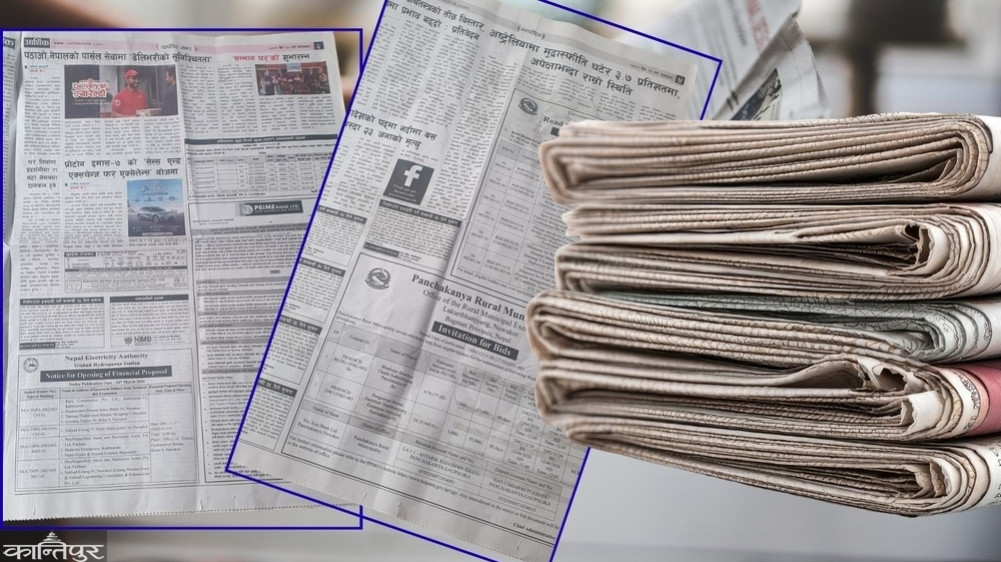
The media industry is not unanimous in its decision to limit all its advertisements to Gorkhapatra and government media. On the one hand, small newspapers are facing an existential crisis, while on the other hand, Nepal's largest media group, Kantipur Media Group, has welcomed the decision, calling it the 'end of a corrupt system'.
We use Google Cloud Translation Services. Google requires we provide the following disclaimer relating to use of this service:
This service may contain translations powered by Google. Google disclaims all warranties related to the translations, expressed or implied, including any warranties of accuracy, reliability, and any implied warranties of merchantability, fitness for a particular purpose, and noninfringement.
The income of non-governmental media outlets from government advertisements is now almost zero. After the government issued a circular on 18 Chaitra and arranged for its advertisements to be published and broadcast only in government media outlets, the income of private media outlets is set to decrease significantly.
While Gorkhapatra earns Rs 1 billion annually from government advertisements, hundreds of private sector newspapers and media outlets are deprived of that source While Gorkhapatra earns Rs 1 billion annually from government advertisements, hundreds of private sector newspapers and media outlets are deprived of that source. This decision of the government is seen to be a major financial blow, especially to small, medium and self-employed media outlets.
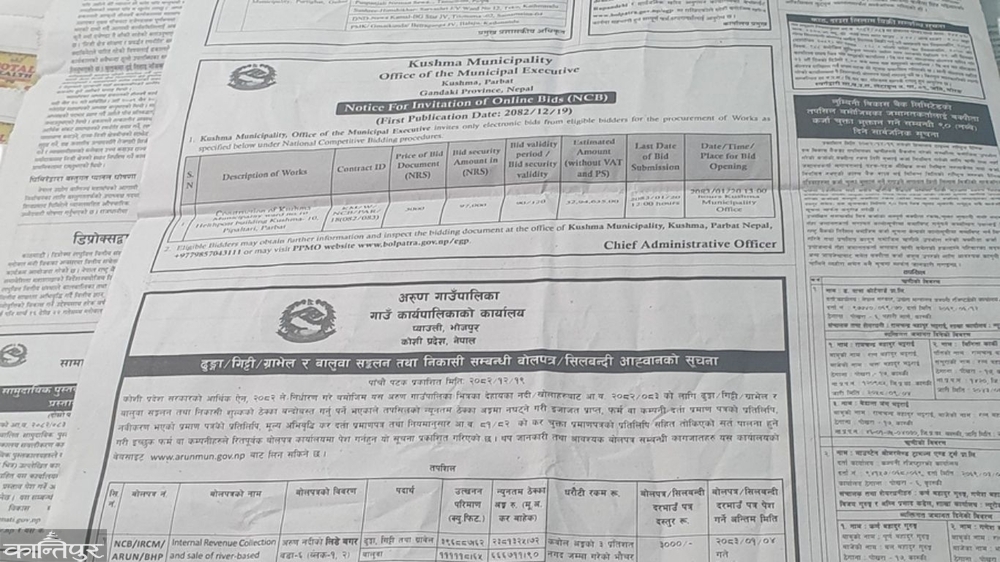
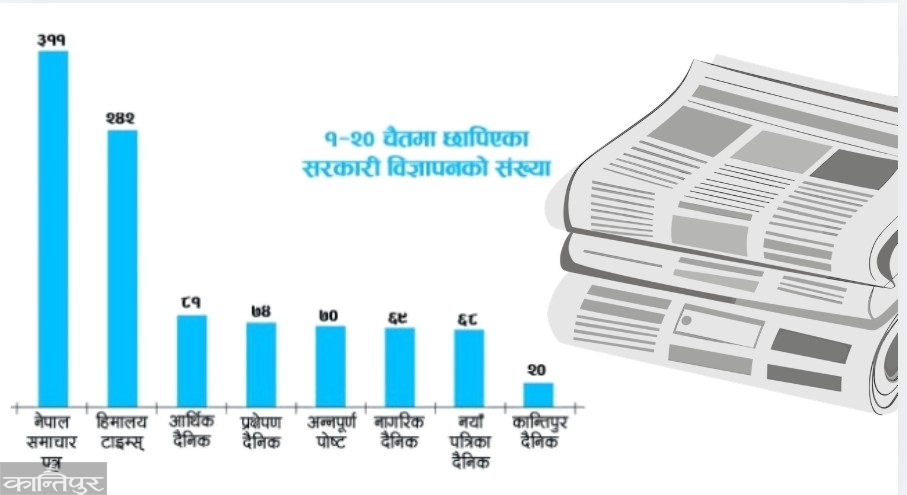
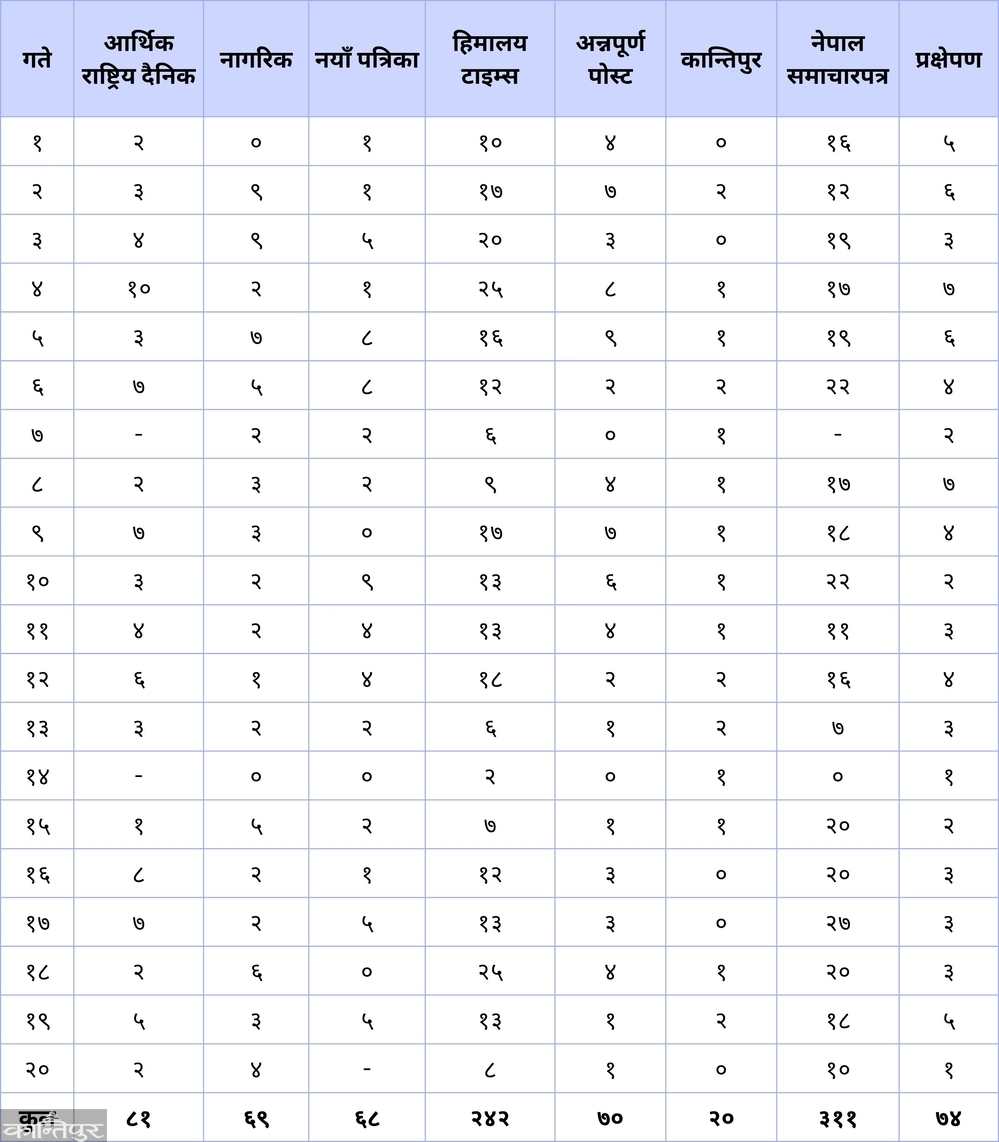
Looking at the data on government advertisements printed in the first 20 days of Chaitra in eight newspapers published in Kathmandu, the number of government advertisements in Prakash, Economic National Daily, Himalaya Times and Nepal Samacharpatra is significantly higher than that in Kantipur, Naya Patrika, Nagarik and Annapurna Post. Up to 27 government notices (advertisements) have been printed in Nepal Samacharpatra and Himalaya Times on some days.
Although Prakash, Economic National Daily, Himalaya Times and other newspapers appear to be numerically ahead in printing the most government advertisements, it does not provide real economic 'reflection'. Because CC (column centimeters) is not calculated in it. CC is important to examine the economic aspect. The newspaper charges advertising fees according to the width (column) and length (centimeters). The more CC, the more expensive it is. The billing of advertisements is done on the basis of CC, including audit.
From 1 to 20 Chaitra, 311 government advertisements of all sizes, both small and large, were published in Nepali newspapers. Most of these were from the provincial and local levels. 242 were published in Himalaya Times, 81 in the Economic National Daily, 74 in Pragati, 70 in Annapurna Post, 69 in Nagarik, 68 in Naya Patrika and 20 in Kantipur. The calculation does not include advertisements from universities and banks. And, only newspapers published in a non-governmental manner are included. A study by the regulatory Nepal Advertisement Board has shown that Gorkhapatra has been earning Rs 1 billion annually from government advertisements.
The media industry is not unanimous about the government's decision to limit all its advertisements to Gorkhapatra and government media only. On the one hand, small newspapers are in danger of survival, while on the other hand, Kantipur Media Group, Nepal's largest media group, has welcomed this decision, calling it the 'end of a corrupt system'.
Following the government's decision, the private sector media operators' organizations Media Alliance Nepal and Nepal Media Society, along with the Federation of Nepali Journalists, an umbrella organization of journalists, have protested. They are calling it an attack on press freedom and the private sector. After the Media Society filed a lawsuit on the issue, Kantipur Media Group, a founding member, has announced its withdrawal.
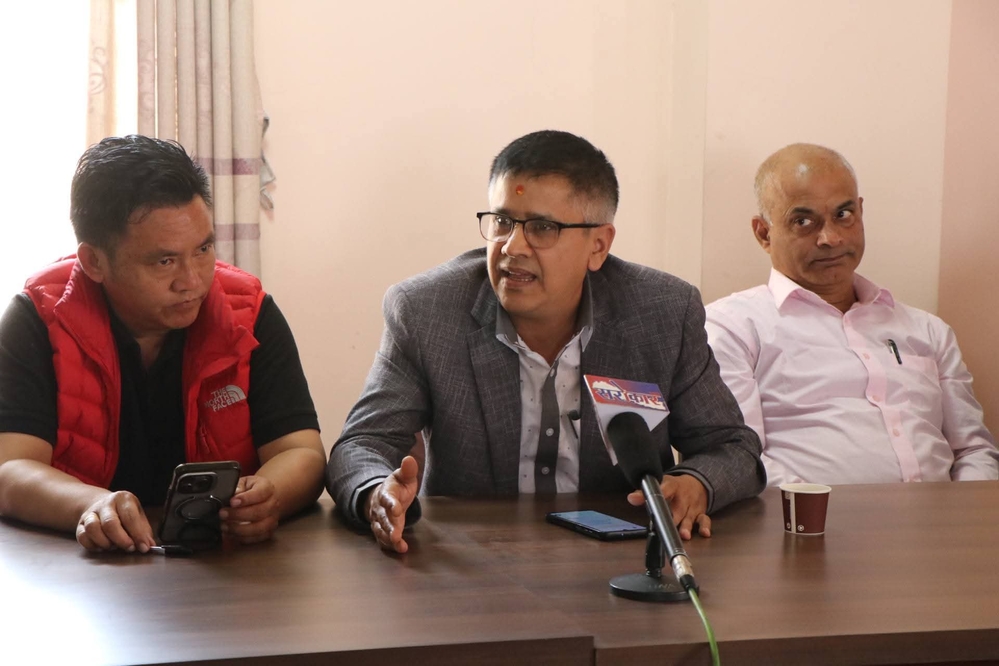
KMG Managing Director Sambhav Sirohiya has been holding a different opinion on the issue. “We directly disagree with the decision of the Media Society to file a lawsuit against the government’s decision not to provide government advertisements to private media,” said Mahesh Swaran, CEO of Kantipur Media Group. “When the organization proceeded with the lawsuit process without our consent, I resigned institutionally and personally, thinking that it would be better to leave the organization than to stay in such a situation.”
KMG Managing Director Sirohia has stated that they are not dependent on government advertisements. “The government has ended the advertisement income of private media, which is good,” Sirohia wrote on social media. “It was a corrupt system worth Rs 3 billion, 70 percent of which was taken by middlemen.” We were not dependent on it, we will survive, as always.'
Media Alliance Nepal, in a statement, said that this government move is a clear violation of the constitutionally guaranteed freedom of expression, right to information and right to equality. The alliance believes that the government has pushed the private media sector, which is struggling to recover from the post-Covid economic downturn, into further financial crisis with this decision. Ashish Sherchan, Managing Director of Rajdhani Daily, which is a member of the alliance, interpreted the latest policy of government advertisement distribution as a collective challenge for private media. 'This issue is not only related to the profit and loss of any media, but is a common problem of the entire industry,' he said. 'Collective solidarity and a common voice are necessary to solve the problems faced by the media sector.'
Media representatives participating in a discussion organized by the Federation of Nepali Journalists on 20 Chaitra expressed concern that government advertisements are being treated discriminatoryly and that attempts are being made to weaken the voice of opposition media. Bishwaraj Tamang, vice-president of the Federation of Nepal Indigenous Journalists (FONJ), believes that 90 percent of district-level advertising agencies are run by journalists and the government's decision will deprive working journalists of their livelihoods.
'When the big media in Kathmandu were facing wage problems and lockouts, journalists in the district had prepared their financial base through these agencies,' Tamang said. 'It is wrong for the government to prohibit the private sector when the third-party billing system implemented by the Advertisement Board has brought transparency to the advertising market.'
Naresh Bhandari, president of the national daily, had pointed out the need for a strong movement, saying that the government had no intention of paying a single rupee to the private sector. He proposed that the media should be handed over to the government or blacked out in protest. A black box with the words 'advertisement' printed by the National Advertising Association of Nepal in protest was published on the 20th Chaitra launch. Kumar Bhattarai, President of the Broadcasting Association of Nepal (BAN), said in the
program that the government decision violated various provisions of Articles 16 to 44 of the Constitution. He believes that the government media alone cannot provide information to citizens of all languages and regions. Tanka Karki, Editor-in-Chief of Crosscheck.com, claims that the media is the opposition now, while the opposition is currently weak in the government and the government is trying to weaken it. ‘The ban on private sector in government advertising is a serious attack on the press, it is like cutting off the throat when the finger is injured,’ he said, ‘It is short-sighted and wrong for some media operators to welcome this decision.’
Press Center Secretary Nawaraj Dahal described this decision as a step that reflects the censorship of the royal era. He claims that the idea that advertising agencies took money is old and now third-party billing has brought transparency. Former Press Council Chairman Balkrishna Basnet mentioned that the government is trying to feed only the media that sings its own hymns, while the media should always be the opposition.
This issue is not just a general question of whether or not to advertise, but an issue related to democratic values, said Professor Kundan Aryal, Head of the Department of Mass Communication and Journalism, Tribhuvan University. According to him, in countries that practice liberal democracy, the government does not keep the press under its direct control. ‘A policy of strengthening only the government media like in China or North Korea is not suitable for democracy,’ he said, ‘The ownership of old institutions like Gorkhapatra should be made public. Instead, it is not theoretically right to focus government advertising only there.’
Kundan Aryal, Head of the Department of Mass Communication and Journalism, Tribhuvan University.
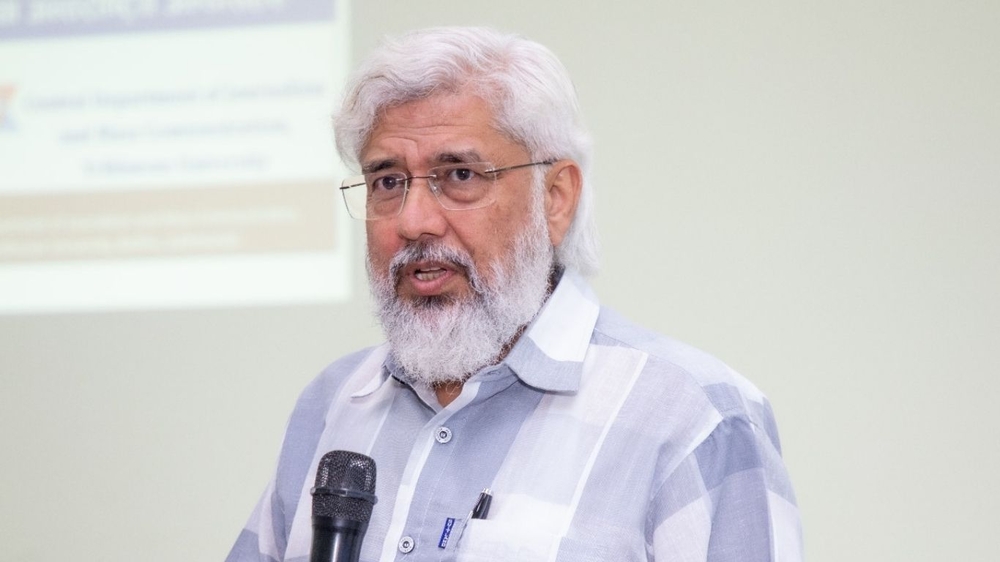
Since the main purpose of advertising is to inform the public, Professor Aryal said that the government reserves the right to review how effective which media is and how many people it is reaching. 'We should consider whether the return on advertising is being achieved or not in the context of good governance,' he said, 'Taxpayer money should not be distributed haphazardly.'
Although it is estimated that there is an annual advertising turnover of about 10 billion rupees in this sector, only a small part of it falls into the hands of the media. The question of where and how about 3.5 billion rupees disappeared is still unanswered. 'There have been mixed reactions to the issue of giving government advertisements only in government media,' said Hemraj Aryal, spokesperson for the Office of the Prime Minister and Council of Ministers. 'Some have called it a good step in favor of good governance, while others have a different understanding.' This decision has been taken after closely examining the discrepancies that have been seen and known for a long time.'
Number of government advertisements printed in Chaitra 2082
Even though the circular of the Prime Minister's Office has reduced a large portion of advertisements going to private sector media, 'public welfare' advertisements will remain the same. The current decision will not affect public welfare advertisements and they will continue as before, said Aryal, spokesperson for the Prime Minister's Office.
'This decision will apply only to public procurement and other government information.' Public welfare advertisements will continue as before,' Aryal said, 'This step has been taken to maintain economy in government expenditure, bring uniformity and transparency in advertising and information publication, and promote government-owned media.'
He said that the Prime Minister's Office has not yet made any study or thought about it since the subject of public welfare advertisements falls within the purview of the Ministry of Communications and Information Technology. Although it is said that public welfare advertisements will continue, the Ministry of Communications has stated that there is currently no sufficient budget for it.

There is no budget left under this program for the remaining three months of the current fiscal year (from Baisakh to Asar) according to Udaya Rana Magar, spokesperson for the Ministry of Communications. ‘Due to budget shortage, we are preparing to send a request to the Ministry of Finance for additional funds,’ he said. ‘If the Ministry of Finance releases additional budget, the amount for public welfare advertisements can be distributed, otherwise it cannot.’
According to the Nepal Advertisement Board, currently, Rs 320 million is spent annually on public welfare advertisements, of which Rs 240 million is distributed in newspapers and magazines and Rs 80 million in electronic media. Out of the 875 newspapers classified by the Press Council, 850 have taken up such advertisements.
Questions have been raised for a few years about the relevance, appropriateness and usefulness of public welfare advertisements, which were launched with the aim of increasing public awareness and strengthening the critical voice of the media. Experts say that although public welfare advertisements have helped some in saving small media outlets from financial crisis, they have not contributed much to improving the quality of Nepali journalism.
In the fiscal year 2058/59, the government allocated Rs 6.5 million for public welfare advertisements. Five years later, the amount increased by 1,600 percent to Rs 113.4 million in 2062/63. During this period, the budget for public welfare advertisements was increased by Rs 106.9 million. In the fiscal year 2079/80, this amount doubled to about Rs 220 million. Now it has increased again to Rs 320 million. Although the government allocated Rs 300 million for this, since it was insufficient, the Advertisement Board itself has been paying the advertisement fee by adding Rs 40 million.